
STAGE 2: FROM RONCESVALLES TO PAMPLONA
Xavier Rodríguez PrietoAfter the Pyrenees, Stage 2 is a relief — and then, just when you are beginning to think Galicia starts now, it reminds you that you are in Navarre. The stage descends steadily from Roncesvalles through beech and oak forests, follows the Arga river valley for 20 km, and delivers you to Pamplona: a city with 75,000 years of human occupation, three medieval boroughs that spent centuries at war with each other, and a saint’s festival that every July turns its streets into one of the most famous spectacles in Europe. Forty-eight kilometres, technically demanding on the path variant, ending in one of the great cities of the French Way.
| Distance | Elevation gain | Estimated time | Difficulty | Distance to Santiago |
|---|---|---|---|---|
| 48 km | +700 m cumulative | 4–5 hours riding | 🟡 Medium–High | ~753 km |
Key stops: Cruz de los Peregrinos (km 1) · Burguete (km 3) · Espinal (km 6) · Alto de Mezkiriz (km 9) · Bizkarreta (km 12) · Alto de Erro (km 16) · Zubiri (km 20) · Larrasoaña (km 27) · Arre (km 43) · Villaba (km 45) · Pamplona (km 48)
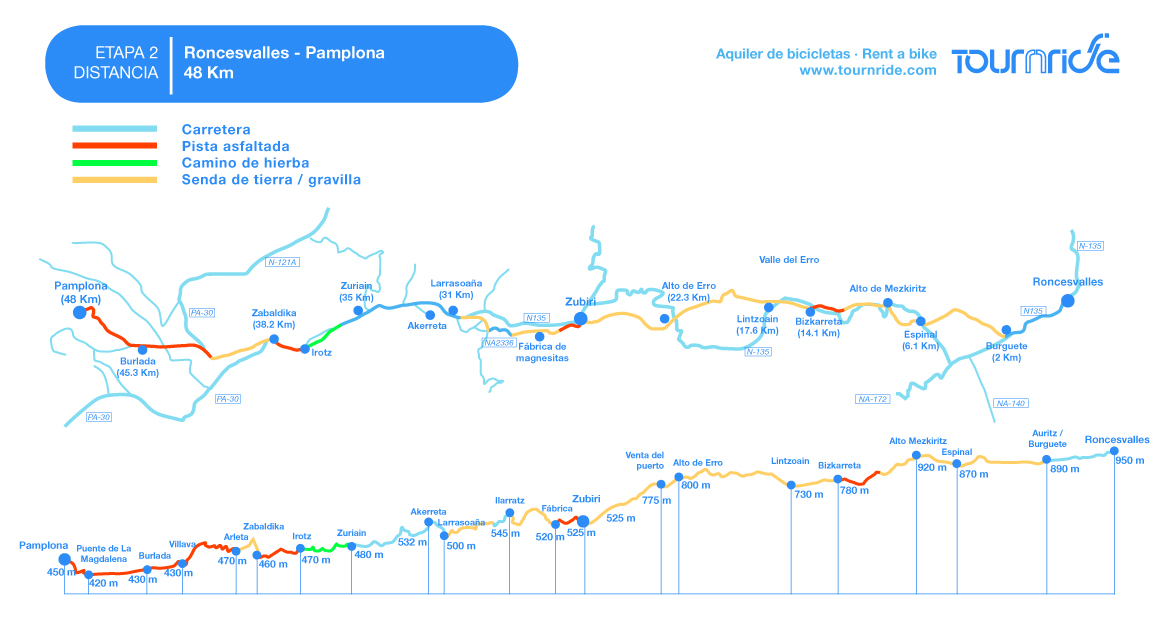
Route profile and key milestones
Choosing your route: path or road?
The stage offers three options. The traditional Jacobean path follows the original route through forests, across medieval bridges and through every village — technically demanding with loose-surface descents, particularly from Alto de Mezkiriz and from Alto de Erro. It requires an MTB or gravel bike and confidence on variable terrain. In rain, some sections become difficult. The N135 road route saves approximately 5 km, has a less rugged profile, stays on tarmac throughout and is well used by cyclists — drivers here are accustomed to sharing. The hybrid option — path to Alto de Mezkiriz, then N135 to Zubiri, then path again — is what most cyclists do and is what we recommend unless the weather is clearly fine and your legs are strong.
The Cruz de los Peregrinos: a mystery assembled from fragments (km 1)
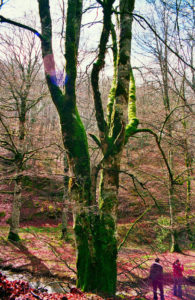
Shortly after leaving the N135, at the start of the traditional path, you encounter the first major landmark of Stage 2: the Cruz de los Peregrinos. Together with the Cruz de Ferro at Foncebadón, it is the most famous cross on the entire French Way — and unlike the Cruz de Ferro, it is surrounded by genuine historical controversy.
What you see is a Gothic cross — Gothic in style, meaning probably 14th century in its oldest surviving elements. The carving shows Jesus crucified at the top, the Virgin with the Child below, and two figures on the sides traditionally identified as King Sancho VII “the Strong” of Navarre and his wife Clemencia. Pilgrims stop here to leave offerings, as they have for centuries.
The controversy is about origin. The documents establish that in 1880 the prior of Roncesvalles, one Francisco Polit, assembled the cross as it stands today from the remains of several different earlier crosses. What those remains were is debated. One theory holds that they include fragments of the Cross of Roland (15th century), associated with the battle and the legend from the stage before. Another argues they derive from a cross installed by Charlemagne himself in the 8th century at the Alto de Ibañeta — a claim supported by the Codex Calixtinus, which states that Charlemagne had a cross placed on the pass above Roncesvalles. If the latter is true, what you are looking at contains material from the age of Charlemagne, assembled by a 19th-century prior from fragments that had survived a thousand years. The truth is that nobody knows for certain. In Tournride’s experience, that uncertainty is exactly what makes it worth stopping for.
Burguete, Espinal and Hemingway’s trout (km 3–8)
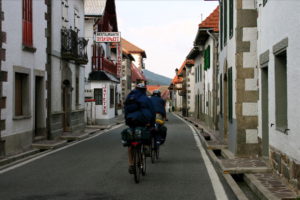
Burguete (km 3) takes its name directly from its origin: it was a borough — a small dependent settlement — created to serve the hospital of pilgrims at Roncesvalles. Its main monument is the church of San Nicolás de Bari: a Baroque facade from the 17th century with a largely 20th-century interior, but with an altarpiece worth a brief pause.
Continue to Espinal (km 6) — a classic Navarrese pueblo-calle, a single-street village whose main road has been the Camino for over eight centuries. The church of San Bartolomé has a distinctive pointed roof with attic windows. The landscape around Espinal is pastoral Navarrese countryside: meadows, beech woods, the sound of the Irati river below. Ernest Hemingway passed through this area and described it in Fiesta (1926), where Jake Barnes and Bill Gorton come here to fish for trout in the Irati before heading to the Sanfermines. The region is still celebrated for its trout fishing and, in autumn, for the extraordinary mushroom harvests from its forests.
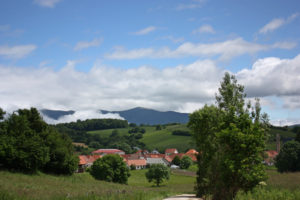
Alto de Mezkiriz: Aymeric Picaud’s description of Navarre (km 9)
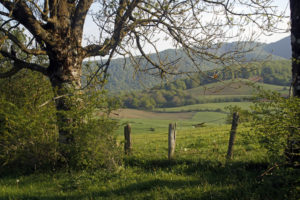
The first climb of the day: from Espinal to the Alto de Mezkiriz (962 m), 1.7 km at an average gradient of 4%. Manageable in comparison with yesterday’s stage, but the legs are still recovering. At the summit stands a stone stele carrying a relief carving of the Virgin and Child — the Virgen de Roncesvalles. The inscription on it asks travellers to pray a salve for the “queen who helps pilgrims cross the hard mountain stage of the Pyrenees and allows them to enter the land of the Navarrese, rich in bread, milk and livestock.” The words are not modern: they are taken almost directly from Aymeric Picaud’s 12th-century guide in the Codex Calixtinus, written when the pilgrim reaching this point from the Pyrenees would indeed have been entering one of the more prosperous agricultural zones of northern Spain after days of mountain crossing.
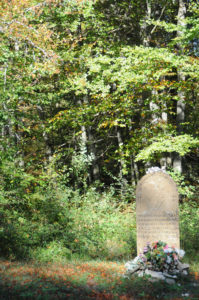
Bizkarreta, Linzoáin and Alto de Erro (km 12–16)
The descent from Mezkiriz to Bizkarreta (km 12) is the first technically demanding section of the stage — a steep slope with a “jump” before the village. Take it carefully.
Bizkarreta was founded in the early 12th century under the Latin name biscaretum. It had a significant pilgrim hospital in its medieval period, but the rise of Roncesvalles gradually eclipsed it and the hospital reduced to ruins. The church of San Pedro preserves its original Romanesque portal — three plain archivolts framing the main door, the characteristically thick walls and minimal decoration of 12th-century Navarrese Romanesque. The rest of the building is 18th century.
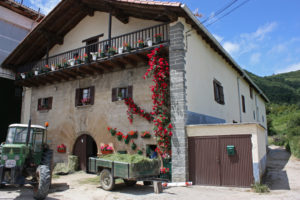
Before the climb to Alto de Erro, a brief flat stretch through Linzoáin (km 14) — a small village on the bank of the Erro river with large traditional livestock houses. The church of San Saturnino is another plain Romanesque building, simple and austere in the manner of the local style. The importance of these villages is not architectural; it is that they have existed here, on this exact path, since the 12th century, and the people who live in them have watched pilgrims pass for nine hundred years.
The Alto de Erro (km 16) is the hardest climb of the day — 120 m of elevation gain with sections that have loose stones and average gradients around 5%. At the side of the path you will pass a modest monument to a Japanese pilgrim who died making this journey. The descent from Erro is the most technically demanding of the stage: fast, with an average slope of 5% and an unsettled surface for approximately 4 km. If it has rained, take it slowly. If you are not confident on loose terrain descents, take the N135.
Zubiri: the town of the bridge, and the bridge of the rabies cure (km 20)
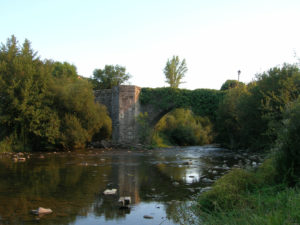
Zubiri (km 20) means exactly what its name says: zubi (bridge) + iri (town) in Basque — town of the bridge. The bridge in question is the Puente de la Rabia, a medieval structure crossing the Arga with two large semicircular arches and prominent cutwaters designed to deflect the river’s pressure. Its name is not decorative. An ancient tradition held that animals suffering from, or at risk of, rabies could be cured by being walked around the central pillar of the bridge. Livestock traders brought their animals here for the purpose; the ritual was documented, observed and believed for centuries. Whether the practice had any practical effect on rabies is a different question.
Zubiri is the administrative capital of the Esteribar valley and its most industrialised settlement — a large magnesite processing plant dominates the approach to the town. The church of San Esteban is a modern replacement: the original was requisitioned as a military barracks during the Carlist Wars of the 19th century and destroyed. The pilgrim hospital at the bridge has also not survived.
Zubiri has several hostels and is a viable overnight stop if you want to split this stage into two. Pamplona is just over 20 km further. If you do not want to stop, you do not need to enter the town — the Camino bypasses it. But the bridge is worth the brief detour.
Larrasoaña: the Bridge of the Bandits and the Fuero de los Francos (km 27)
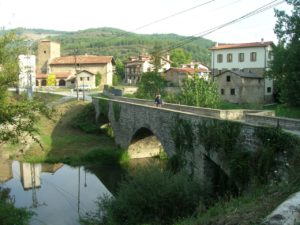
From Zubiri, retrace briefly and then take the stone path through Illaratz, Ezkirotz (which had an important monastery in the 10th century) and on to Larrasoaña (km 27). The Puente de los Bandidos — the Bridge of the Bandits — is a medieval crossing of the Arga that takes its name from the thieves who made this spot famous. The bridge crosses between two steep banks; pilgrims arriving from the descent above had to dismount and were at their most vulnerable. The bandits exploited this geography. This is not a romantic legend: medieval Camino administrators repeatedly issued regulations against highway robbery at specific points on the route, and Larrasoaña appears in several such documents.
Larrasoaña is also a good example of the Fuero de los Francos — a series of laws issued in the 12th century, on royal authority, offering tax exemptions and legal protections to foreigners who settled along the Camino. The incentive was straightforward: the pilgrimage needed services, the towns needed population, the tax exemptions attracted immigrants. All foreigners who made the pilgrimage were called francos — from Francia, a term that then meant approximately “western Europe” rather than specifically France. The immigrants created new settlements with a characteristic urban logic: a long central street through which the Camino passed, flanked by houses and services. The street was the Camino; the Camino was the street. This is the configuration you will see in Larrasoaña and in every town-street village from here to Santiago.
From Larrasoaña to Zabaldika: the Arga valley (km 27–44)
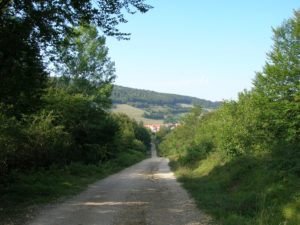
After Larrasoaña the path follows the Arga river closely, alternating between dirt track, gravel and asphalt sections. The profile is gentle — mostly a 2% descent — with one short, sharp section between Akerreta and Zuriáin that requires caution. Through Ilárraz, Ezkirotz, Akerreta and Zuriáin to Zabaldika, where the route divides. Two options for the final approach to Pamplona:
Option A (via Huarte, recommended for cyclists): Turn left at Zabaldika onto a river walk through the Parque de la Tejería and into Huarte. Cross the Puente de la Magdalena — declared a Historic-Artistic Monument, built between the 12th and 15th centuries, with an elaborate crucifix bearing the apostle’s image on one bank — and enter Pamplona’s old town through its medieval gate. The terrain is flat, the route longer but considerably more pleasant than the road alternative.
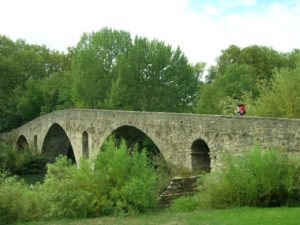
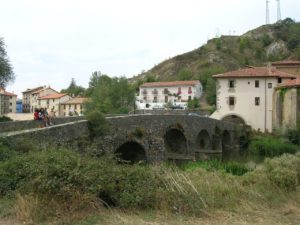
Option B (via Villaba, traditional route): Go straight at Zabaldika on the original path through Arre and Villaba. In Arre (km 43), a 55-metre medieval bridge crosses the Ulzama river to the Trinity complex — a pilgrim hospital from the 11th century, now a hostel and basilica managed by a brotherhood and the Marist order, with a neo-Romanesque altarpiece from the 19th century inside. From Arre, continue to Villaba (km 45): founded in the 12th century by royal mandate, linked to Pamplona’s expansion via an electric railway in the 20th century. On a roundabout in the town stands a metal sculpture of a figure climbing a stage profile on a bicycle — a monument to Miguel Induráin, born here in 1964. Five Tour de France victories, two Giro d’Italia. The silhouette is unmistakable to anyone who watched professional cycling in the 1990s.
When you arrive: Pamplona
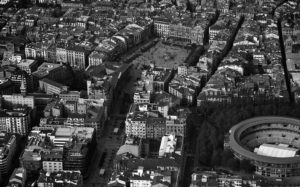
Pamplona is one of the three great cities on the French Way — alongside Burgos and León — and has more history concentrated in its walls than almost any other stop on the route. Plan at least a full afternoon; a rest day here is not wasted.
A city of three boroughs: 75,000 years compressed into one afternoon
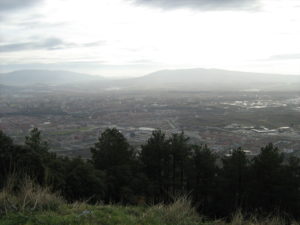
The land under Pamplona has been occupied for at least 75,000 years — evidence in the form of flint tools and menhirs has been found beneath the city. By the time the Romans arrived in 75 BC, the plateau above the Arga river was already settled by the Vascones — the Basque-related people who had lived in this territory since before recorded history. The Romans recognised the strategic value of the position and established Pompaelo (named after Pompey, who founded or refounded it), turning it into a communications hub between the Iberian Peninsula and the rest of the empire.
After Rome fell, the Visigoths and then the Arabs passed through. The Church played a decisive role in the Christian recovery of the territory and was rewarded accordingly: Pamplona became effectively a clerical city-state — the “Kingdom of Pamplona” — in which the bishop held the powers of a lord and the cathedral was the nerve centre. This arrangement generated the specific social composition that shaped everything that followed: high clergy and aristocracy in unusual concentration, a city with strong independent traditions and a population accustomed to special self-governance.
In the 11th century the first wave of francos arrived — foreign merchants attracted by the Camino’s trade — and built their own borough immediately beside the original nucleus. In the 12th century a second wave of Navarrese settlers created a third borough, the navarrería. Three boroughs, each walled, each with its own laws and identity, and each periodically at war with the others. The conflicts were not metaphorical: in 1276 the navarrería was destroyed in an armed conflict with the other two boroughs and had to be rebuilt. This situation persisted for over a century until King Carlos III — “the Noble” — unified the three into a single entity in 1423. The year is the founding date of Pamplona as we know it.
When the city passed to the Crown of Castile in the 16th century, its proximity to France became a military problem. The Ciudadela was built to address it — a pentagonal Renaissance fortification designed by the Italian military engineer Giacomo Palearo, who had previously designed the citadel of Antwerp. It is one of the finest examples of Renaissance military architecture in Europe and today, its five bastions intact, it is a public park of 280,000 square metres. No vehicles, including bicycles, are permitted inside.
The 18th century brought a wave of civic modernisation: sewers, public buildings, and the reworking of the cathedral’s facade. Napoleon captured the city in the 19th century; the War of Independence followed. Then the Carlist Wars — a conflict between liberals (who wanted centralised national government) and Carlists (who wanted to preserve Navarre’s traditional self-governing fueros) — eventually produced a compromise that gave Navarre special fiscal and administrative arrangements that persist in modified form today. When the government attempted to abolish these privileges at the end of the 19th century, a mass public demonstration stopped them. The Monumento a los Fueros in the Paseo de Sarasate commemorates that moment.
The walking tour (90 minutes)
The Sanfermines circuit: from the Plaza Consistorial to the Plaza del Castillo
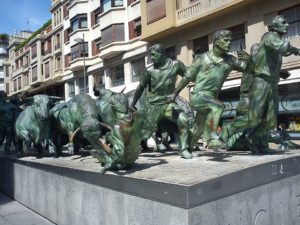
Start at the Plaza Consistorial (the old town hall square). Leave along Calle Mercaderes and turn into the pedestrian Calle Estafeta. The corner where the two streets meet is one of the most photographed points of the encierro — the running of the bulls — because it is where the animals make their most dangerous turn. Walk up Estafeta; midway along, a flight of stairs on the right brings you out of the encierro route and into the Plaza del Castillo.
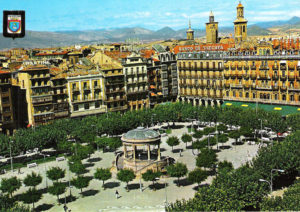
The Plaza del Castillo is the nerve centre of Pamplona. A castle once stood here — hence the name. The square was the original bullring before the permanent one was built: when bullfighting was organised here, wooden barriers were erected and sand laid on the cobbles. Today it has gardens and cafés under its arcades. Two moments of the Sanfermines belong specifically to this square: the chupinazo on 6 July, the rocket launched from the balcony of the adjacent town hall that opens the nine days of festival, and the pobre de mí on 14 July at midnight, when a crowd gathers with candles and sings “Poor me, poor me, the parties of San Fermín have ended”. The festival itself originated as a medieval traders’ fair — a feria franca with tax exemptions — held in honour of the patron saint. The bullfighting came later, then the street processions, then Ernest Hemingway, then the world.
The Paseo Sarasate and the church of San Nicolás
From one corner of the Plaza del Castillo, the Paseo de Sarasate leads south — a broad promenade with the Monumento a los Fueros at its end, and at its beginning the church of San Nicolás. This is not a conventional church. It was built to function as a defensive position in the ongoing conflicts between the three boroughs — what appears from outside to be a tower is actually a watchtower, built to observe and control the rival borough to the north. The exterior is stark and military, with thick walls and minimal openings. The interior is the opposite: a soaring Gothic space with elegant stone vaults and a quality Baroque altarpiece. The contrast tells you everything about the peculiar history of this city.
The Parque de la Taconera
From the Paseo Sarasate, turn west along the walls to the Parque de la Taconera — a park created in the old moat of the city walls, where deer, ducks and peacocks live in partial liberty among mature trees. It is one of the quietest and most unexpected spaces in the city. The Café Vienés near the park entrance was historically a gathering point for Pamplona’s intellectual and Bohemian community; the tradition continues in various forms.
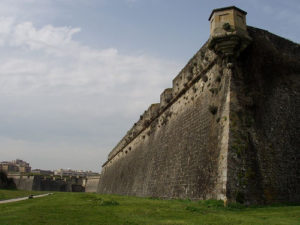
The Ciudadela and the cathedral
Continue to the Ciudadela — 280,000 square metres, five bastions, moats now converted to green areas with drawbridge approaches. Enter on foot only (no bikes permitted) and walk the circuit of the walls. The scale of the Renaissance military engineering is apparent from inside: Giacomo Palearo built this to withstand artillery, and he succeeded. It is one of the best-preserved Renaissance citadels in Europe.
Return to the old city along the Calle Mayor to the church of San Lorenzo — home of the Chapel of San Fermín, the city’s patron saint from Amiens. The feria franca created in his honour is the direct ancestor of the Sanfermines.
Continue to the Cathedral of Santa María la Real. Built primarily in the 14th and 15th centuries, the exterior presents a neoclassical facade added in the 18th century — the medieval original was considered insufficiently modern and was replaced. The interior is Gothic, austere and tall. What you must not miss is the cloister: considered one of the finest Gothic cloisters in Europe, its stone tracery is of extraordinary delicacy — individual stone ribs of great thinness and precision, creating patterns of remarkable elaboration in the light. The cathedral charges an entry fee, with reductions for pilgrims with the credencial. Get it stamped here.
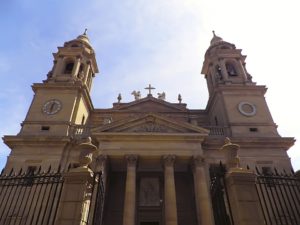
The Rincón del Caballo Blanco and the pintxos
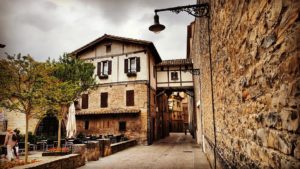
From the cathedral, take the Calle de la Navarrería — the old Navarrese borough — to its end, turn right on Calle del Carmen, and at the Portal de Francia turn right again to the Rincón del Caballo Blanco. This belvedere above the city walls offers the best view in Pamplona: the Arga valley below, the plain stretching toward the Pyrenees, the curve of the river you followed all afternoon. Bars and restaurant terraces here are the ideal place to end the day.
For the evening meal, the streets of Correo, Mercaderes and Zapatería around the Plaza del Castillo concentrate the best pintxos bars in the city. Pamplona’s pintxos tradition is among the finest in Spain: small compositions on bread, typically free-standing rather than on a toothpick, of high culinary quality at a price that makes the tapas bars of Madrid look expensive. Order a zurito with each — the Navarrese term for a small beer, the equivalent of a short caña. It is the efficient local method for working through multiple bars without committing to a full drink at each one.
Practical notes for Stage 2
Route choice summary
The traditional path from Roncesvalles to Pamplona requires an MTB or gravel bike and is manageable in dry conditions for a cyclist with reasonable technical skills. The critical sections are the descent from Alto de Mezkiriz (steep, variable surface), the climb to Alto de Erro (loose stones, average 5%), and the descent from Erro (fast, 4 km, unsettled surface). In rain, these become significantly more difficult. The N135 is a sensible alternative or supplement throughout. From Zabaldika, the Huarte river walk route is preferred for cyclists over the Villaba option.
Water and supplies
Services are available in every significant village: Burguete, Espinal, Bizkarreta, Zubiri, Larrasoaña, Arre and Villaba all have bars or shops. This is not a supply-critical stage — carry 1.5 litres from each stop and you will never run short. Zubiri is the last comfortable overnight option if you want to split the stage; from there Pamplona is just over 20 km.
Starting in Roncesvalles
From Pamplona: bus (Alsa/Conda via Movelia, approximately €6 plus €6 per bicycle) or taxi (approximately €60 from the city centre, or use the pilgrim taxi-share service at taxipamplona.com). The Roncesvalles hostel accepts advance bookings by email to info@alberguederoncesvalles.com (card or bank transfer required in advance). Tournride delivers bikes to your accommodation in Roncesvalles the evening before departure.
Frequently asked questions about Stage 2
How far is Stage 2 from Roncesvalles to Pamplona by bike?
48 km on the traditional Jacobean path; approximately 43 km on the N135 road route. The profile has two significant climbs — to Alto de Mezkiriz (962 m) and Alto de Erro — with technically demanding descents on the path variant. Allow 4–5 hours riding time on either route.
Is Stage 2 harder than Stage 1?
Physically easier — considerably less total climbing and no sustained high-mountain section. Technically more demanding on the path variant, because the descents are faster and on looser surfaces than anything on the Napoléon route. On the N135 road route it is straightforwardly easier than Stage 1 in every way.
What is the Puente de la Rabia?
A medieval bridge at the entrance to Zubiri crossing the Arga river. Its name — Bridge of the Rabies — refers to an ancient practice of walking animals around the central pillar of the bridge to cure or prevent rabies. Livestock traders brought their animals here for this purpose for centuries. The bridge has two large semicircular arches and prominent cutwaters to deflect the river’s force.
What are the Sanfermines and when do they happen?
The Sanfermines are Pamplona’s annual festival in honour of the city’s patron saint, San Fermín. They run from 6 to 14 July each year. The festival opens on 6 July with the chupinazo — a rocket launched from the town hall at noon into the crowd gathered in the Plaza del Castillo — and closes on 14 July at midnight with the pobre de mí (Poor me) song. The encierro — the running of the bulls through the streets from the corral to the bullring — takes place every morning at 8:00 during the nine days of the festival. The route runs from Santo Domingo through Mercaderes, around the corner into Estafeta, and into the Plaza de Toros.
Can I rent a bike starting from Roncesvalles?
Yes. Tournride delivers your bike to your accommodation in Roncesvalles the evening before your departure. At the end of the Camino in Santiago de Compostela we collect it from our office, 5 minutes from the cathedral. Luggage transfer from Roncesvalles to Santiago is also available. See all bike models and check availability here.


