STAGE 12: FROM O CEBREIRO TO SARRIA
Erea FabeiroStage 12 is where Galicia reveals itself fully. After the dramatic entry at O Cebreiro yesterday, today you descend through the ancient mountain landscapes of the Ancares — a UNESCO Biosphere Reserve that has been geographically isolated for so long it preserved pre-Roman building traditions, Atlantic forest ecosystems and the last remnants of Galician bear habitat — and work your way through deep green valleys to Sarria, the starting point of the Last Hundred Kilometres. Two routes diverge at Triacastela: the direct San Xil path north, or the longer southern loop via Samos and its extraordinary Benedictine monastery. Both are worth knowing about. The distance difference is 6.5 km. The cultural difference is substantial.
Planning the full route? Our cycling the Camino de Santiago page maps every stage, with distances and planning tips.
| Distance | Elevation gain | Estimated time | Difficulty | Distance to Santiago |
|---|---|---|---|---|
| 40 km (San Xil) / 46 km (Samos) | +450 m cumulative | 5–7 hours riding | 🟡 Medium | ~150 km |
Rent your bike for the Camino: from €22/day (conventional bike) or €33/day (e-bike) on a one-week trip. 2027 rates, bike transport not included.
See availability and priceKey stops: Liñares (km 3) · Alto de San Roque (km 5) · Alto do Poio (km 8.5) · Triacastela (km 21) · Samos (km 31, Samos route only) · Sarria (km 40/46)
Detour (on-route): Monastery of Samos — adds 6.5 km but one of the largest inhabited monasteries in Spain, worth the extra distance if you have the legs
Route profile and key milestones
O Cebreiro to Liñares: into the Ancares (km 0–3)
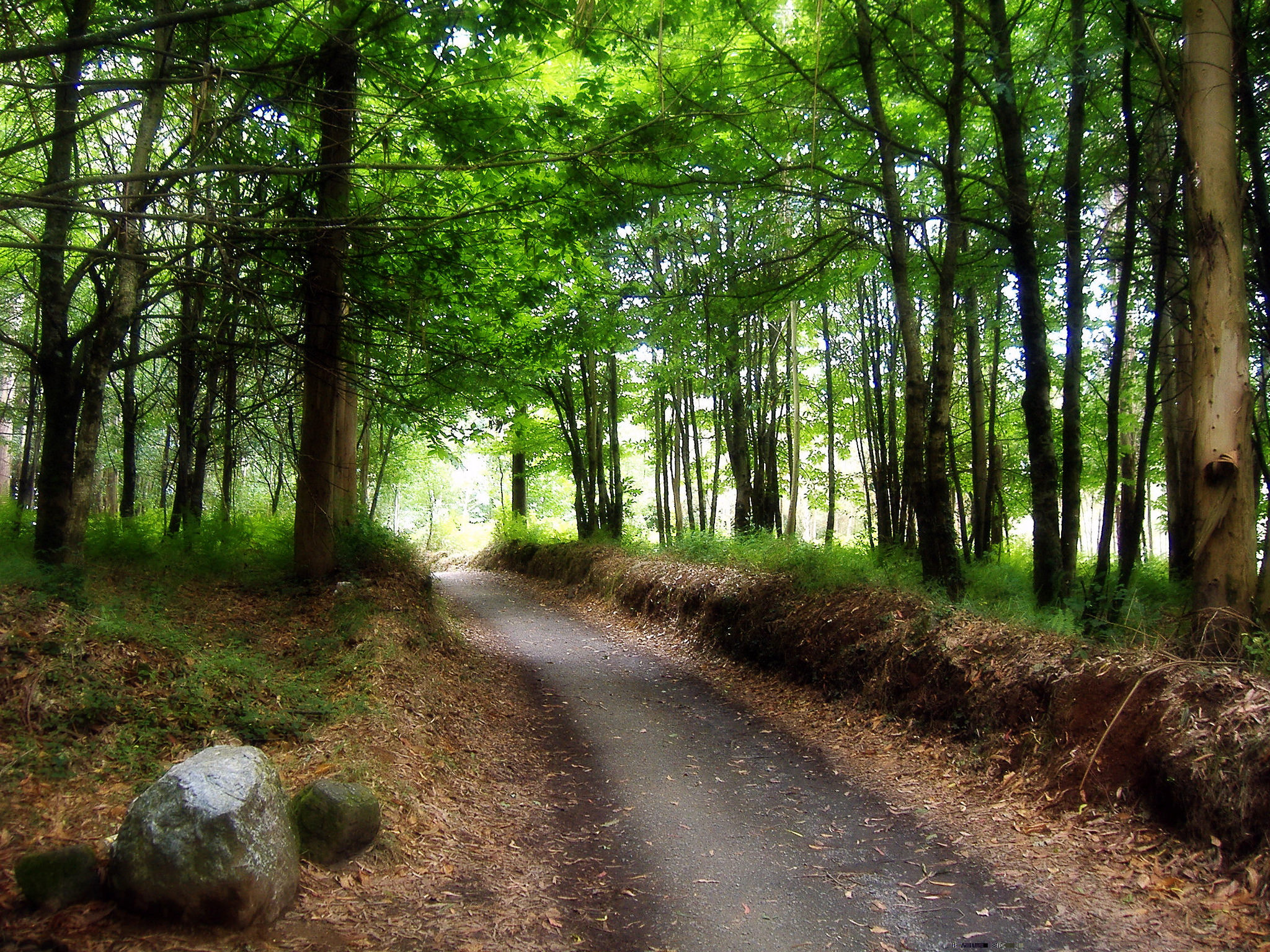
Leave O Cebreiro — by path from the shelter or directly by the LU-633 — and in under 3 km you reach Liñares, the first village of the stage. Its population is under 70, most of them working in agriculture and livestock. The church is dedicated to San Esteban (Santo Estevo in Galician) and is believed to have been founded in the 8th century. The village once belonged to the important monastery of Santa María do Cebreiro, which it supplied with linen — liño in Galician — that is the probable etymology of the name.
From Liñares you are entering the territory of Los Ancares — the mountain range that forms the natural and political border between León and Galicia. UNESCO designated this area a Biosphere Reserve in recognition of its exceptional natural and cultural heritage: the combination of geographical isolation and Atlantic climate has preserved ecosystems, architectural traditions and species assemblages that have largely disappeared elsewhere. You encountered Los Ancares as an obstacle on Stage 11; today you are travelling through its Galician interior. Wolves still move through these forests, though you will not see them — they avoid human contact. The same cannot be said of the eagles and owls, occasionally spotted over the open ridges. Before the 20th century there were brown bears in Galicia; the last ones sheltered in precisely this mountain range before the population finally collapsed.
Alto de San Roque and Alto do Poio: the highest road in Galicia (km 5–8.5)
The pedestrian path from Liñares winds through stone paths to the two high passes of the stage; the LU-633 road follows a more consistent gradient and is the recommended option for cyclists on the climbs. Both reach the same destinations.
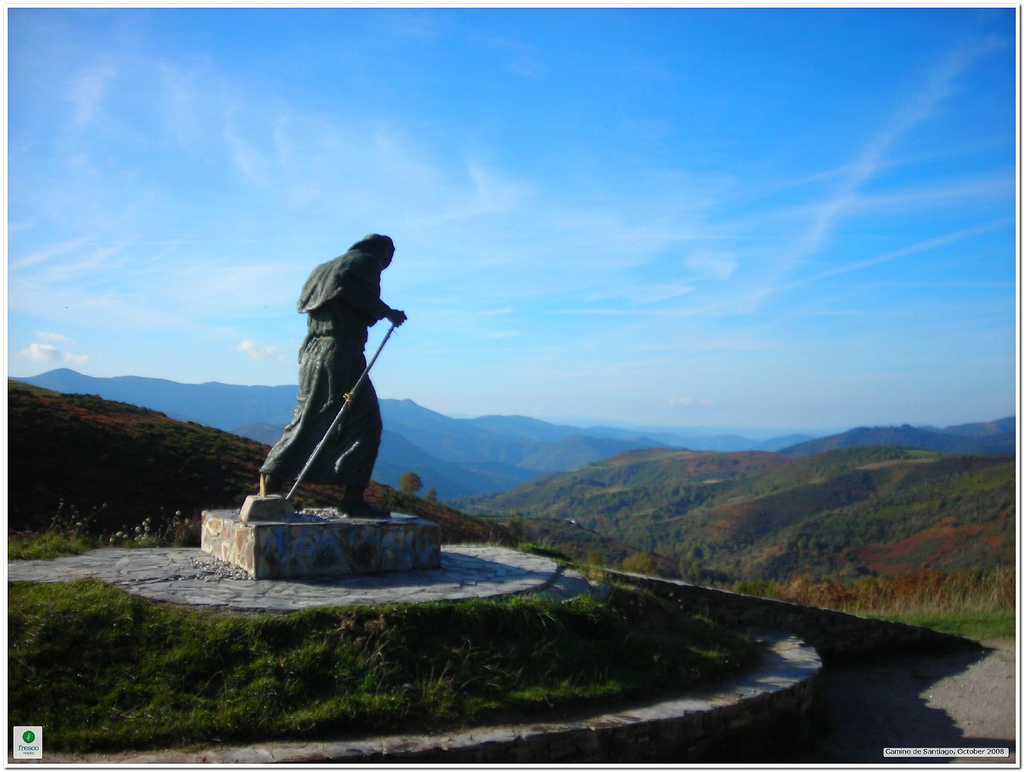
The Alto de San Roque (1,275 m) is marked by a striking bronze statue — a medieval pilgrim in full Jacobean dress, one hand clamping his hat against the wind that is almost always blowing here, the other gripping his staff as he leans into the climb. The sculptor was the Galician artist José María Acuña, who made it in 1993. The figure’s posture captures something true about this place: the passes in the Ancares are exposed, the wind can be strong enough to push a cyclist sideways, and the medieval pilgrim’s gesture of holding onto his hat is not theatrical — it is practical.
The road then descends to Hospital de la Condesa (km 5.7). The name records what was once here: a pilgrim hospital, almost certainly funded by an aristocratic patron — a condesa, a countess. The practice of noble women founding and endowing pilgrim hospitals was common on the Camino; it offered spiritual credit and practical philanthropy combined, and is reflected in a series of village names along this section of the route.
From Hospital de la Condesa the road climbs again to the Alto do Poio (km 8.5, 1,339 m) — the highest point on the entire French Way within Galicia, and the point from which this section of the LU-633 claims to be the highest road in the Galician road network. The views from here over the surrounding mountains — in clear weather, you can see into the valleys of Lugo province ahead and back toward the ridgeline you crossed from Las Herrerías yesterday — are significant. The descent from Alto do Poio is gentle at first, then steepens as you approach Triacastela; the final slopes reach 17%.
Fonfría and the approach to Triacastela (km 12–21)
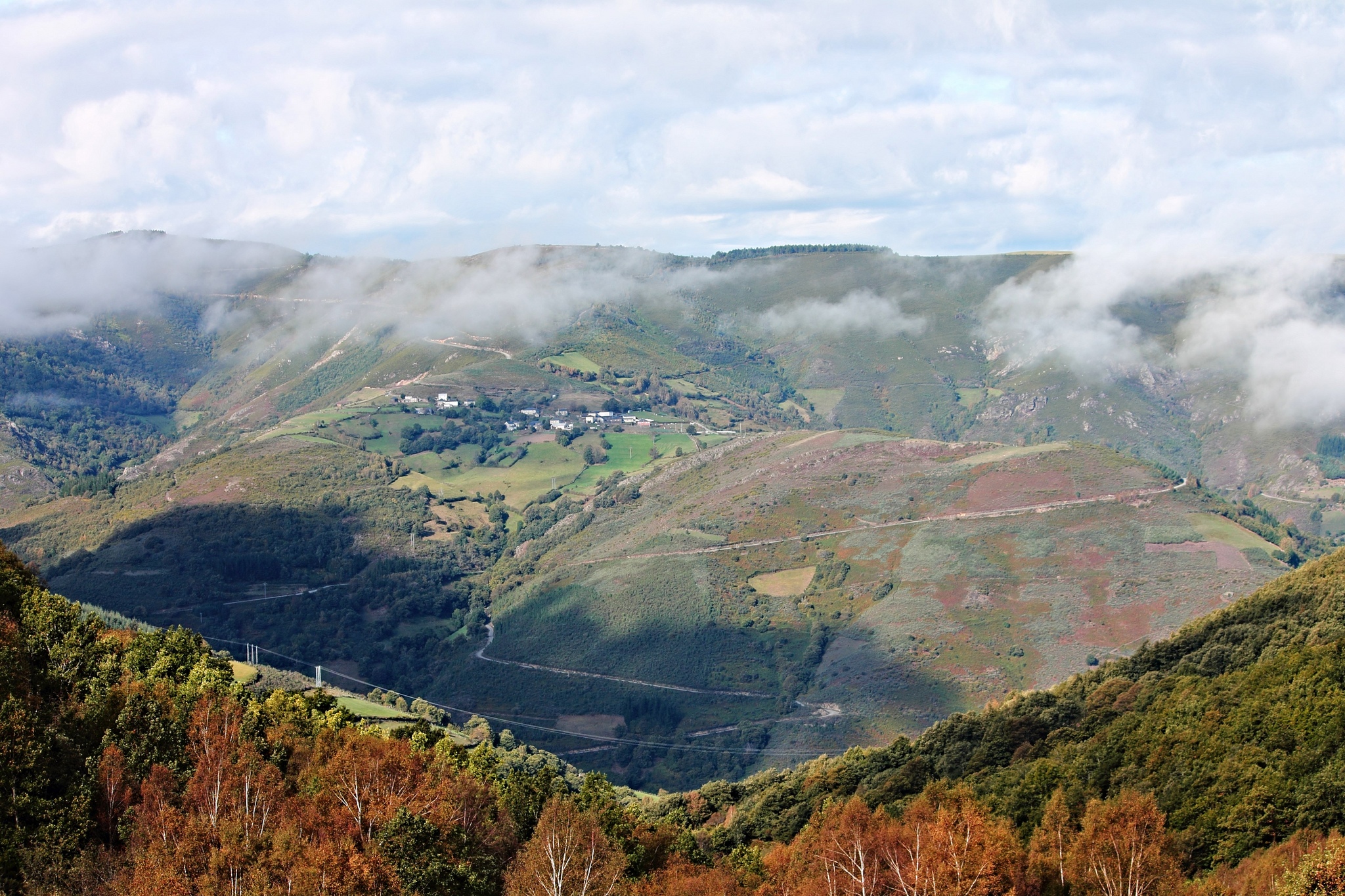
From Alto do Poio to Fonfría (km 12) the road runs almost flat for 4 km. The village’s name is simply Galician for cold spring — fonte fría — and there is still a fountain at the village entrance, fed from the Reñadoiro mountains.
After Fonfría you enter the municipality of Triacastela. The first settlement is O Biduedo (km 14.3) — named for the birch trees (bidueiros in Galician) that once lined the river here. From O Biduedo the road and the pedestrian path diverge; cyclists follow the road while walkers take mountain paths. The mountain you are passing through was the setting of a medieval tradition recorded in the Codex Calixtinus: pilgrims were expected to take a stone from the limestone outcrops in the mountains around Triacastela and carry it with them until they reached Castañeda, on the final stage before Santiago. There, the stones were deposited in lime kilns that burned the limestone into the mortar used to build the cathedral. Every pilgrim, through this small act of physical labour, contributed to raising the house of the Apostle. The tradition has no modern equivalent but its logic — the pilgrimage as collective construction project — is quietly powerful.
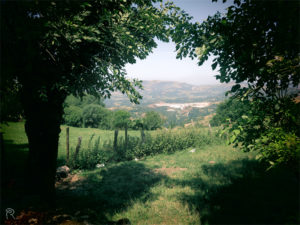
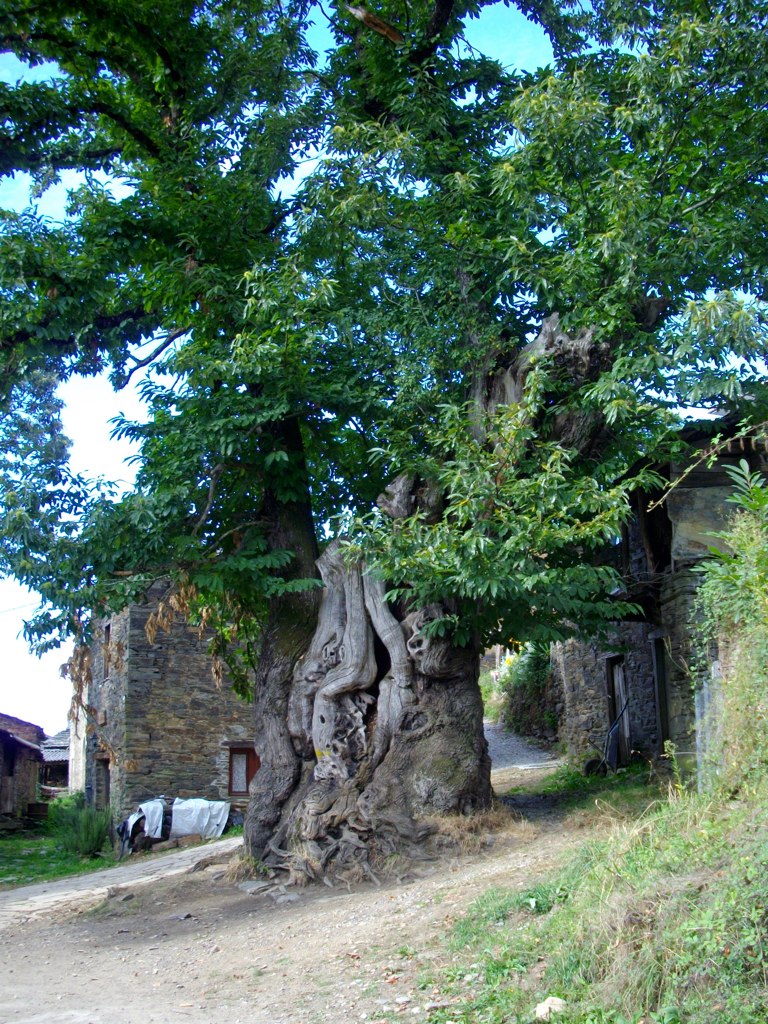
The road passes O Filloval (km 17.3) — a village whose name can be legitimately written several ways in Galician, a source of gentle local controversy — and continues to Ramil, just outside Triacastela. In Ramil stands a chestnut tree of extraordinary age — estimated at around 800 years old, which would make it a contemporary of the 13th-century pilgrims who left their stones in the lime kilns of Castañeda.
Triacastela: fraud, a prison and the disputed name (km 21)
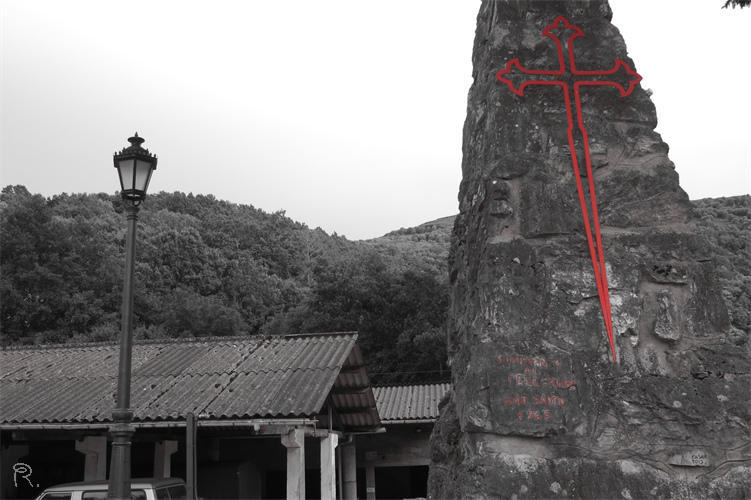
Triacastela (km 21) is where the stage’s fork occurs, and it has a longer Jacobean history than its modest size suggests. By the 12th and 13th centuries, when the pilgrimage was at its medieval height, the town was so well established as a Camino waypoint that — according to the Codex Calixtinus — hostel touts from Santiago came here specifically to recruit pilgrims with promises of superior accommodation in the capital. These promises, once the pilgrims actually arrived, regularly proved false: substandard lodging, inflated prices, conditions nothing like what had been described. The fraud problem was serious enough that the Camino’s administrators created a prison for false pilgrims — people who pretended to be pilgrims to extract charity and free beds. The old building that housed it, largely in ruins today, is visible before the Plaza Mayor.
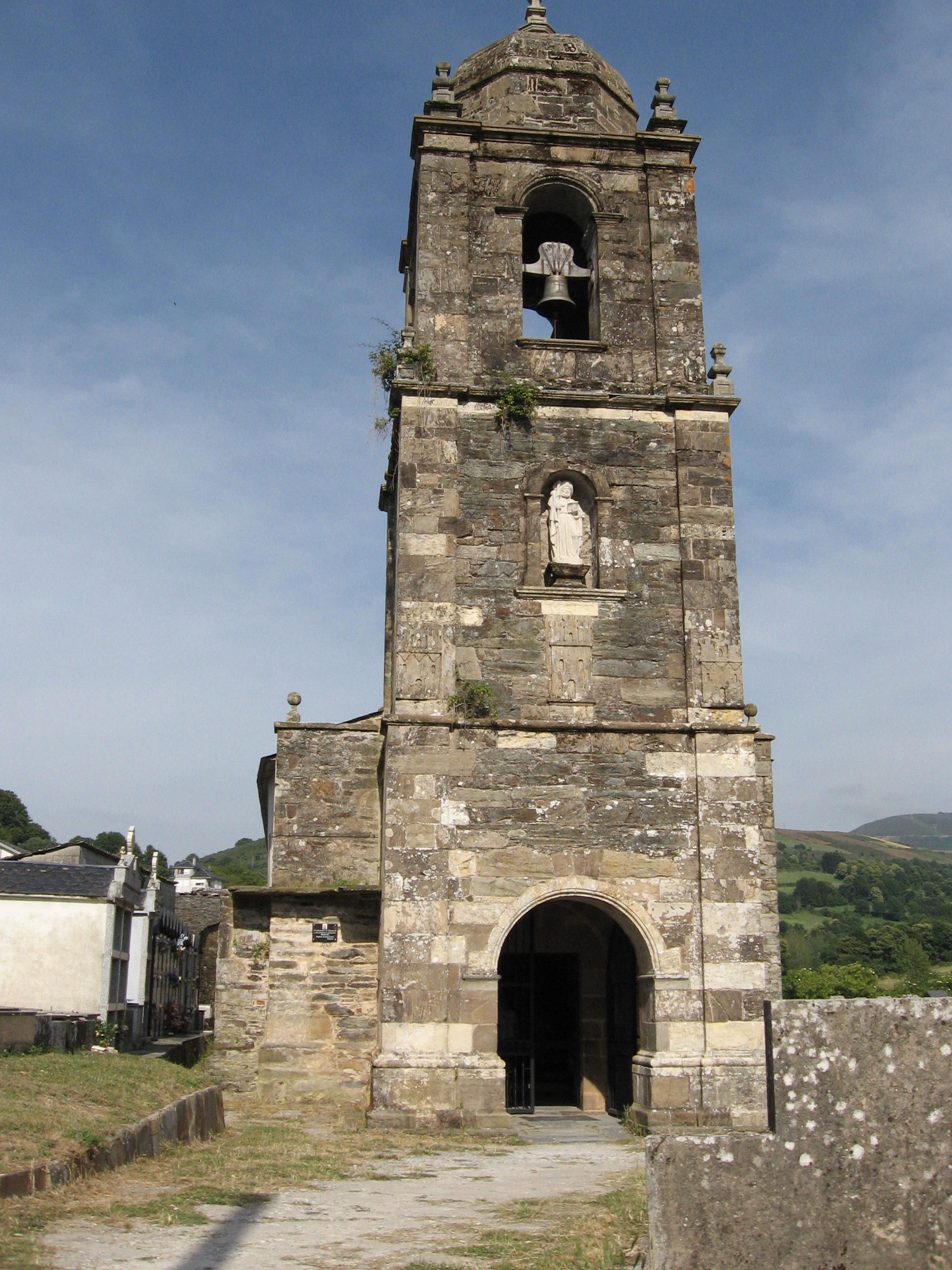
The town’s name is etymologically debated. The obvious reading is three castles — and there is indeed a shield carved on the tower of the parish church bearing three castle towers, which gave rise to the theory. Other historians argue the name refers to a pass toward Castile. Neither explanation is settled.
The parish church is worth a brief stop. The Romanesque apse is preserved from the original medieval building; the rest is Baroque (18th century). Inside, the major altarpiece carries a large image of Santiago dressed as a pilgrim — one of many representations of the Apostle in his pilgrim aspect that you will see multiplying as you get closer to Compostela. The main streets, as in all Jacobean villages, take their name directly from the route: Rúa do Peregrino and Rúa de Santiago.
Rest and eat here before the fork. At the end of the main street, yellow signs indicate the two options: right for San Xil (north), left for Samos (south). The two routes reconnect at Aguiada, 5.5 km before Sarria.
Route A: via San Xil (40 km total)
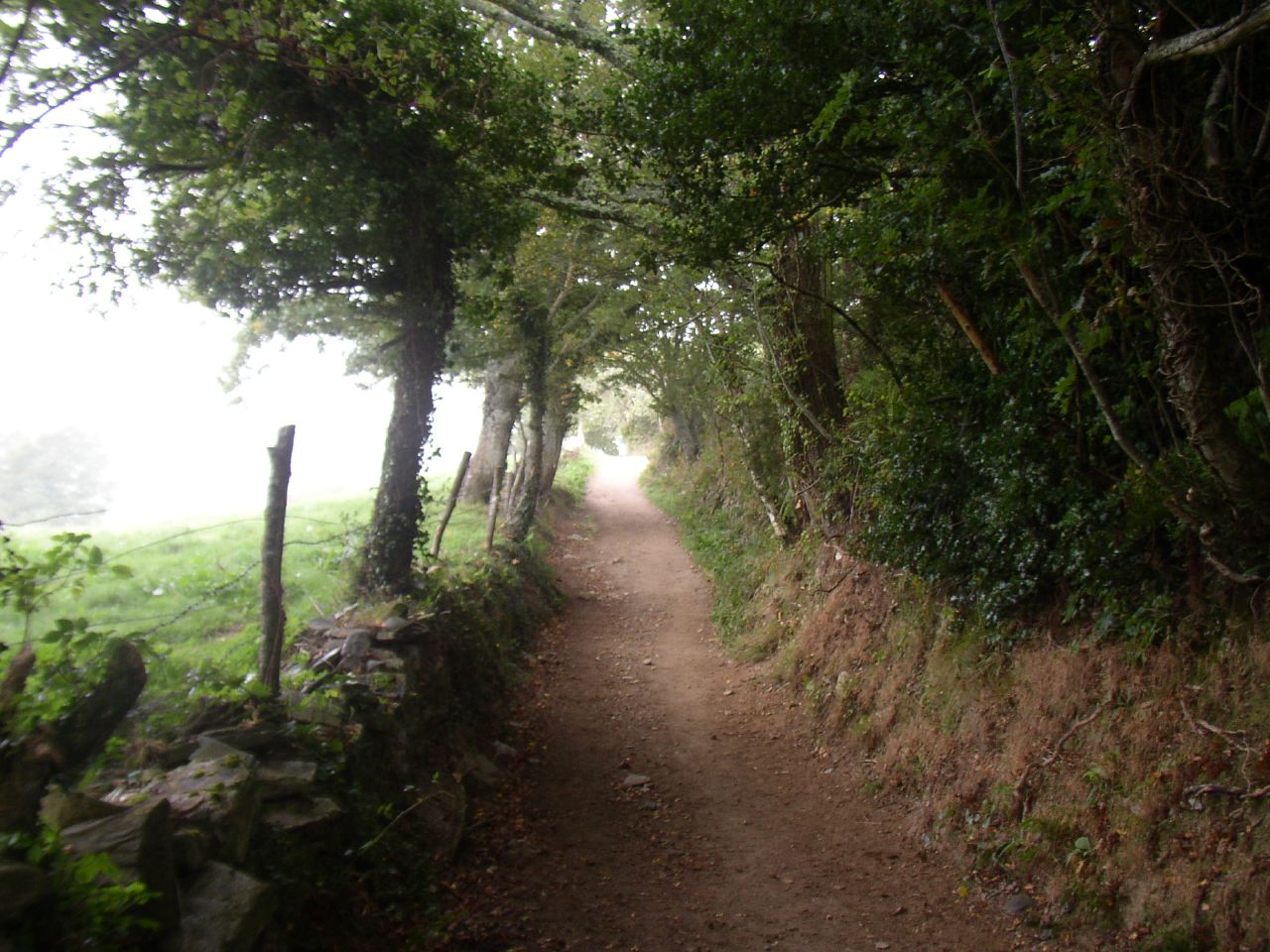
The San Xil route is shorter and more direct, running north from Triacastela. It has a more demanding profile than the Samos alternative — a climb to the Alto de Riocabo (890 m) followed by a descent that includes sections of natural stone stairs through the forest — and less monumental cultural content. But the landscape is exceptional: corredoiras, the characteristic Galician sunken lanes that run between ancient oaks (carballos) and chestnuts, with canopies of leaves filtering the light into the shapes that inspired Wenceslao Fernández Flórez when he wrote El Bosque Animado — The Animated Forest — the 1943 novel set in exactly this kind of Galician oak woodland.
From Triacastela, a concrete track signed “San Xil” leads 2 km to A Balsa, a small rural village with a chapel dedicated to Nuestra Señora de las Nieves. From A Balsa the pedestrian way to San Xil has a complex surface — stone, earth, muddy when wet. In good conditions it is rideable with care; in rain, follow the road to A Balsa and continue by concrete to avoid the worst sections.
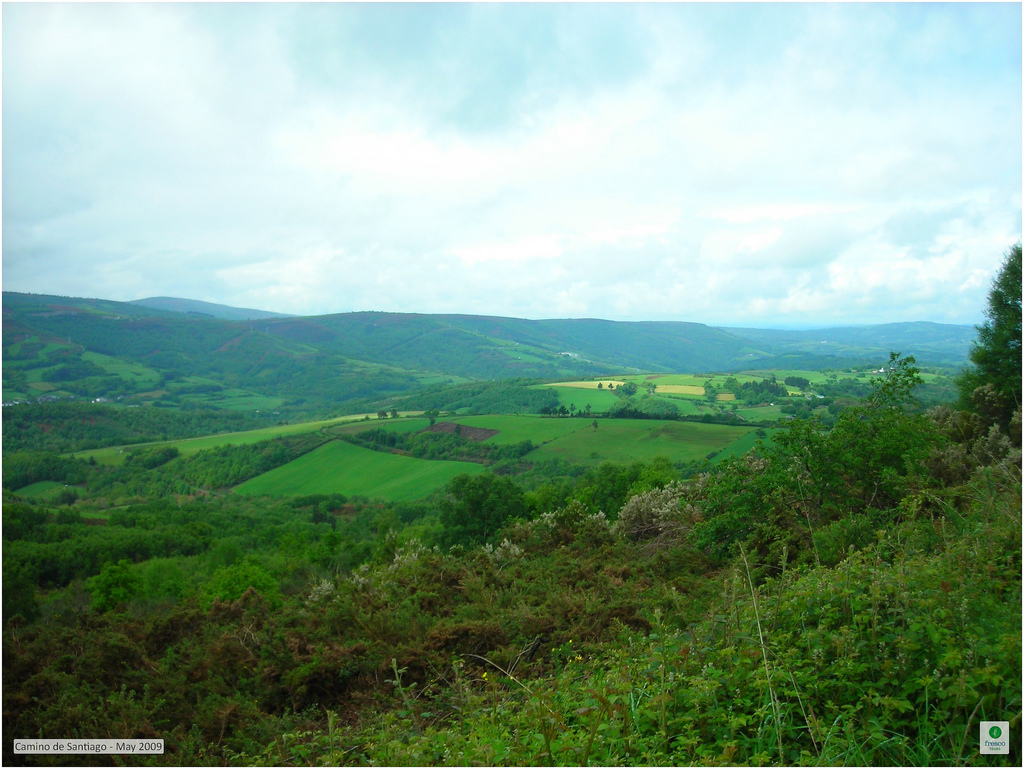
San Xil (km 25.8) is a small village without services. Its dedication to Saint Gilles — a saint particularly venerated in France along the Camino routes — suggests an early Jacobean connection. From San Xil the road climbs by road to the Alto de Riocabo. The descent from there is where the San Xil route requires the most care: the pedestrian way enters the forest on corredoiras with natural stone-step sections that are slippery when wet. If conditions are doubtful, take the concrete track bypass from Alto de Riocabo directly to the LU-5602 and follow the road to Sarria from Montán.
The path passes through Montán (with the simple Romanesque church of Santa María, masonry and slate, a portico at the entrance as protection from the Galician rain), then Fontearcuda, Furela and Pintín before joining the LU-5602 and the final approach to Aguiada (km 34.7), where the San Xil and Samos routes reunite.
Route B: via Samos (46 km total)
The Samos route turns left at the end of Triacastela’s main street, passes the town hall and the Plaza de la Diputación, and returns to the LU-633 heading south. The profile is gentler than San Xil — maximum height 592 m — and the route follows the road along the Sarria river valley for most of its length, with pedestrian path alternatives in sections. The 6.5 km of additional distance is justified by what waits at km 31: the monastery of Samos.
The Desfiladero de Penapartida and San Cristovo do Real (km 22–27)
The first notable feature of the Samos route is the Desfiladero de Penapartida — a narrow gorge where the road passes between vertical stone walls. The name means the split rock, and the local legend provides an explanation suitably grand for the scale of the geography: the Virgin Mary, on pilgrimage to Compostela, reached this spot and found a huge rock blocking her path. She summoned two angels who descended from heaven with a lightning bolt and split the rock in two, creating the passage. The road was later built through the gap the angels made. Whatever the geological reality, the gorge is impressive and the story is typical of the Galician habit of incorporating natural landmarks into sacred narrative.
A right turn detour leads into San Cristovo do Real (km 24.9) — a village of fewer than 35 people that appears to have changed very little in several centuries. The popular architecture is well preserved in varying states of repair; the parish church from the 17th century contains a churrigueresque altarpiece — the elaborate, almost overwhelming Baroque style named after the Spanish architect Churriguera, characterised by dense surface decoration — that is a genuinely unexpected find in a village this small. The Oribio River runs through the town, its banks lined with large trees. You cross it on a bridge to exit the village into the forest on corredoiras.
Casa Forte de Lusío: a mathematician born in a manor house (km 26)
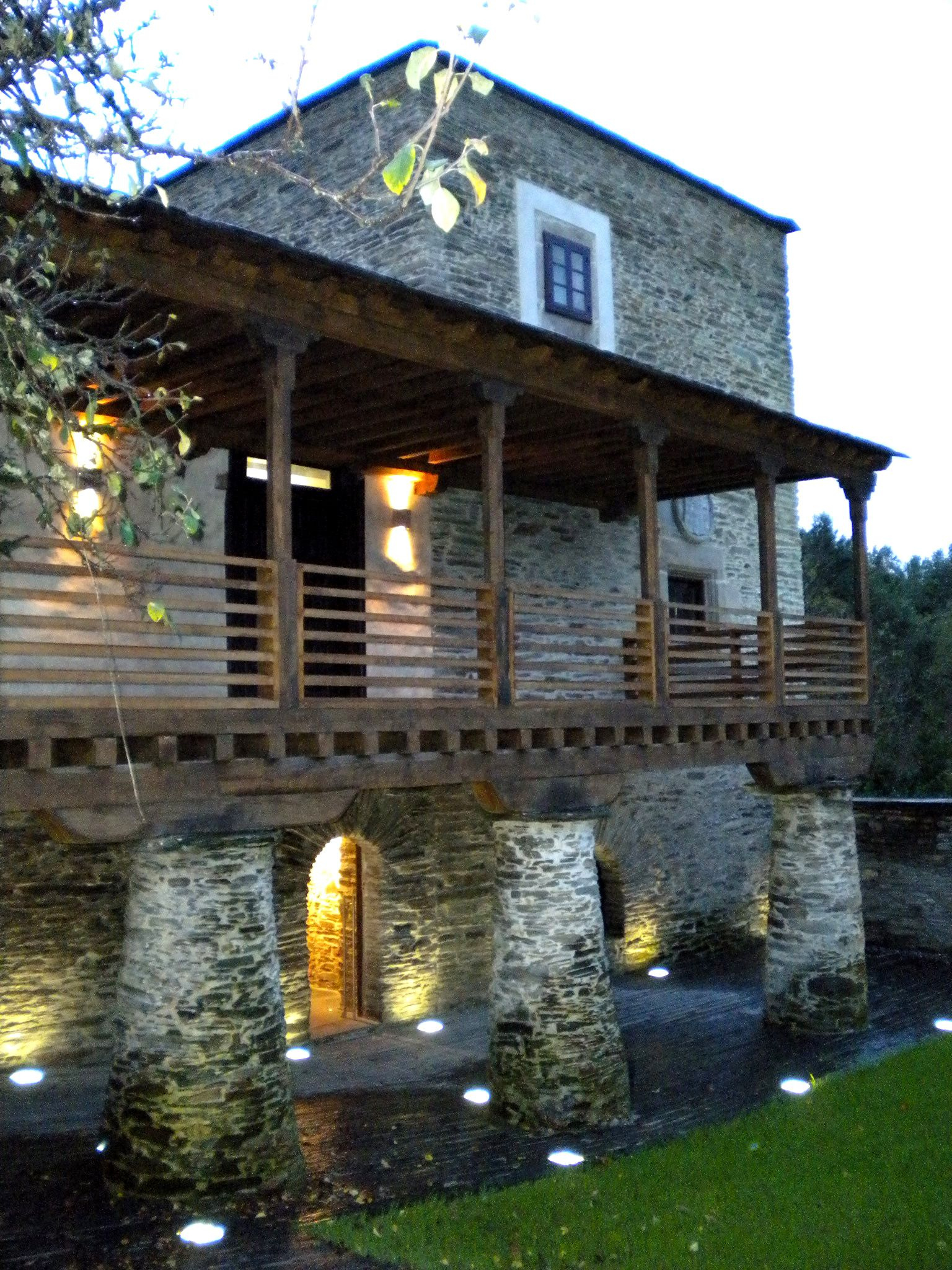
Shortly after San Cristovo, the path passes the Casa Forte de Lusío — a 16th-century Galician manor house, pazo in Galician, that has been restored as a pilgrim hostel. The building retains its original external arches, the family shield carved with eight scallop shells, and a large conical chimney above where the kitchen once was. The surrounding farm extends to 15 hectares with stables, a mill, a smithy and a chapel.
The building is notable for a historical connection: Vicente Vázquez Queipo de Llano was born here in 1804. Queipo de Llano was a mathematician, physician and politician who, in 1797, published tables of logarithms that became a standard reference in Spanish-language mathematics for over a century. The tables earned him a prize at the International Exposition of Paris in 1867 — a recognition of the quality of the computational work. His birthplace is now used for exhibitions about his life and legacy alongside the pilgrim accommodation. It is an unusual coincidence: a house that was a centre of 17th-century rural Galician aristocracy becomes the birthplace of an Enlightenment mathematician, and is finally restored as a Camino hostel. The scallop shield on the facade, which presumably pre-dates the mathematician by two centuries, connects all three phases.
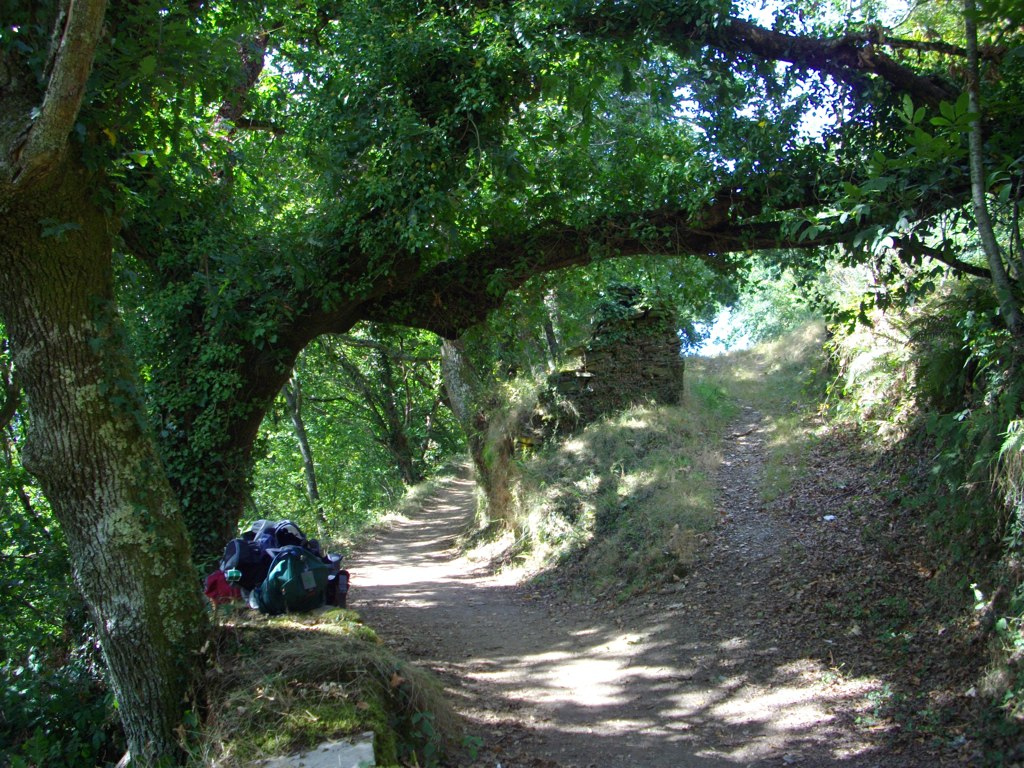
Beyond the Casa Forte, 2 km of path through a canopy of oaks and chestnuts lead to Renche (km 26.6), a small village that was granted by the Pope to the monastery of Samos in the 16th century with a specific condition attached: the monks were required to come here every day and provide food and wine to pilgrims. The church is dedicated to the Apostle. The forest you are riding through here was the landscape that Wenceslao Fernández Flórez had in mind when he wrote El Bosque Animado — the light falling through the canopy, the paths between ancient trees, the sense that something moves at the edge of vision. The novel was adapted into a film in 1987 and remains one of the most beloved works of Galician literature.
The monastery of Samos: 1,500 years of prayer and work (km 31)
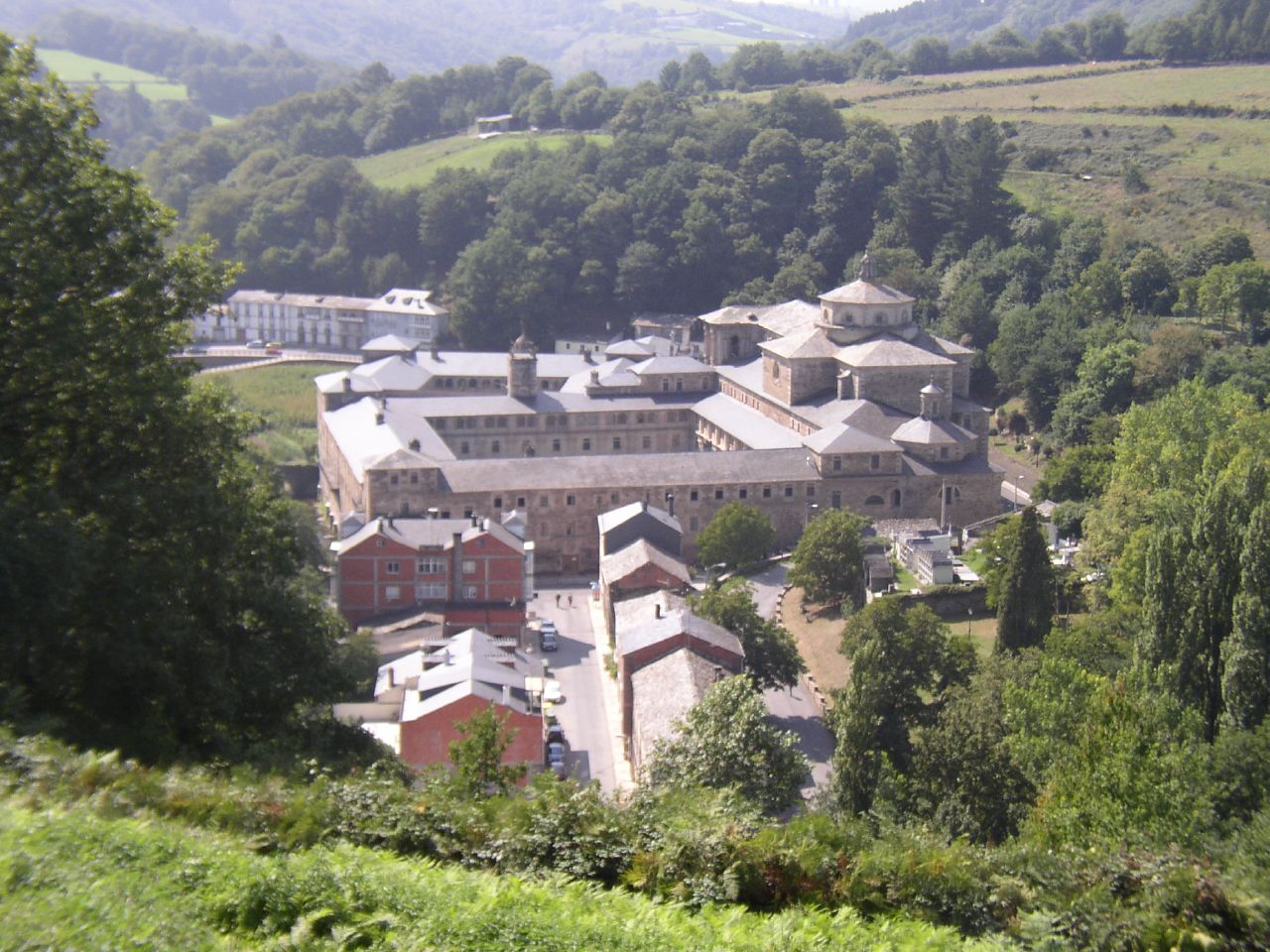
If you approach by the pedestrian path rather than the road, you come over a ridge and see the monastery of Samos suddenly below you — a vast complex of buildings in the valley floor, disproportionately large for its setting, the grey stone glowing against the green of the surrounding hills. The view from this approach is one of the more dramatic architectural sightlines on the French Way. From the road you enter from the north and the monastery appears more gradually.
The Monastery of San Xulián de Samos has been in continuous Benedictine use for approximately 1,500 years, interrupted only briefly in the 19th century. It is one of the oldest inhabited monasteries in Spain — and one of the largest.
Origins: San Martín de Dumio and the first foundation
The monastery’s origins are attributed to San Martín de Dumio — a bishop and theologian born in Hungary in the 6th century who, after visiting the Holy Places in the East, settled in what is now northern Portugal and became bishop of Braga. His influence was extraordinary: he is credited with converting the Swabian kingdom of north-western Iberia from Arianism to Catholicism — a significant shift that brought this Germanic people, who had ruled Galicia since the 5th century, into orthodoxy with Rome. He also worked to move the rural population away from the pagan and Roman-era practices that had survived the formal Christianisation of the peninsula, writing a treatise on the subject that is a remarkable document of popular religion in 6th-century Galicia. The monasteries he founded, including Samos, followed the Hispano-Visigothic rule — a specifically Iberian monastic tradition that differed from both the Celtic and the Roman Benedictine models.
Over the following centuries the monastery also adopted the rule of San Fructuoso de Braga (who founded monasteries throughout El Bierzo, which you passed through on Stages 10 and 11) and later the rule of San Isidoro of Seville. In the 10th century, as the Cluniac reform movement standardised monastic practice across Western Europe, Samos transitioned to the Benedictine Rule — the ora et labora of prayer and work — abandoning the Iberian traditions for the international norm that the Camino’s Cluniac patrons were propagating along the entire route.
The golden age and Father Feijoó
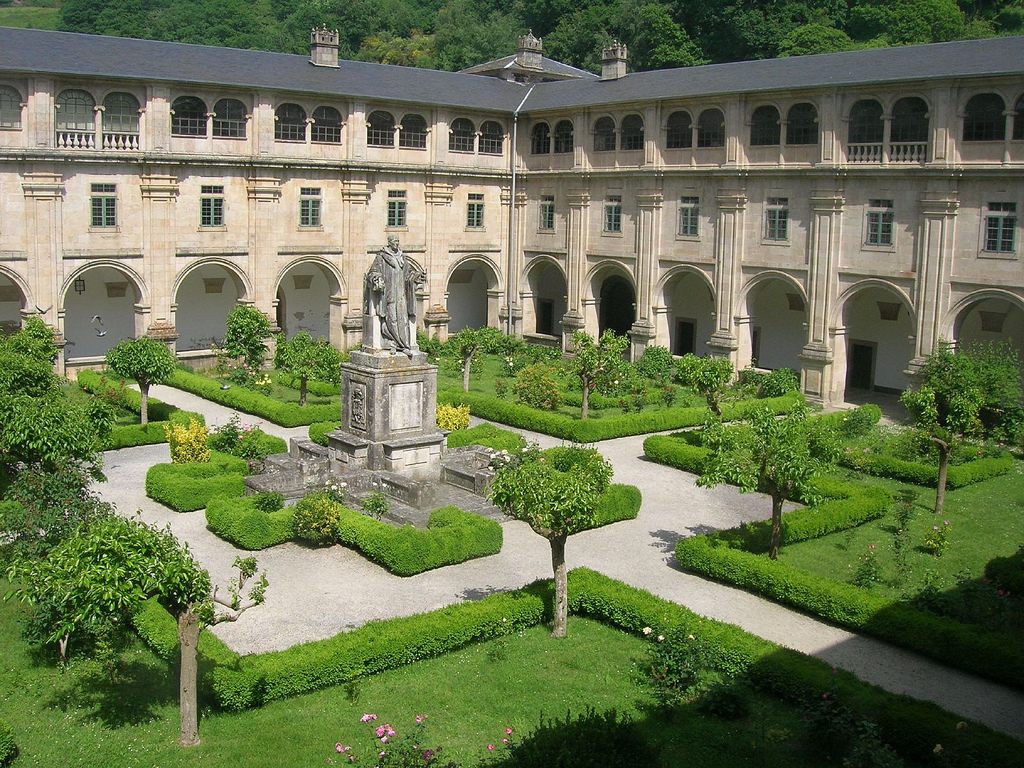
The monastery reached its greatest prominence in the 16th century, when eight future bishops and several major religious intellectuals emerged from its community. The most significant of these was Padre Benito Feijóo (1676–1764), a Benedictine monk who became one of the leading figures of the Spanish Enlightenment. Working from within the monastic tradition, Feijóo wrote widely circulated essays challenging superstition, advocating for empirical reasoning and, most controversially for his time, arguing for the equal intellectual capacity of women in a text titled “En defensa de las mujeres”. In the 18th century this was a genuinely radical position, and his willingness to publish it — alongside his attacks on folk medicine, astrology and other popular beliefs — brought him both wide readership and ecclesiastical criticism. He is now recognised as one of the founders of Spanish essay writing and a major figure of the Iberian Enlightenment. A courtyard of the monastery is named in his honour.
The 19th century brought violent disruption. During the Napoleonic Wars the monastery served as a military hospital. The Liberal disentailment of 1835 forced the monks out, and the buildings were emptied. They were allowed to return 24 years later, in 1859.
The buildings: four cloisters and a hidden inscription
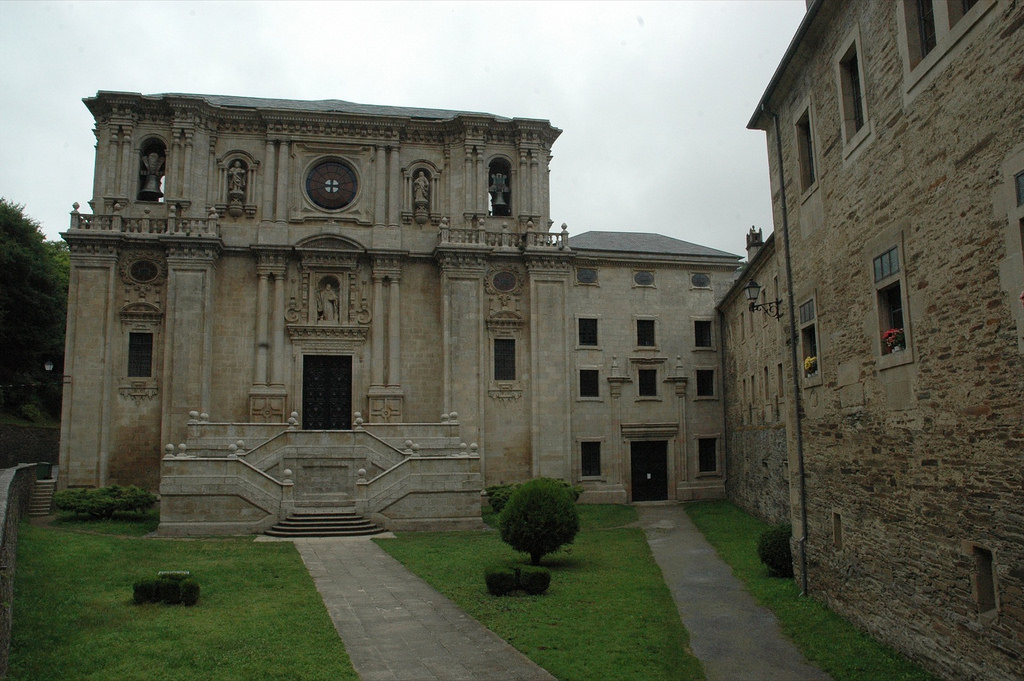
Most of the surviving structure dates from the Renaissance and Neoclassical periods — the 15th to 17th centuries, the monastery’s golden age — built in a deliberately austere style that was considered more appropriate to Benedictine principles than elaborate decoration. The effect is a building whose scale is immense and whose ornamentation is restrained: a combination that has its own kind of grandeur.
The church facade is missing the two towers that were planned but never built, giving it a compressed horizontal character. The external staircase leading to the entrance portal is worth noting: it will look familiar again when you reach the cathedral of Santiago de Compostela.
The monastery has four cloisters, of which the largest is one of the biggest in Spain. Dedicated to Feijóo, it contains a large sculpture by Francisco Asorey — one of the major figures of 20th-century Galician sculpture — depicting the monk in his habit holding books. Asorey, working in the early and mid-20th century, was instrumental in creating a Galician sculptural tradition that drew on Celtic and pre-Roman roots.
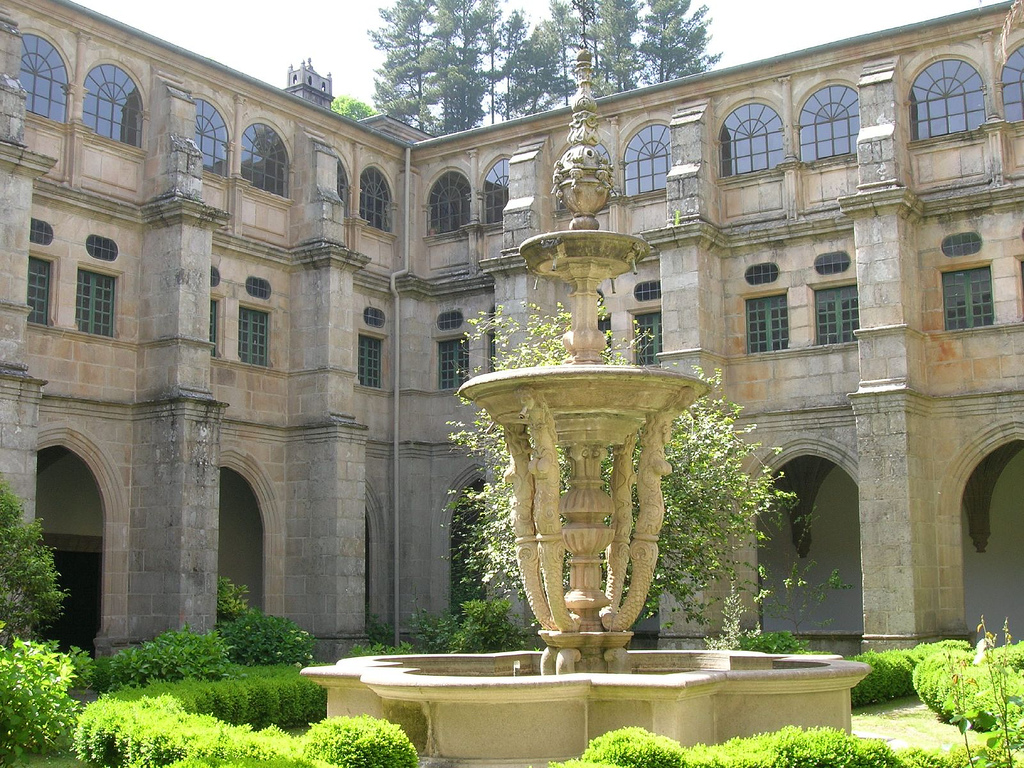
The second notable cloister is the Cloister of the Nereids, named for the Baroque fountain at its centre: four mythological nymphs supporting a basin. The cloister is also the location of an excellent piece of 16th-century wit: somewhere in the carved stonework of the arches, a stonemason of that century hid an inscription in the form of a hieroglyph that translates as “¿Qué miras, bobo?” — What are you looking at, fool? It has been discovered, photographed and pointed out by guides for centuries. Whether the stonemason faced consequences for this is not recorded.
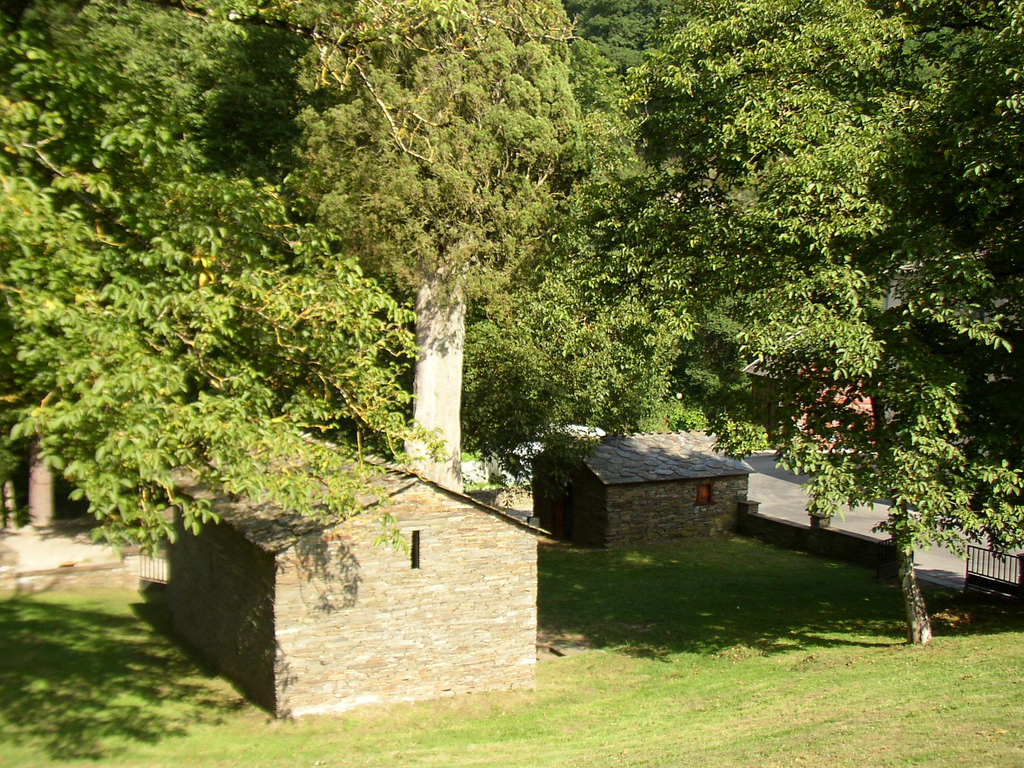
Set slightly apart from the main complex is the Capilla del Ciprés — the Chapel of the Cypress. This small building dates from the 9th century and is one of the oldest surviving structures of the monastery; it may originally have been a monastic cell. Beside it grows a cypress tree of extraordinary age, marked by a large black scar where a lightning bolt once struck it. The tree predates the Romanesque period; its presence beside an early medieval oratory is the kind of continuity — vegetable, spiritual, meteorological — that accumulates meaning on the Camino.
The monastery still functions as a Benedictine house and offers pilgrim accommodation. Tourist visits follow a fixed schedule — check the day before at abadiadesamos.com to plan your arrival at an open time. Entry to the cloisters requires a guided tour.
Samos to Sarria: Teiguín and the final approach (km 31–46)
From Samos the LU-633 follows the Sarria River north toward Teiguín (km 32.8). At Teiguín a Jacobean sign offers a detour left into the forest toward Pascais, Sivil and Calvor — the alternative that reconnects with the San Xil route at Aguiada (km 41.5). The detour is entirely rideable in dry conditions but adds distance; if you prefer to continue straight, the LU-633 runs directly to Sarria in 9 km with a mixed profile of modest climbs and descents.
The Pascais detour passes the small church of Santalla de Pascais (Santa Eulalia) — a Romanesque building from the 12th century of which the apse, north wall and one door survive; the rest is Baroque. The main altarpiece is of notable quality for a church this small.
Both routes converge at Aguiada and share the last 5.5 km to Sarria along the LU-5602.
When you arrive: Sarria
Sarria is the starting point of the Last Hundred Kilometres — the minimum distance required to receive the Compostela, the certificate of completion of the Camino. This fact transforms the town: from June to September it is dense with pilgrims who are beginning rather than continuing, many of them doing the Camino for the first time, with new boots and full panniers. After the relative solitude of the Ancares and the Samos valley, the demographic shift is noticeable. From here to Santiago the Camino will be more crowded than anything you have experienced since the Basque country.
Sarria itself has all services and a reasonable concentration of bars and restaurants in the old town around the castle. The Rúa Maior (Main Street) follows the Camino east-west through the town and is lined with the pilgrim services — credential stamps, hostels, supply shops — that this role demands. The church of O Salvador, at the top of the old town, is a 13th-century Romanesque building with later Gothic additions; the Convento de la Magdalena, founded in the 13th century by Augustinian friars and later taken over by Mercedarian monks, now operates partly as a hostel and has a pleasant cloister. The castle ruins above the town are fragmentary but worth the short climb for the view over the valley and the sense of Sarria’s medieval importance as a control point on the road west.
Sarria is the natural end of the day. The 100 km marker is technically a few kilometres further on the route toward Portomarín — some pilgrims walk to see it and return. You will pass it properly on Stage 13.
Practical notes for Stage 12
Which route: San Xil or Samos?
San Xil is shorter (40 km vs 46 km), has a more varied profile and more dramatic forest paths. Samos adds 6.5 km but has a gentler profile and the monastery — one of the most historically significant buildings on the entire French Way. If the weather is dry and your legs are good after Stage 11, take the Samos route. If it has rained heavily, the San Xil paths can be difficult; in that case, San Xil by road is actually the simpler option. In any conditions, avoid the most technical trail sections on both routes in favour of the parallel roads.
Surface and bike type
Both routes combine tarmac (LU-633 and local roads) with corredoiras and earth/stone paths. The recommended cyclist itinerary uses road for the climbs (O Cebreiro to Alto do Poio) and selective sections of path where the surface is suitable. An MTB or gravel bike handles everything comfortably in dry conditions. A road bike should stay on tarmac throughout — the path sections have surfaces inappropriate for road tyres. In wet conditions, both routes should be done on road. An e-bike makes the climbs to Alto de San Roque and Alto do Poio much more accessible, leaving energy for the forest sections.
Water and supplies
Galicia has small settlements every few kilometres and services are more frequent than anywhere since the Pyrenees. That said, some of the rural villages on both the San Xil and Samos routes have no services at all — they are too small. The reliable service points are: O Cebreiro itself, Liñares, Hospital de la Condesa, Fonfría, Triacastela (full services), Samos (Samos route only), and Sarria. Fill up at Triacastela before the fork.
Weather and navigation
The Galician mountains generate their own weather rapidly and the LU-633 section over Alto do Poio can be foggy, windy and wet even when the valley below is clear. Start with waterproof clothing accessible, not packed away. On the Samos route between Triacastela and Samos, navigation requires attention: vertical signs are sparse, yellow arrows are the main guide, and there are sections where blue arrows from trail-running events cross the Camino arrows. The blue arrows are for runners, not pilgrims. Follow only the yellow arrows (and the Scallop shell markers, whose ridges point toward Santiago).
Starting in O Cebreiro
There are no buses, trains or flights to O Cebreiro. The nearest bus stop is Piedrafita do Cebreiro (3.5 km from O Cebreiro, served by Alsa from Lugo and Santiago and from cities including Madrid and Barcelona). From Piedrafita, taxi to O Cebreiro costs approximately €10. Tournride delivers bikes to your accommodation in O Cebreiro the evening before your departure.
Frequently asked questions about Stage 12
How far is Stage 12 of the Camino Francés by bike?
40 km via the San Xil route or 46 km via Samos. Both routes start and end at the same points and reconnect 5.5 km before Sarria. The extra 6.5 km for Samos includes the monastery visit and a gentler overall profile.
Is the Samos route worth the extra distance?
Yes, if you have any interest in history or architecture. The monastery of San Xulián de Samos has been continuously inhabited since the 6th century, is one of the largest in Spain, and contains a cloister that is among the biggest in the country. Father Feijóo — whose courtyard you will walk through — was one of the most important Spanish intellectuals of the 18th century. The Samos route also has a gentler profile and the forest between San Cristovo and Renche is one of the most beautiful sections of the entire French Way in Galicia.
What is the significance of Sarria on the Camino?
Sarria is the last point from which pilgrims can start their journey and still cover the 100 km minimum required to receive the Compostela (the certificate of completion). This makes it the starting point for the most popular short version of the Camino Francés, and from Sarria onward the route will be significantly more crowded than everything you have experienced since Navarre.
Where can I sleep in Sarria?
Sarria has a wide range: the municipal hostel on the Rúa Maior, several private hostels, guesthouses and hotels of all categories. Book in advance from June to September — Sarria fills quickly because so many pilgrims start here. The Convento de la Magdalena operates part of its space as a hostel and is one of the more atmospheric options if it has availability.
Can I rent a bike in O Cebreiro and return it in Santiago?
Yes. Tournride delivers your bike to any accommodation in O Cebreiro the evening before your departure and collects it in Santiago de Compostela when you finish. Luggage transfer in a single leg, from the start to the end of the trip, is also available. See all bike models and check availability here.
Cycle the Camino de Santiago at your own pace.
Plan this stage by bike