STAGE 13: FROM SARRIA TO MELIDE
Erea FabeiroStage 13 is the busiest stretch on the entire French Way. From Sarria onwards every pilgrim you meet is on the Last Hundred Kilometres — the minimum required for the Compostela — and the Camino changes character: more crowded, more varied in pace and purpose, more emotionally charged. In 60 km you cross more than 60 named settlements, wade through medieval corredoiras, pass the real 100 km marker (not the false one in A Brea), cross the river that swallowed a town, and arrive in Melide — where the only thing to do after dismounting is order a plate of octopus.
Planning the full route? Our cycling the Camino de Santiago by bike page maps every stage, with distances and planning tips.
| Distance | Elevation gain | Estimated time | Difficulty | Distance to Santiago |
|---|---|---|---|---|
| 60 km | +900 m cumulative | 6 hours riding | 🟡 Medium–High | ~111 km |
Key stops: Barbadelo church (km 3.7) · real 100 km marker (km ~13) · Morgade (km 12) · Ferreiros (km 13) · Portomarín (km 22) · Castromaior (km 32) · Palas de Rei (km 47) · Leboreiro (km 55) · Furelos (km 58.5) · Melide (km 60)
Optional detour: Castillo de Pambre (8.5 km from Palas de Rei, on a favourable route — the only castle that survived the 1467 peasant revolt)
Route profile and key milestones
Leaving Sarria: the Ponte da Áspera and the first climb (km 0–4)
Leave Sarria along the Rúa Maior, pass the Concello (City Hall) and continue to the small Romanesque-Gothic chapel of O Salvador where the yellow arrows direct you right. A brief detour to the mirador de la Prisión — the castle ruins above the old town — offers an unbeatable view of the Sarria valley before the descent. Then pass the Convento de la Magdalena (13th-century Augustinian foundation, now partly a hostel) and drop down the hill in front of the convent.
In 200 metres you reach the Ponte da Áspera — the Rough Bridge — a medieval structure built when the settlement of Vilanova de Sarria developed on the far bank of the Celeiro river, giving pilgrims a crossing. The current fabric retains much of the original: three semicircular arches in granite ashlar with the upper course in slate slabs, from which enormous quantities of vegetation grow, giving the bridge a picturesque quality that is simultaneously beautiful and structurally concerning. Across it, a dirt path runs beside the railway tracks; you will almost certainly need to dismount to cross the rails.
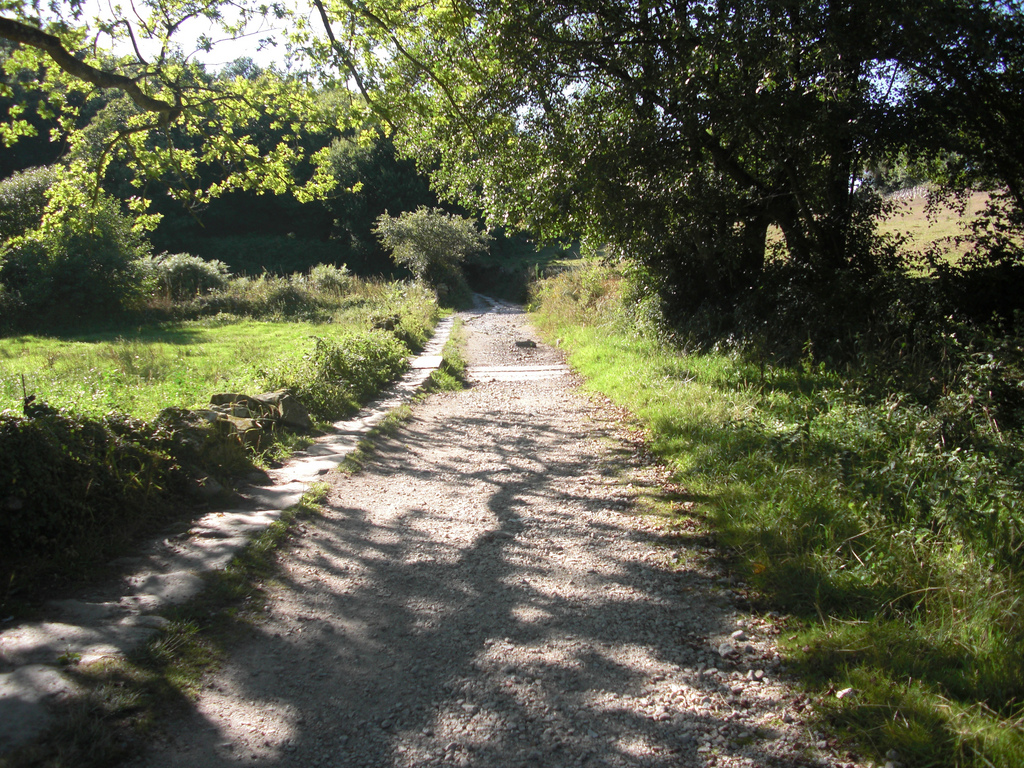
Immediately after the railway crossing, the path enters a dense carballeira — oak forest — and begins the most demanding ascent of the day: 600 metres at an average gradient of 10%, with loose stones underfoot and tree roots claiming space on the surface. In wet conditions the path becomes mud. After a sharp final curve the trees give way and you can see the sky again. Cross pastures to reach Vilei (km 3.7), where all services are available.
Barbadelo: beasts carved in stone (km 3.7)
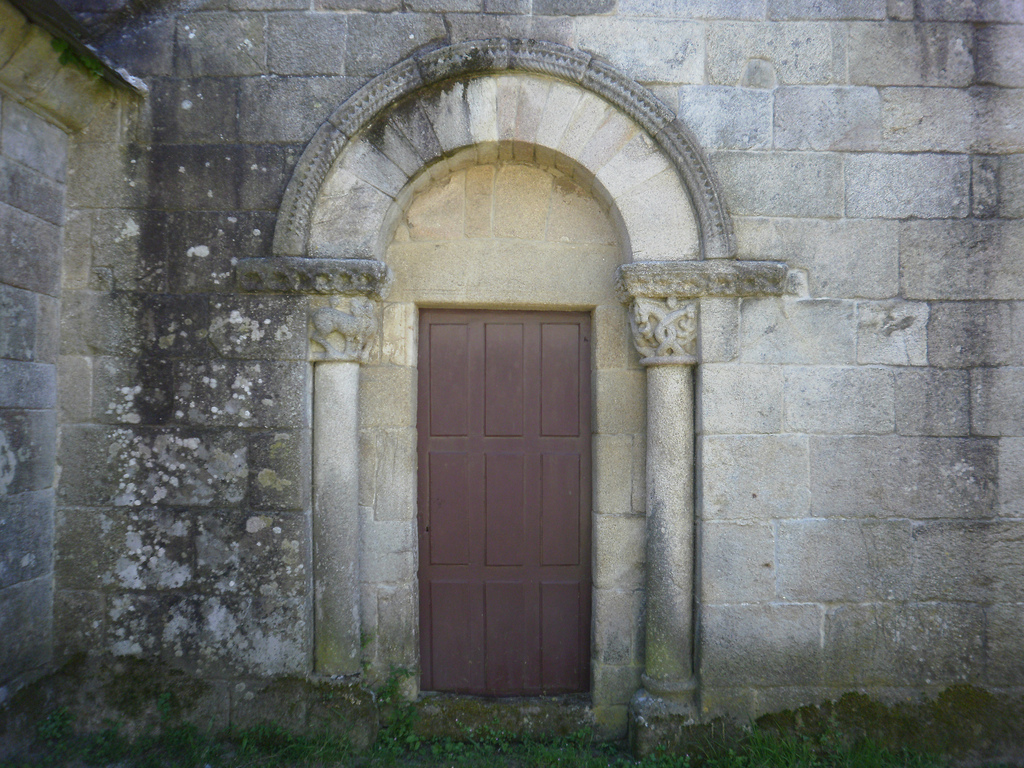
At Vilei a paved path climbs slightly and, after 450 metres, a right-hand junction leads to the church of Santiago de Barbadelo, declared a Bien de Interés Cultural. The detour is short and entirely worth making.
The church was originally part of a monastery dependent on Samos — of which only ruins survive — and was built in the 12th century, though the apse was replaced in the 18th. Its tower is believed by some to have functioned as a lantern: a light source visible from the valley that guided pilgrims up the hill at night, a function the Church organised on a large scale across the Camino’s mountain sections. The north wall and western facade preserve the most intact 12th-century carved decoration.
The carving is what makes Barbadelo exceptional. In the capitals and constructive elements of the portals you can read the full medieval bestiary — the encyclopaedia of real and imaginary animals that decorated Romanesque churches as a form of visual theology. On the north door and the main gate there are dragons: the most recognisable enemies of the Good, whose bodies were conceived as serpentine — the serpent being the animal linked to sin since Genesis. Facing them, at the north door, is a lion: guardian of the threshold, symbol of strength and divine nobility, positioned to warn that the visitor is crossing from profane to sacred space.
It is worth dwelling on the social function of this imagery. To a modern eye these are decorative carvings of fabulous creatures. To a 12th-century Galician peasant, they were not. Dragons appeared in the Bible — the book that represented all Truth — and other exotic animals were reported to live in the distant East. They were genuinely believed to exist: the dragon was a real threat, the lion a real power. The Church understood this and used it. By placing these creatures at the church entrance, it communicated in the language of a population that could not read text but could read stone: cross this threshold and enter the space where the forces of sin are kept outside. This is how visual art functioned as social control in a pre-literate world.
Granaries, the real 100 km marker and the Fonte do Demo (km 8–12)
Back on the main route, a paved track leads through Rente and crosses the LU-5709 at Mercado da Serra — a town whose name records the great medieval market fair held here that reportedly attracted merchants from Santiago itself. Continue by dirt path and further crossings to A Pena (km 8.5) and Peruscallo (km 9.2), where the first concentrations of hórreos appear built directly beside the track.
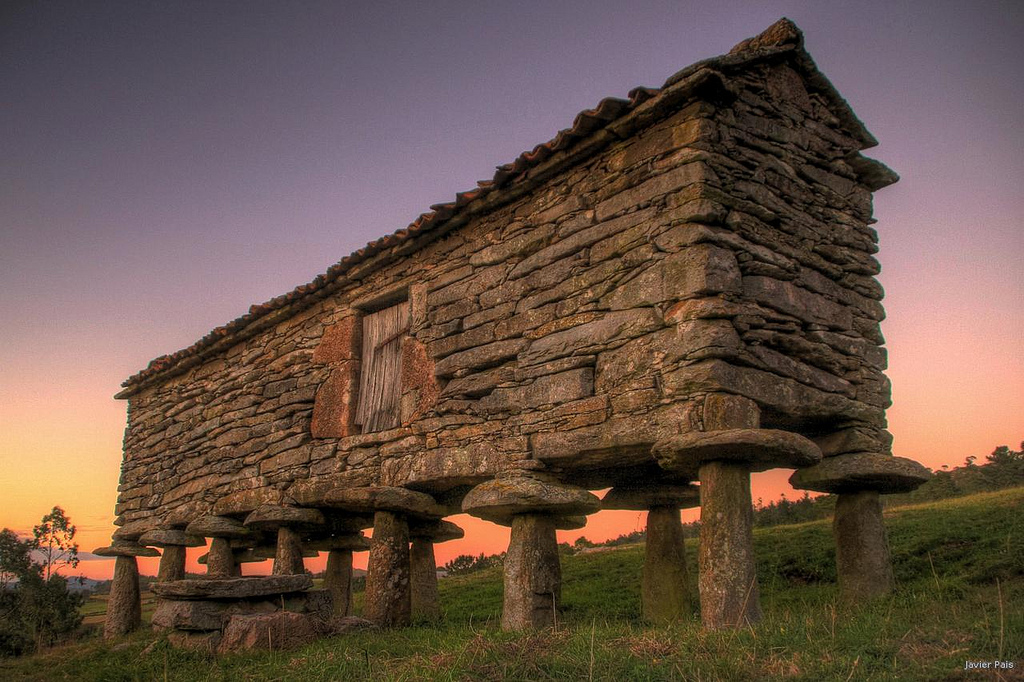
The hórreo is the most characteristic construction of Galician rural culture and one of the things that will accompany you constantly between here and Santiago. Its function is storage: an elevated chamber to keep grain — and after the 16th century, the maize and potato imported from the Americas — dry, ventilated and protected from rodents. The structure has three permanent elements. The pés (feet) raise the chamber off the ground to prevent moisture absorption. The chamber itself has slatted rather than solid walls so air circulates continuously. Between the legs and the chamber sits the tornarrato — literally “turn-the-mouse” — a large round stone disc that prevents rodents from climbing the legs to reach the food.

Hórreos became increasingly important from the 16th century as maize and potato transformed Galician agriculture, and the construction evolved a clear social symbolism. A large hórreo announced wealth without its owner needing to say anything: a big food reserve implied a big harvest, which implied substantial land. The buildings evolved from wood to granite ashlar, were decorated with Christian crosses, and in some cases grew to extraordinary dimensions — the hórreo of Carnota, on the coast, is over 35 metres long and belonged to the Church. Size was status. In Galicia there are also round wooden hórreos in the Ancares mountains (like the pallozas of O Cebreiro), L-shaped examples mixing stone and wood across the rest of the territory, and numerous local variants. The concentration in Galicia is unmatched anywhere — not Asturias, not northern Portugal, though both have comparable traditions. Open your eyes from here to Santiago: every hamlet will have at least one.
After a potentially difficult section through a narrow path alongside a stream (Peruscallo to A Brea — avoidable in wet conditions by a southern detour via Santa María de Belante and San Miguel de Biville, both well-preserved Romanesque churches), you reach A Brea. A milestone here claims to mark 100 km to Santiago. It does not. The real 100 km marker is a few kilometres further, on the paved track between A Brea and Morgade. The false one was placed by a local business; the official Jacobean milestone is further along.
Morgade (km 12) has a bar serving meals and a fountain beside the exit path. The Fonte do Demo — the Devil’s Fountain — has a legend attached: it was ruled by the devil and ceased to flow if an innocent person came to drink, because the devil could only give water to sinners. The theology here is inverted, which is typical of Galician popular religion: the devil as the gatekeeper who protects the pure by denying them access to contaminated water. Or perhaps as the guardian who knows everyone’s secrets. Leave the interpretation open and continue.
Ferreiros, the Ribeira Sacra and the church that walked (km 13–22)
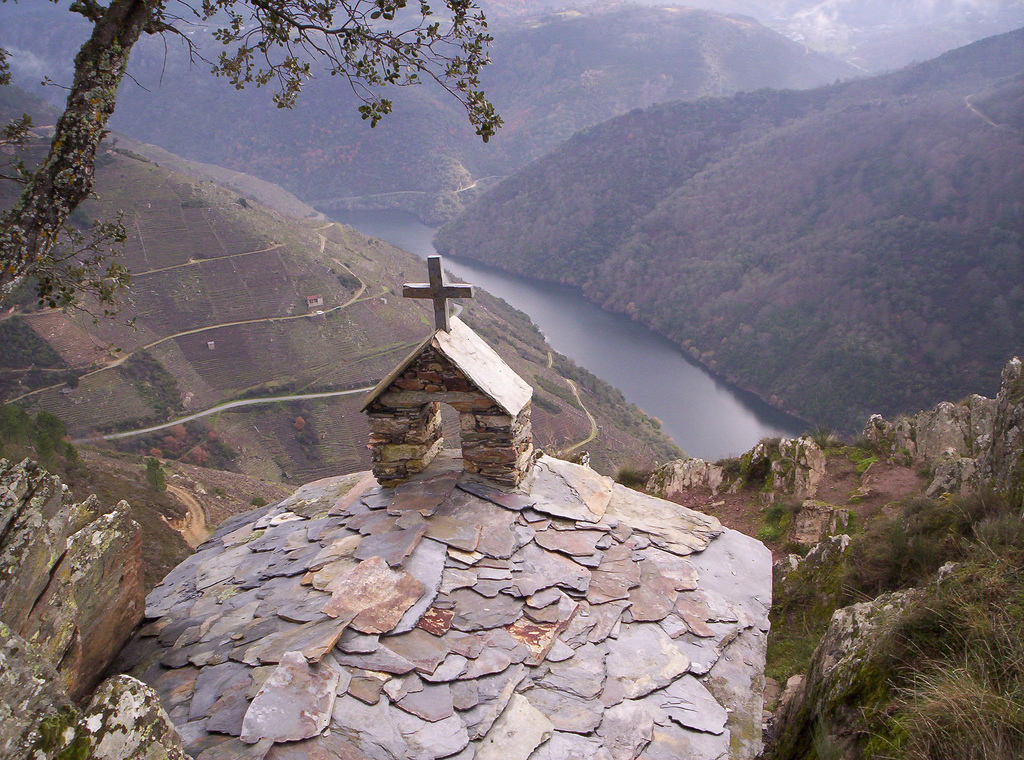
An 800-metre section with some stones and water brings you to Ferreiros (km 13.1). The name is explanatory: ferreiros means blacksmiths. In the Middle Ages this settlement had multiple forges where Jacobean craftsmen shod horses and repaired pilgrims’ footwear. It marks the boundary between the municipality of Sarria and Paradela, which runs along the eastern shore of the Miño for the next 9 km.
This territory is part of the Ribeira Sacra — the Sacred Shore — a designation that originated in the 7th century when communities of monks settled in the deep canyons of the Miño and the Sil, seeking the most isolated and ascetically demanding landscape they could find. What they built there, across the 12th and 13th centuries of the Romanesque boom, produced the highest concentration of Romanesque architecture in Europe. The canyons that the monks chose for their solitude — impossible to farm, difficult to reach, spectacularly defended by the rivers — turned out to be excellent for viticulture. The same slopes that gave the monks their isolation give the winemakers their headaches: gradients above 60%, harvested by hand because no machinery can operate there, producing wines under the D.O. Ribeira Sacra whose producers are known as “heroic winemakers.”
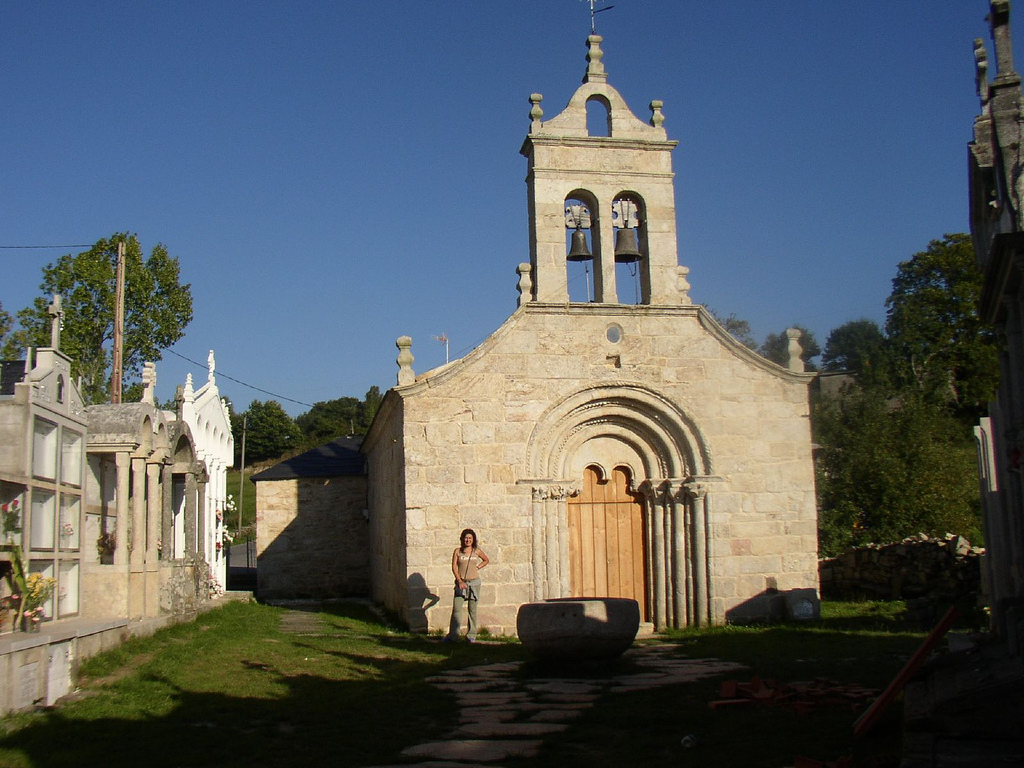
Just below Ferreiros stands the church of Santa María de Ferreiros. The fact that it is here, beside the Camino, rather than in its original location is the result of a decision taken in the Middle Ages: the entire building was dismantled stone by stone and rebuilt on the Camino margin so that it could function as a pilgrim hospital. The Gothic bell tower was added later. To reach the church you pass through the local cemetery — in Galician rural culture the union of church and cemetery is entirely normal. This arrangement is a legacy of medieval practice: the church was the most important social gathering place in any community, and after Mass people remained in the vicinity to honour the dead and maintain the social bonds of the parish. Over time taverns appeared and customs shifted, but the physical configuration of church-beside-burial-ground remained — the social and sacred layered on top of each other in the same space, which is very Galician.
Continue through A Pena, then along a corredoira to As Rozas (km 14.5) — impassable in heavy rain; bypass via the LU-4203 — and through Mercadoiro, A Parrocha and Vilachá (km 20) before the final descent to the Miño.
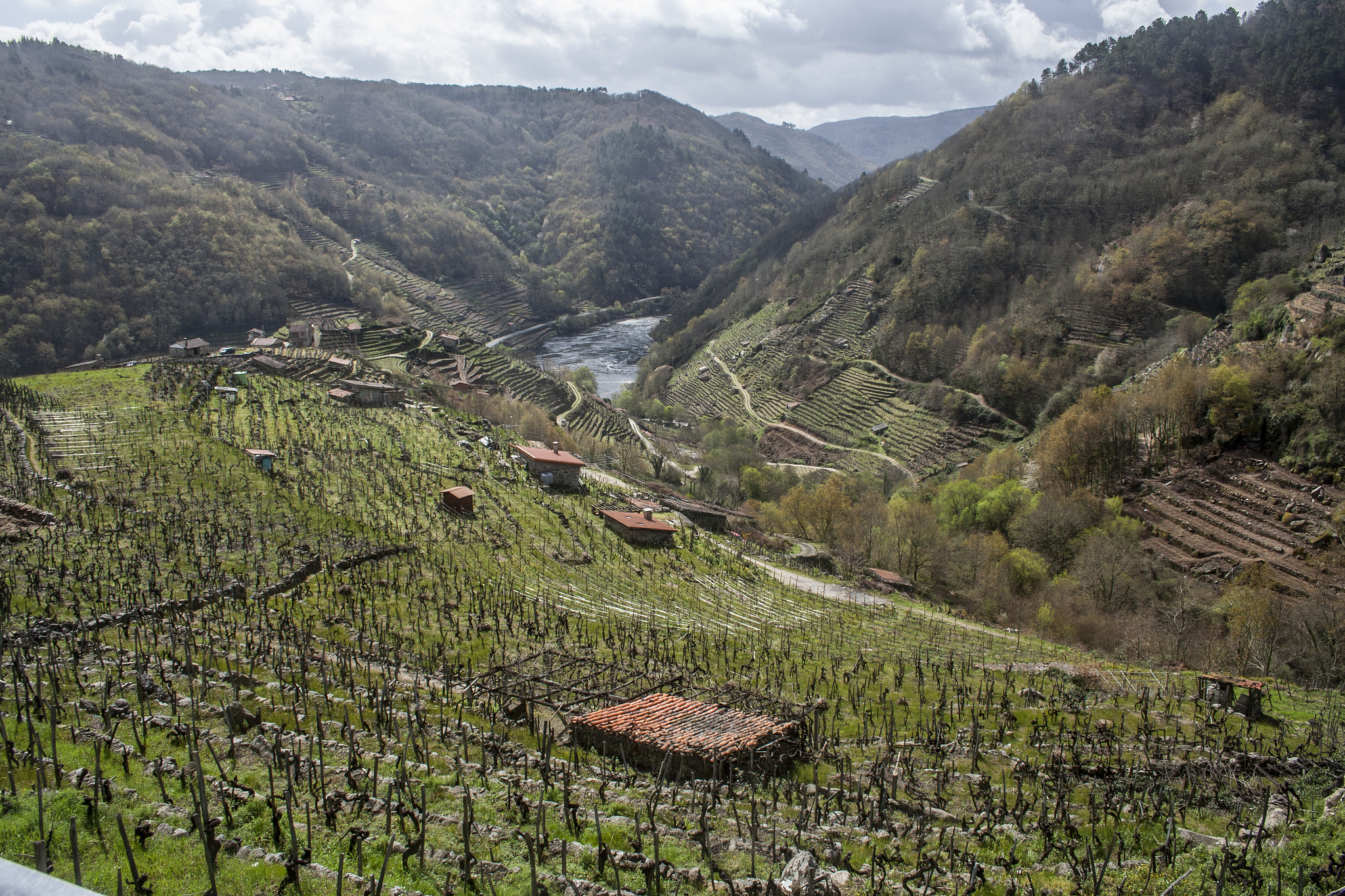
The descent into Portomarín offers the first view of the Miño as a wide reservoir rather than a river, and on the far bank the town climbing the hillside above the waterline. As you approach the bridge, you are crossing into one of the most unusual stories on the French Way.
Portomarín: the town that moved (km 22)
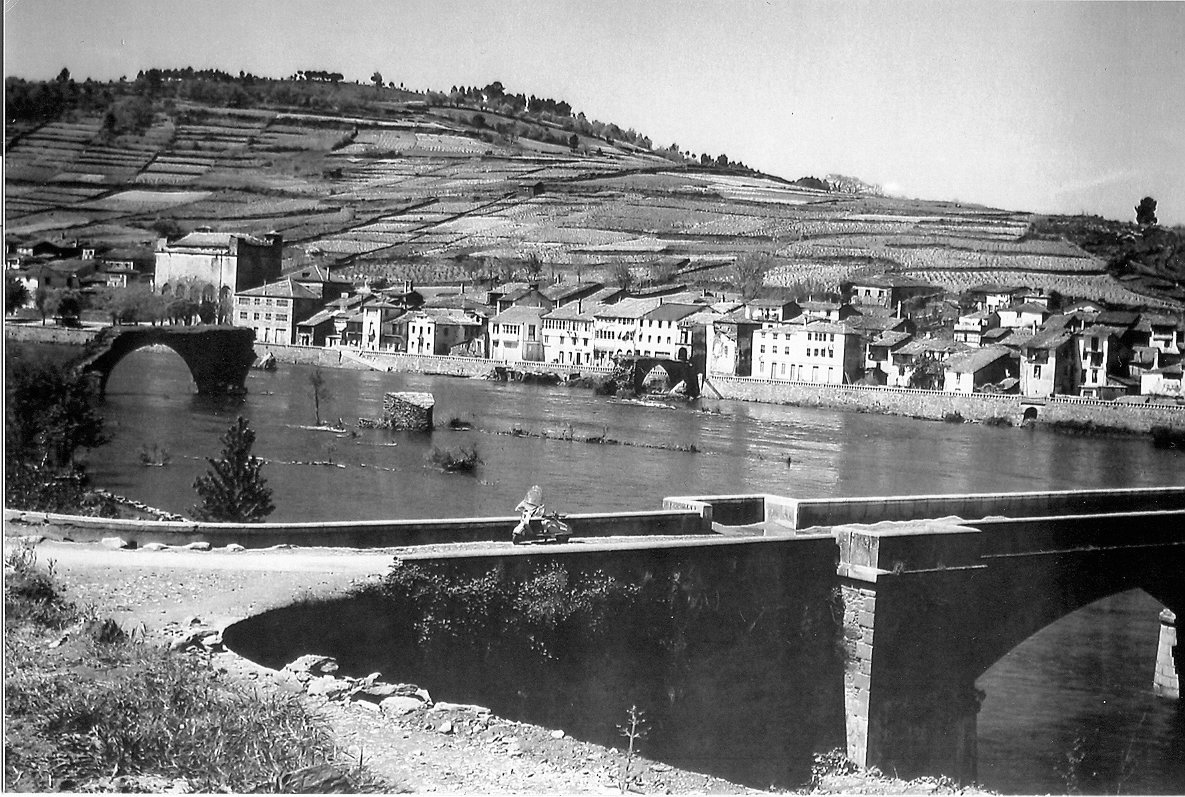
The Miño is the longest river in Galicia and the most abundant from its junction with the Sil to the Atlantic. The Romans built a bridge here in the 2nd century AD; Queen Urraca ordered a larger one in the 11th century for Jacobean traffic. That bridge survived 900 years until one day in 1963, when Franco ordered the construction of what remains the largest reservoir in Galicia: the Embalse de Belesar. A concrete wall 135 metres high and 350 metres long was built 32 km south of Portomarín, creating a reservoir that flooded everything on the river’s banks: pre-Roman castros, vineyards, mills, wineries, and the medieval town of Portomarín itself with its bridge, its streets, its ancient buildings.
The residents of the old Portomarín decided to move. Working with extraordinary patience, they dismantled their most important monuments stone by stone, marking each one with red ink and numbers so it could be rebuilt identically at higher elevation on the western bank. The new Portomarín was constructed on the hill above the flood line, and the marked stones were reassembled. The arch you pass through after crossing the modern bridge is a section of the old medieval bridge, transplanted here as the town’s entrance gate. When drought reduces the reservoir level significantly, the old Portomarín appears again below the water: stone structures protruding through the surface, the ghost of the original town reclaiming its space.
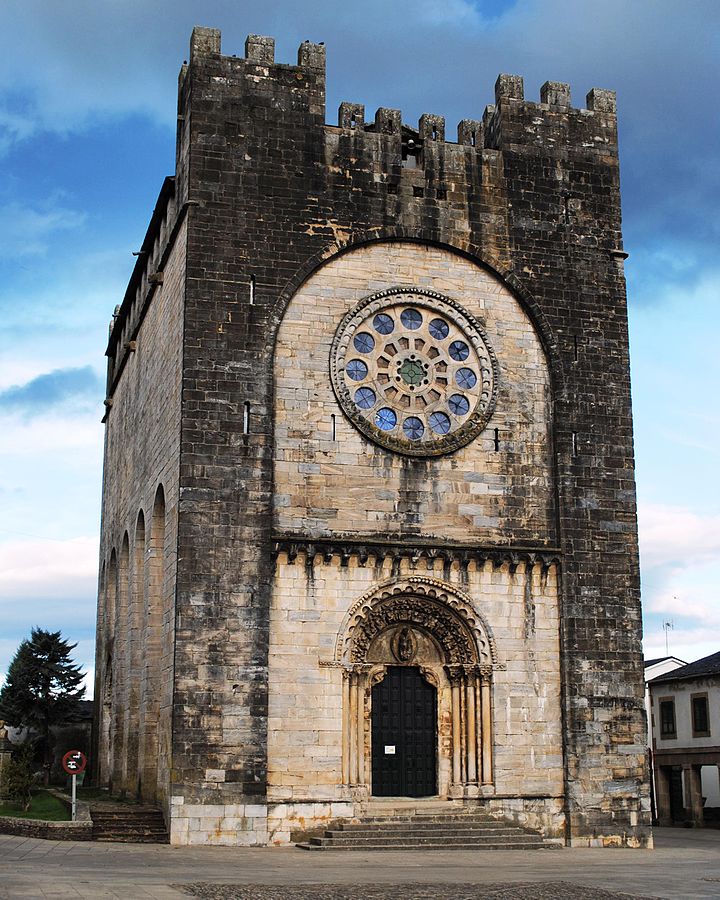
At the top of the new town is the church of San Nicolás, one of the most important Romanesque monuments in Galicia. It was built by the Order of St John of Jerusalem — the Hospitallers, the armed knights who protected pilgrims and defended the bridge. The building reflects this dual function: the thick walls with battlements at the top give it the profile of a military fortress, while the sculptural programme of the portal and the great rose window above it are of exceptional delicacy and refinement. The contrast — fortified exterior, precious interior carving — encodes the Order’s dual identity: soldier and servant.
If you look closely at the stones of the church, you can still see the red ink marks placed during the move in 1963, alongside the stonemason marks carved into the ashlars in the 12th century. Eight centuries of masonry practice on the same stones.
Portomarín to Castromaior: from a 20th-century dam to a 6th-century BC hillfort (km 22–34)
Leave Portomarín by the same Avenida Chantada you entered. The road diverges right but yellow arrows direct you across a river bridge onto a path that crosses the road again in 2 km — the surface here is very irregular with loose stones; in wet conditions it is better to stay on the LU-633. From this junction to Hospital da Cruz (km 34), the pedestrian path runs parallel to the LU-633 as a dirt track. After Toxibó (km 27) and Gonzar (km 30) — where the Baroque church of Santa María has on its main altar the tomb of a woman who according to local legend spent thirty years without eating anything — the arrows divert from the road toward Castromaior.
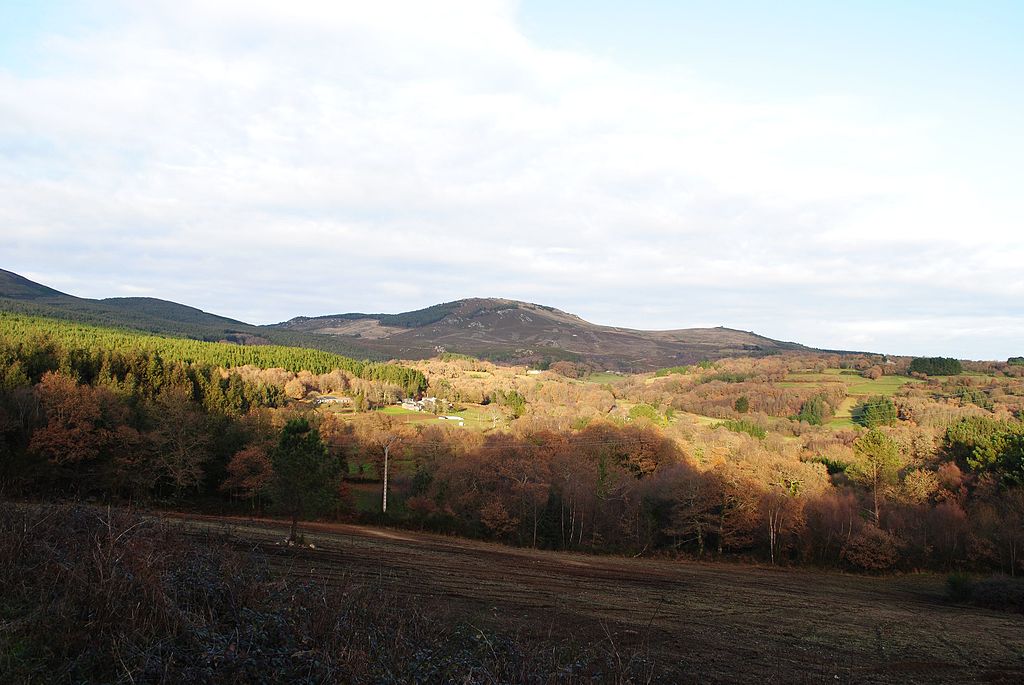
Follow the detour. On a paved track and dark earth you climb 600 metres to the summit of the hill of Castromaior. To the right: sweeping views across the Lugo valley. To the left: one of the most important archaeological sites on the French Way — a Celtic hillfort inhabited from the 6th century BC to the 1st century AD, with a complex urban configuration: a walled circular enclosure at the summit, surrounded by platforms bounded by walls and moats on lower terraces. Because nothing was ever built here after abandonment, everything lies preserved under the hill in a good state of conservation.
The standard narrative of Roman history in Iberia describes the conquest as violent and decisive, with the Celtic cultures quickly extinguished. The archaeological record tells a more nuanced story. Castromaior was inhabited for more than two centuries after the Roman conquest — and there were other Galician castros populated into the 3rd and 4th centuries AD. The evidence points to cultural synergy rather than violent erasure: the Romans absorbed existing practices and settlement patterns, and Celtic culture persisted in modified forms for generations after the conquest. The mythical battle of Monte Medulio — in which the last Galician warriors supposedly committed collective suicide rather than surrender — is almost certainly a literary invention. The reality was more gradual, more complex, and in many ways more interesting.
The descent from the hill returns you to the LU-633 and in 1.5 km you reach Hospital da Cruz, named for the pilgrim hospital that once stood at this road junction. Cross the N-540 by an overpass.
The cruceiros, Palas de Rei and the irmandiño revolt (km 34–47)
From Hospital da Cruz to the N-547 junction, 11 km of quiet paved road with minimal traffic — the most comfortable cycling of the day. The profile continues climbing gently to Ventas de Narón (km 35.3) then descends. Shortly after A Prebisa (km 37.3), a walled enclosure on the left of the road with steps leading up to it presents the Cruceiro de Lameiro.
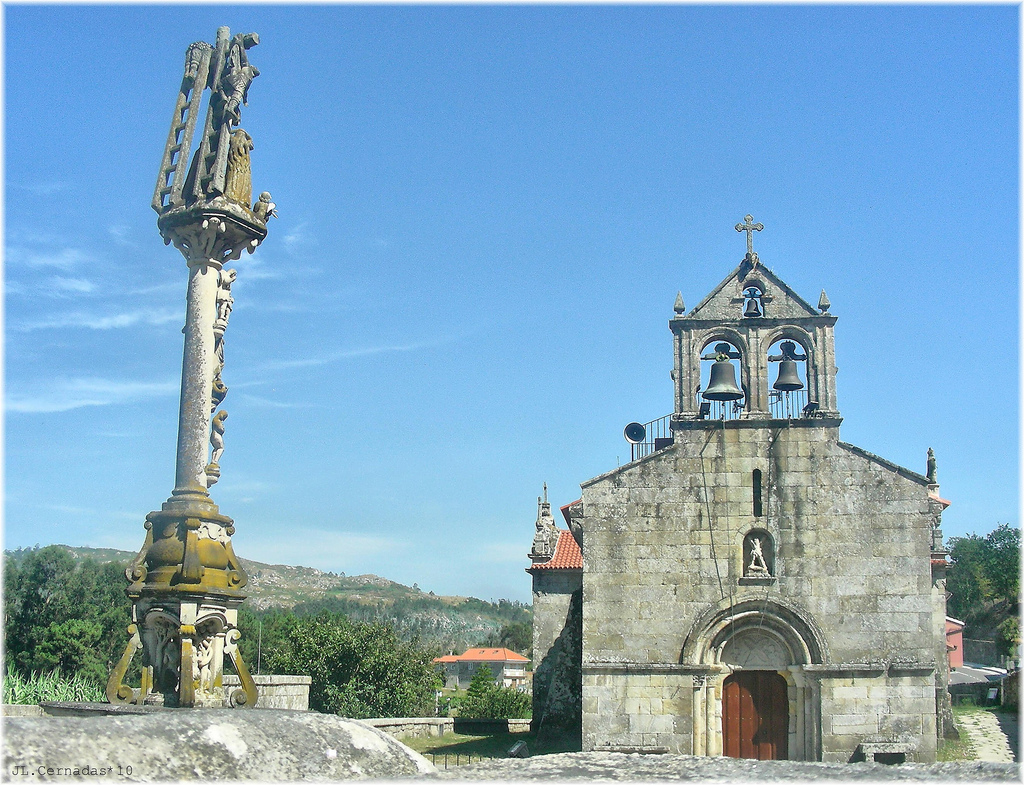
By now you have been passing cruceiros — roadside stone crosses — at regular intervals since you entered Galicia. Galicia has over 12,000 of them, more than any other territory in Europe. The cruceiro is, alongside the hórreo, the most characteristic expression of Galician popular culture. But its origin has nothing to do with Christianity.
In the pre-Roman Celtic culture of Galicia — the same culture that built the castro at Castromaior — roads and their intersections were sacred. The dead were believed to wander the roads, and at crossroads a series of gods could “purchase” the wandering soul. Relatives of the deceased performed rituals at these points, leaving offerings — often stones, which accumulated into cairns called milladoiros, like the one at the Cruz de Ferro on Stage 10. When the Romans arrived, religious syncretism fused Celtic and Roman road gods: rituals at crossroads continued but the prayer was now addressed to Mercury and the Lares Viales — the divine guardians of roads. Of the 36 Roman miliarios with Lares Viales inscriptions found anywhere in the Roman Empire, 28 were found in the territory of Gallaecia — 77% of the total. The practice was particularly intense here.
When Christianity became the official religion, these traditions did not disappear overnight — popular tradition never changes by decree. People continued going to crossroads to perform their old rituals, which scandalised the Church. The Church’s solution was pragmatic: rather than prohibit and punish, it Christianised the sacred points. Crosses were placed on the same spots where offerings had been left for centuries, and the rituals continued but were gradually redirected toward Christian prayer. The cruceiro is the physical result: a Celtic-Roman sacred spot marked with a Christian cross, sometimes on the exact site of a Roman miliario, in a tradition that has never broken.
The Cruceiro de Lameiro, dated 1670, is the most famous on the French Way. Jesus crucified on the top; on the reverse, the Virgin or a representation of maternity (largely worn away). At the base, carved instruments of the Passion: pincers, nails, a ladder, the crown of thorns, and a skull with bones representing the eternal triumph over death. Beside the cruceiro is an old pilgrim cemetery.
Through Ligonde, Airexe, Portos and into the municipality of Palas de Rei, the paved road leads through Lestedo, Os Valos and A Brea (km 44) where the N-547 is crossed. Uncomfortable track into Palas de Rei (km 47).
Palas de Rei was the last stopping point recorded by Aymeric Picaud in the Codex Calixtinus before Santiago. Its name is traditionally attributed to the Visigoth era: palace of the king, referring to a residence of the Visigoth king Witiza, who ruled at the beginning of the 8th century. With the Jacobean pilgrimage, the town grew in importance and became a significant centre for the Galician nobility during the medieval and early modern periods, with fortresses and pazos (manor houses) built throughout the surrounding area.
The most historically notable structure nearby is the Castillo de Pambre, 8.5 km from Palas on a favourable route. The castle is distinguished by a single fact: it is the only Galician castle that survived the Irmandiño Revolt of 1467. The Irmandiño uprising was a peasant revolution — one of the largest in medieval European history — in which the Galician rural population rose against the nobility, demolished their castles and temporarily dismantled the feudal structure. The name comes from irmán, the Galician word for brother: the brotherhood of the common people against the lords. Most of Galicia’s medieval castles were destroyed in 1467; Pambre’s thick walls and strong tower survived. It was built in the 14th century, has a three-storey keep surrounded by a thick wall with towers at the corners, and has been substantially restored in recent years.
Also near Palas: the church of Vilar de Donas, a Romanesque building believed to have been founded as a women’s monastery (donas = ladies) and later associated with the Military Order of Santiago. Some of the Order’s most important knights are buried here, their 14th-century tombs and their likenesses still visible.
Palas to Melide: Leboreiro, Furelos and the provincial border (km 47–60)
Leave Palas on an uncomfortable stony track that crosses the N-547 before alternating forest paths and road shoulder to San Xulián do Camiño (km 50) — Romanesque church, single nave, large semicircular apse — and then through Pontecampaña (km 51) and Casanova (km 52) to O Coto (km 55.5), the provincial boundary between Lugo and A Coruña. You are in the final province.
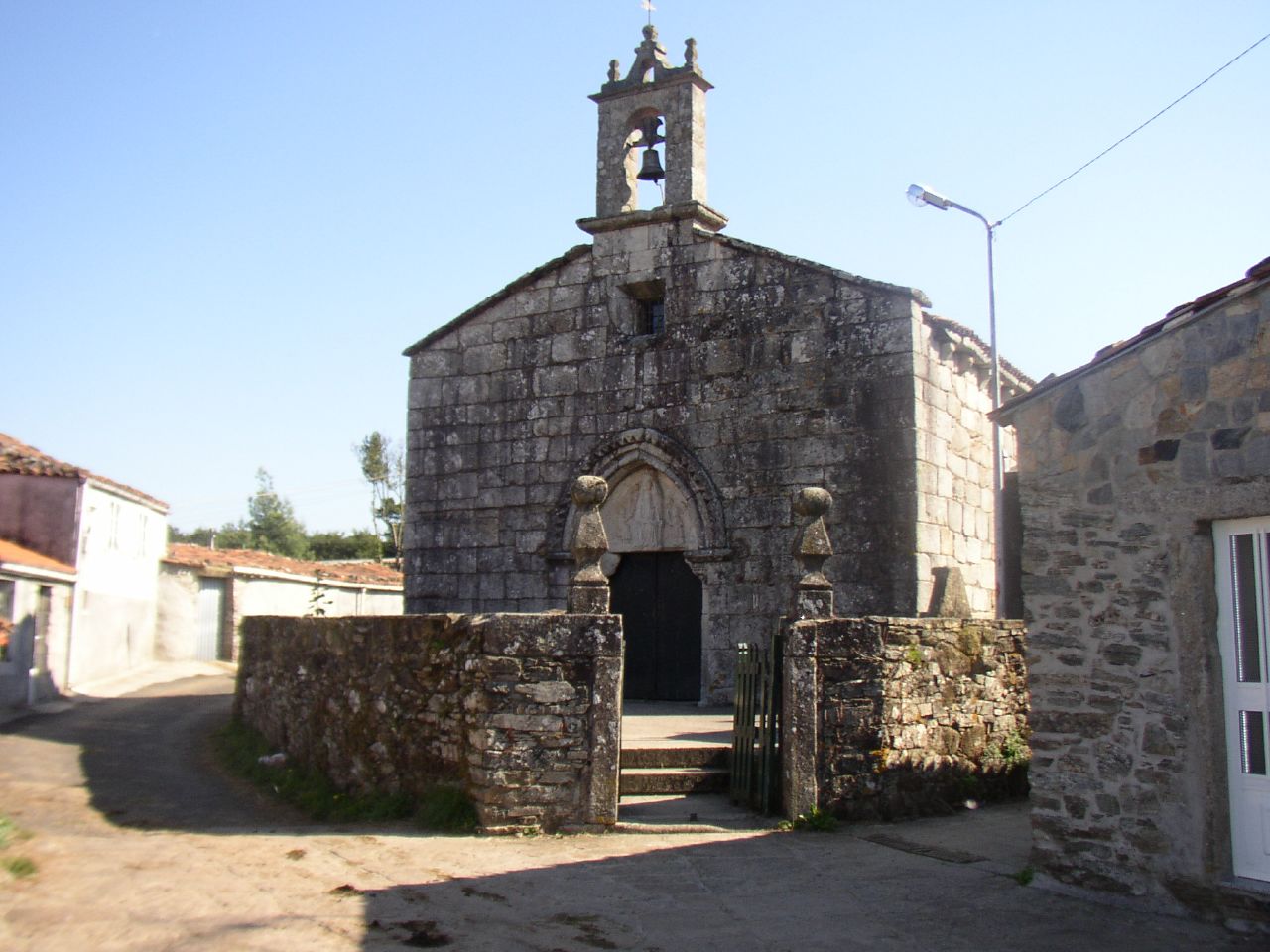
Leboreiro (km 55) is mentioned in the Codex Calixtinus as Campus Leporarius — the Hill of Hares. In the 12th century it had a pilgrim hospital. The church of Santa María de Leboreiro stands in the Romanesque-Gothic transitional style; above the main door a relief carving of the Virgin holding the Child is connected to a legend of the village. A miracle sculpture of the Virgin was found in a nearby fountain and placed in the church, but every night it returned to the fountain where it had been discovered — until a local sculptor carved this image in the tympanum of the door, after which the original sculpture remained in place permanently. If the church is open, the painted medieval murals on the north wall are worth seeing.
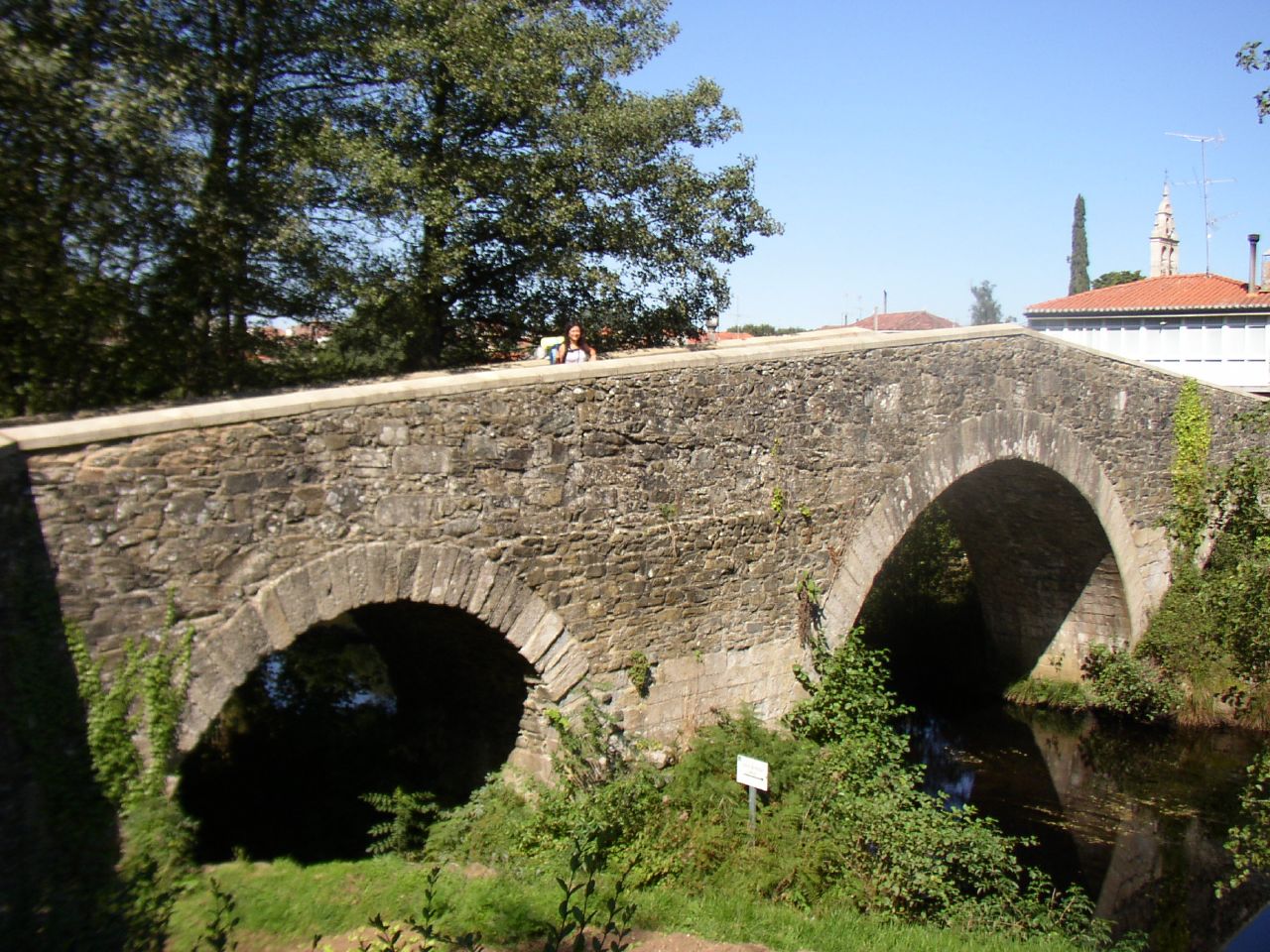
After Leboreiro and a brief passage through an industrial estate on Melide’s outskirts, the path and road separate to visit Furelos (km 58.5) on the banks of the homonymous river. The village is entered across its medieval bridge with four large arches — the largest and best-preserved medieval bridge on the French Way in Galicia. After the bridge, the main cobbled street passes the medieval church of San Juan before the final track to Melide.
Melide: capital of the pulpo (km 60)
Melide is the crossroads where the French Way and the Camino Primitivo — the oldest Jacobean route, running from Oviedo — meet. The town is famous for one thing above all others: pulpo á feira — octopus in the Galician fairground style, boiled, cut with scissors, served on a wooden board with olive oil, coarse salt and hot paprika. Melide is the undisputed capital of this dish on the Camino, with octopus restaurants (pulperías) that have been operating for generations. After 60 km of legbreaking Galician paths, it is exactly the right meal.
Practical notes for Stage 13
Surface and navigation
Stage 13 is the most technically varied of the Galician stages. It combines corredoiras, narrow stone paths, dirt tracks alongside streams, paved pilgrim paths, and sections of road shoulder. In dry conditions an MTB or gravel bike handles everything on the Jacobean route; a road bike should use the LU-633 throughout. In rain, three specific sections become genuinely problematic and should be bypassed:
Section 1: Peruscallo (km 9.2) to A Brea (km 11.4) — narrow stone and soil path alongside a stream. Bypass: turn south before Peruscallo on a dirt/asphalt route, rejoin at A Brea.
Section 2: As Rozas (km 14.5) to Moimentos (km 16) — a corredoira that becomes a quagmire in rain. Bypass: paved path then LU-4203 to Moimentos.
Section 3: Portomarín exit (km 22) — the 2 km path across the river has loose stones and irregular surface. Bypass: stay on the LU-633 from Portomarín.
Water and supplies
With over 60 named settlements on this stage, services are theoretically frequent — but many rural hamlets have nothing. Reliable service points: Sarria (start), Vilei (km 3.7), Morgade (km 12), Portomarín (km 22, full services), Hospital da Cruz (km 34), Palas de Rei (km 47, full services), Melide (end). Fill water bottles at Portomarín and again at Palas de Rei for the final stretch.
Starting in Sarria
Sarria has good connections via Lugo. Alsa and Monbús run regular services to Lugo (every 1-2 hours); from Lugo there are 6-8 trains daily to Sarria, plus direct connections from Barcelona and Madrid. Tournride delivers bikes to your accommodation in Sarria the evening before departure.
Frequently asked questions about Stage 13
How far is Stage 13 from Sarria to Melide by bike?
60 km between 360 m (Portomarín, minimum) and 730 m (maximum). The profile is legbreaking — continuous changes of slope throughout — with the main climbs from Sarria (steep initial ramp), from Portomarín (13 km of climbing to Ventas de Narón), and several further undulations. Allow 6 hours riding time plus stops.
What happened to old Portomarín?
In 1963 the Belesar dam was built 32 km south of the town, flooding the entire original settlement. The residents dismantled their monuments stone by stone, marked each piece with red ink and numbers, and rebuilt the town at higher elevation on the western bank. The church of San Nicolás (12th century, Order of St John) was fully reassembled; the marks are still visible. In drought years, the submerged old town appears above the waterline.
Where is the real 100 km marker?
The real official 100 km marker is on the paved track between A Brea and Morgade, approximately km 13 of Stage 13. The milestone in A Brea itself is a commercial marker placed by a local business; it is not the official Jacobean milestone. The official distance for the Compostela is measured from specific points and the correct marker is a few kilometres further along.
What is the Irmandiño Revolt?
A peasant uprising in 1467 in which the Galician rural population rose against the nobility and demolished most of the region’s castles. The name comes from irmán (brother in Galician). The Castillo de Pambre near Palas de Rei is the only Galician castle known to have survived intact. The revolt was one of the largest peasant uprisings in medieval European history.
Can I rent a bike in Sarria and return it in Santiago?
Yes. Tournride delivers your bike to any accommodation in Sarria the evening before your departure and collects it in Santiago de Compostela when you finish. Luggage transfer in a single leg, from the start to the end of the trip, is also available. See all bike models and check availability here.
Cycle the Camino de Santiago at your own pace.
Plan this stage by bike