
STAGE 7: FROM BURGOS TO CARRIÓN DE LOS CONDES
Erea FabeiroStage 7 is where the Camino teaches you something about yourself. Eighty-five kilometres across the Castilian Meseta — the great plateau that stretches from Burgos to León — on tracks between fields of golden cereal, with a sky that seems larger than anywhere else you have been. There are those who dismiss the Meseta as monotony. They are wrong. This is the landscape that Antonio Machado and Miguel de Unamuno wrote about: a world of stillness and deep time, where the flatness is not emptiness but a kind of amplification. The hills that rise like statues on the horizon, the stoic oaks in the fields, the silence broken only by wind — these are the images that seal themselves in the memory and return later as a source of peace. The Meseta is hard, particularly in summer, but it is also the essential of the pilgrimage. Do not cross it on autopilot.
Planning the full route? Our cycling the Camino de Santiago page maps every stage, with distances and planning tips.
| Distance | Elevation gain | Estimated time | Difficulty | Distance to Santiago |
|---|---|---|---|---|
| 85 km | +400 m cumulative | 6–6.5 hours riding | 🟡 Medium | ~487 km |
Key stops: Hornillos del Camino (km 21) · Hontanas (km 32) · Castrojeriz (km 41) · Frómista (km 65) · Villalcázar de Sirga (km 78) · Carrión de los Condes (km 85)
Optional detour: Aguilar de Campoo (+40 km from Carrión — Romanesque capital of Palencia, best as a rest day)
Route profile and key milestones
Leaving Burgos: the Arco de San Martín and the Meseta begins (km 0–21)
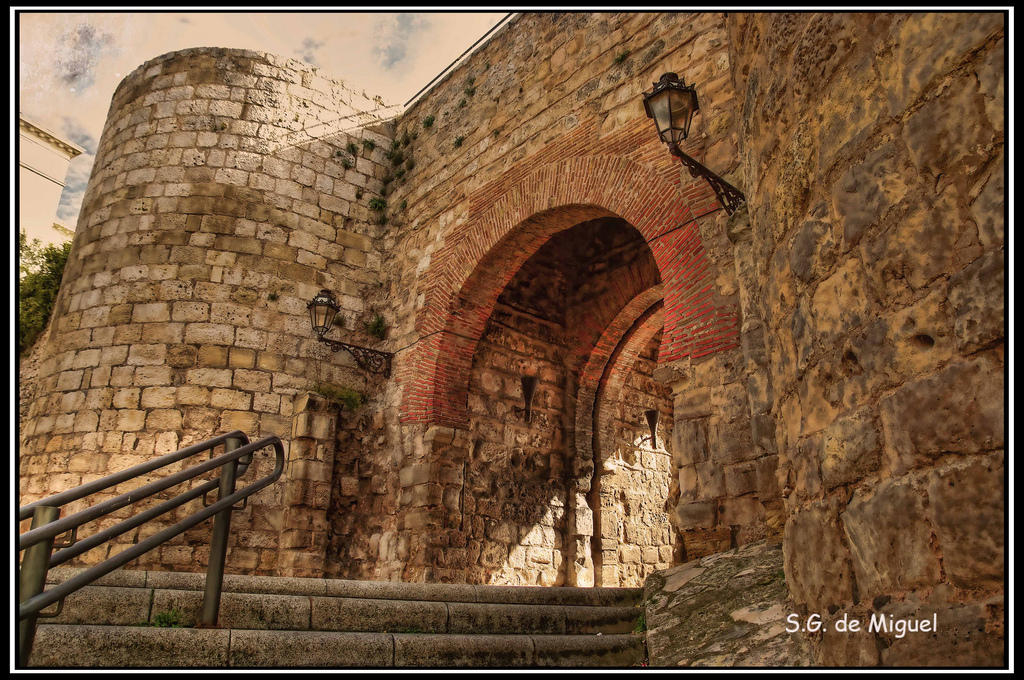
Leaving the municipal hostel, follow Fernán González Street with the cathedral on your left until you reach the Arco de San Martín. This arch is worth a moment’s attention: it is horseshoe-shaped and built in brick — not stone, as you might expect from a medieval city gate. The explanation is that it was built in the 14th century by Mudéjar architects — Christians who lived under Muslim territorial control and whose architectural training was deeply influenced by Islamic traditions. The horseshoe arch and the use of brick are signatures of that Mozarabic-Mudéjar tradition, and finding them in the exit gate of a medieval Castilian city is a reminder that the boundaries between cultures on the Iberian Peninsula were never as absolute as the narratives of Reconquest suggest.
The arrows at the arch direct you down steps to the left — on a bike it is much more practical to go straight and turn 60 metres later, avoiding the stairs. Take Calle Emperador, turn left onto Villalón Street, and cross the Arlanzón on the Puente de los Malatos — the Bridge of the Sick — so called because a hospital for lepers once stood nearby. Follow the bike path alongside the N-120 for 1.5 km through the Parral Park and university campus until the road turns left. Here you have two options: follow the traditional Camino (trail through Villalbilla de Burgos, crossing railway tracks and the A-231 before rejoining the N-120 at Tardajos) or stay on the N-120 directly to Tardajos — the same 7.5 km, without the navigational complexity. In Tardajos the N-120 disappears and from here you follow the original Camino all the way to Carrión.
Tardajos and Rabé de las Calzadas: Roman roads and a medieval saying (km 8–10)
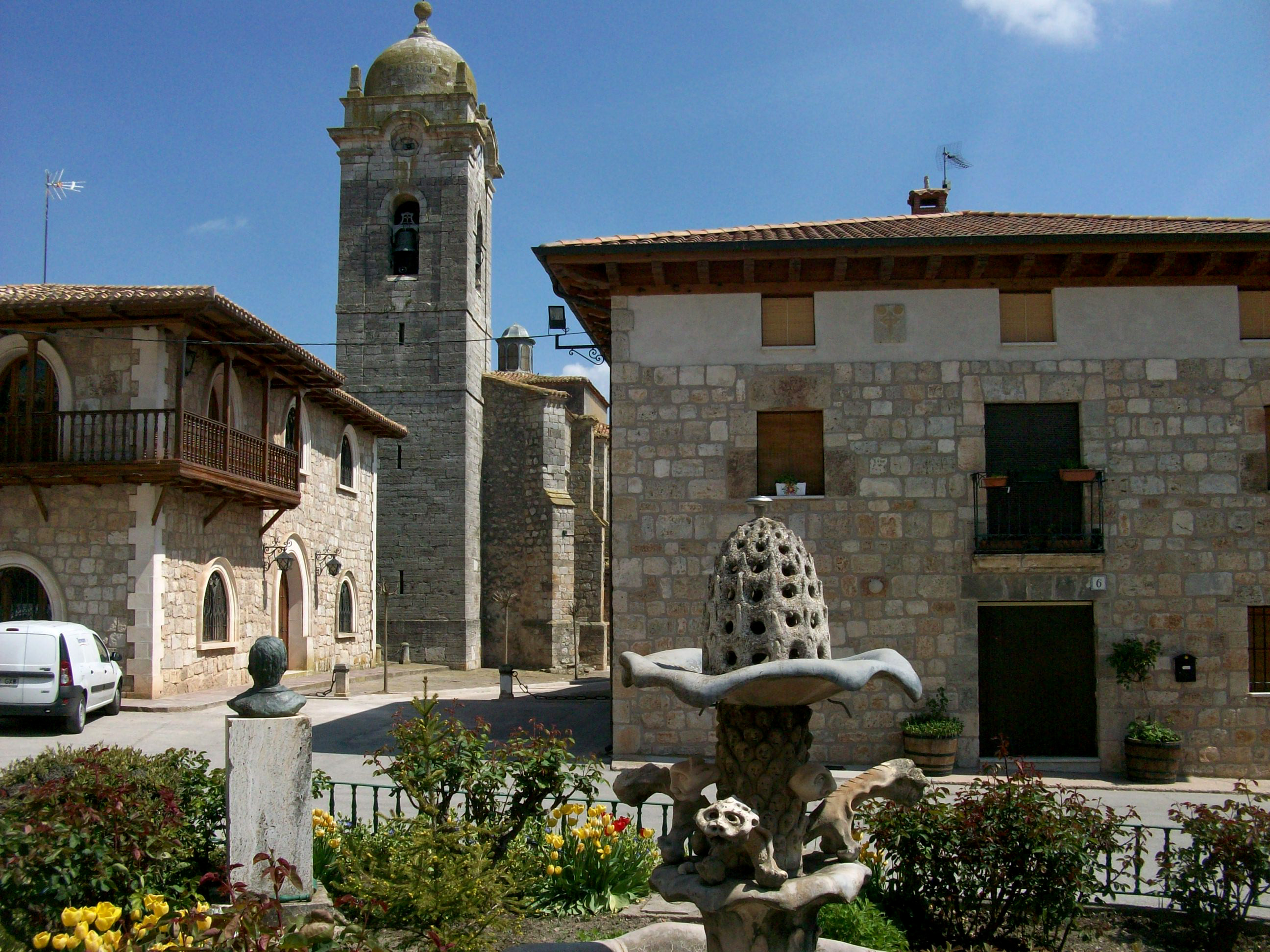
Tardajos and Rabé de las Calzadas are 1.5 km apart on a paved track. Both villages have Roman origins and stood at a strategic junction of ancient roads, including the Quinta Via — the Fifth Road — that connected Clunia (south of Burgos) with Sahagún. The name Rabé de las Calzadas (of the Causeways) comes from this heritage. Between the two villages the river Urbel ran, flooding regularly in the Middle Ages and making the road famously unreliable. The frustration generated a saying that local people still know: “From Rabé to Tardajos, you will not lack woes; from Tardajos to Rabé, God deliver me.” Today the road between them is entirely without drama.
Rabé was the more significant settlement in the Middle Ages, though Tardajos also had a pilgrim hospital. Of the castle and three churches that Rabé once had, almost nothing survives. The most notable building today is the Palacio de Villariezo at the village entrance, a 17th-century manor house.
To Hornillos del Camino: the Meseta opens (km 10–21)
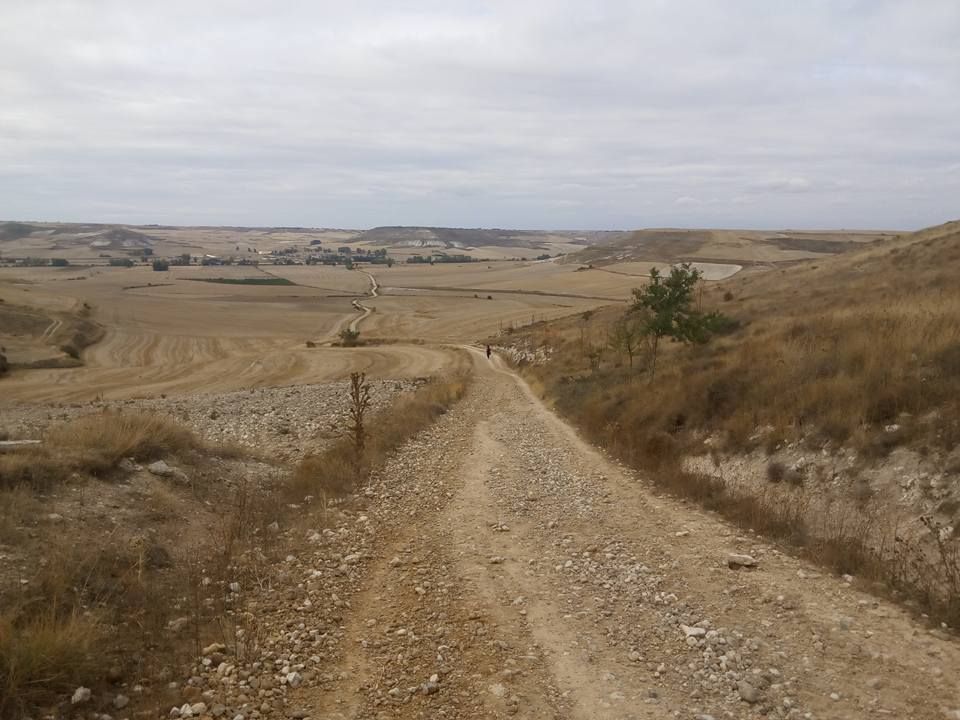
From Rabé, 8 km of dirt track between open fields lead to Hornillos del Camino. The first 4 km climb gently to a high point from which the village below becomes visible — then the track drops in a long descent. Pilgrims on foot call this section Matamulos — mule-killer — because the loaded animals struggled so badly on the slope. On a bike the descent is straightforward; the difficulty for the past thousand years was going up it on the other side with a pack animal.
Hornillos del Camino (km 21) is a textbook example of Jacobean urban planning: the main street runs exactly east to west, coinciding with the Way itself, with the church rising above everything else as the tallest building in the village — the standard medieval hierarchy of space. The town had a pilgrim hospital founded in the 12th century by the king, who subsequently donated the entire settlement to a French Benedictine monastery. That French monastic connection is a reminder of how international the Camino’s institutional infrastructure was: the great French orders — Cluny, Cîteaux — were embedded in the management of pilgrimage towns across the whole route.
Hornillos to Hontanas: the invisible village (km 21–32)
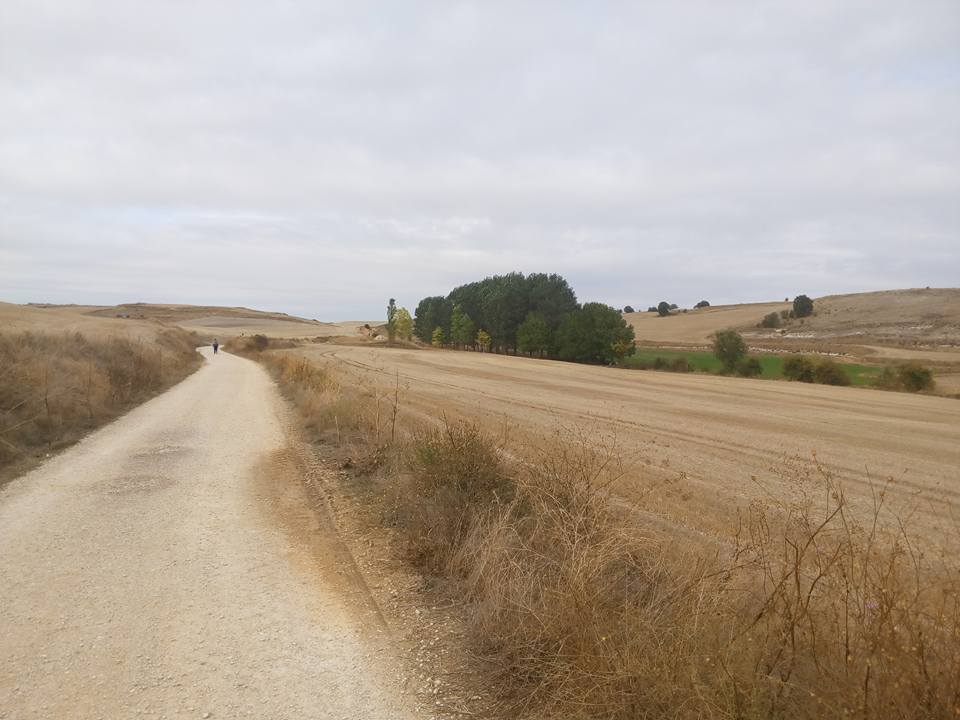
Leaving Hornillos, 11 km of open Meseta track with no services connect to Hontanas. The maximum altitude of the stage (930 m) is reached about halfway through this section. The only place of refuge in between is the hostel of San Bol, 6 km from Hornillos, reached via a signposted detour to the left — important for pilgrims on foot who have come all the way from Burgos, but less critical for cyclists with the pace to move through.
Hontanas is invisible until you are almost upon it — the village sits in a slight depression, hidden by the flatness of the Meseta, and appears suddenly as a 200-metre descent drops you into the village centre. The name comes from the old word fontanas (springs), and those springs were the reason the village existed: in the Middle Ages, after the waterless crossing from Hornillos, the springs of Hontanas were a literal oasis. Before the descent, on the right, a small picnic area sits next to a hermitage housing an image of Santa Brígida — a Swedish mystic from a noble family, born in the early 14th century, who had religious visions from childhood and eventually made pilgrimages to Santiago among other destinations. Her presence here is a reminder of how far medieval pilgrims came, and from how many different directions.
The village church in the centre — dedicated to the Immaculate Conception — is Gothic in origin (14th century) but was heavily restored in the 18th century; its tower shows the Neoclassical style clearly, with semicircular arches and pediment decorations.
The ruins of San Antón: bread, wine and the fire of Saint Anthony (km 37)
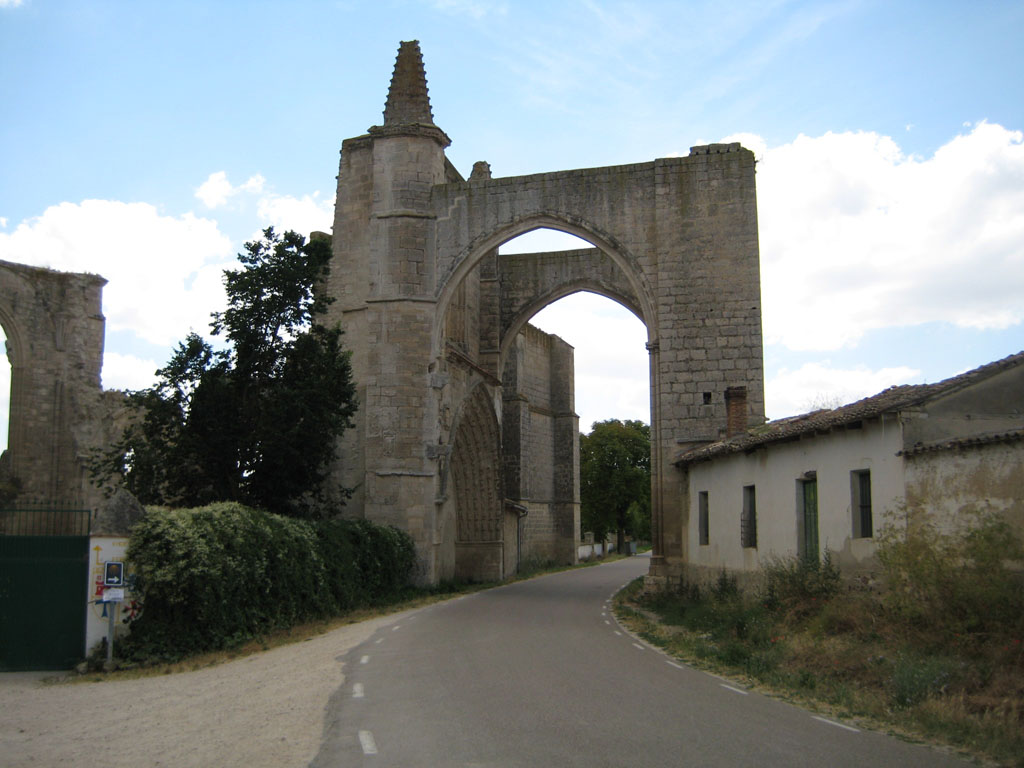
Leaving Hontanas, the arrows at the village exit direct you across the road onto a path that traverses a hillside — this section is narrow with no safety barrier against the drop, and for cyclists the more practical option is to continue along the road directly to Castrojeriz. Either way, 6.5 km from Hontanas brings you to one of the most atmospheric stops on the entire French Way: the ruins of the monastery of San Antón.
The road passes directly under an imposing Gothic portico — two large ogival arches framing the old north portal of the church. The portal has six archivolts covered in sculpture in a remarkable state of preservation. On either side, set into the wall, are two small niches. These were not decoration: they were cupboards where the monks left bread and wine for pilgrims passing through, day and night, without any obligation to enter or identify themselves. The monastery was founded in the 12th century; what survives today is Gothic (14th century). It operated until the 18th century when Carlos III transferred its management to the secular sphere, and from the 19th-century disentailment it was abandoned. The quality of its ashlar masonry meant it never collapsed entirely. In 2002 a rehabilitation project opened it again as a pilgrim hostel — the founding principles of gratuity and austerity, unchanged after a thousand years.
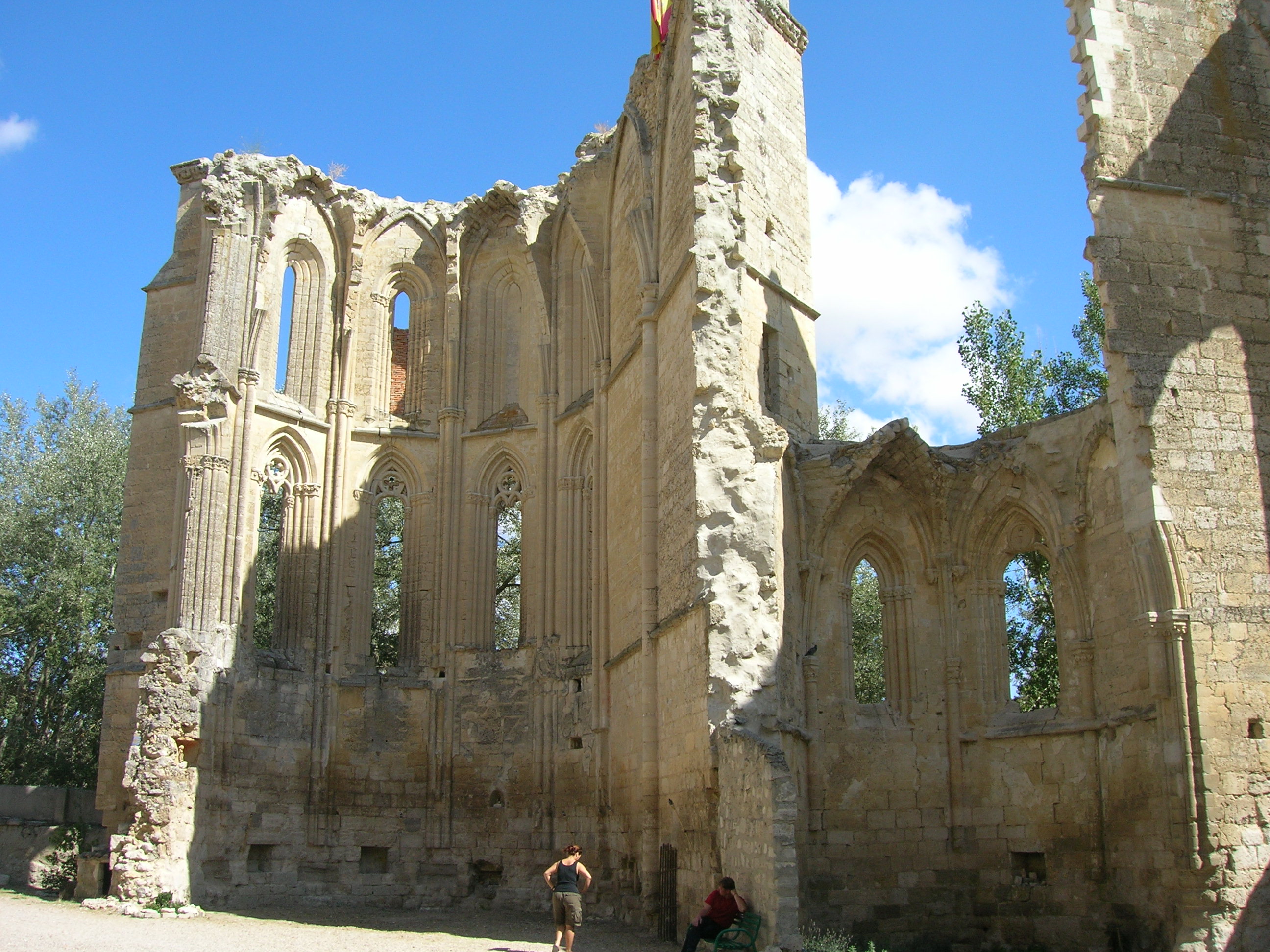
If you skirt the building on the south side you can enter the roofless church and see the structure of the original three-nave plan and the surviving apse wall with its large buttresses.
What made this monastery famous throughout medieval Europe was its specialisation in treating a disease called Ignis Sacer — Sacred Fire — also known as St Anthony’s Fire. The illness caused an excruciating burning sensation in the extremities, followed by gangrene and the loss of limbs. It was widespread in the Middle Ages because it was caused by a fungus (Claviceps purpurea) that parasitised rye — one of the staple foods of the poor. The Antonine monks, uniquely, discovered the cause and the cure: they isolated patients on a wheat-based diet and treated them with specific plants. They kept this knowledge secret, which meant that only they could cure the disease. Ignis Sacer became known as “St Anthony’s Fire”, and pilgrims suffering from it made the journey specifically to pass through this monastery and be healed. It was, in effect, the most specialised medical centre in the Camino corridor — operating centuries before anyone in mainstream medicine understood what ergotism was.
Castrojeriz: a Trojan horse, a revolutionary charter and three churches (km 41)
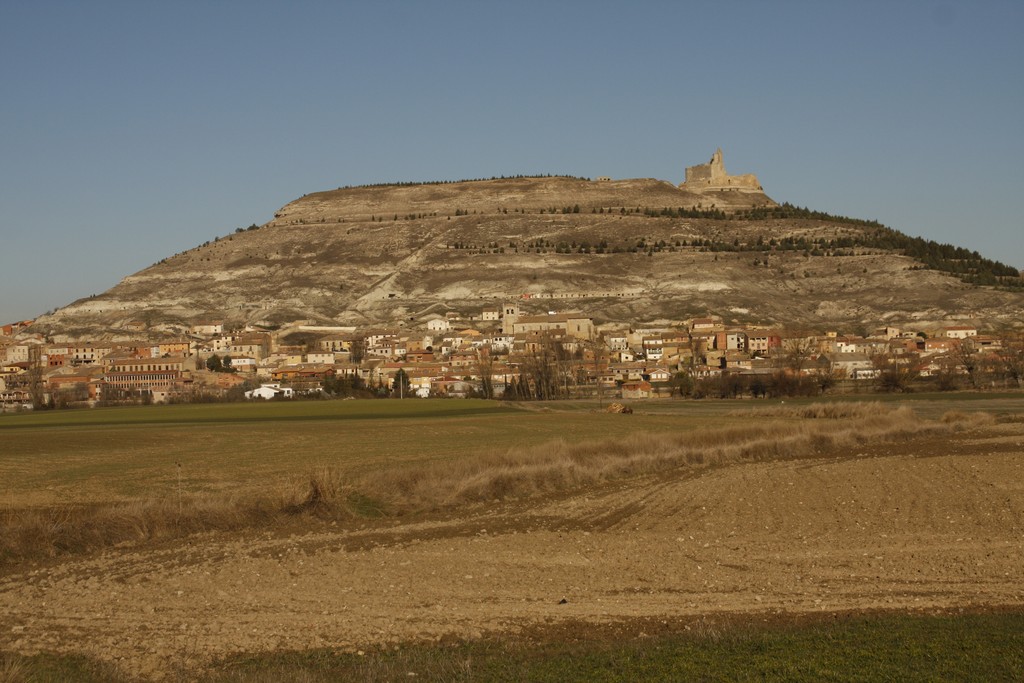
Castrojeriz appears ahead as a long low town at the foot of a hill crowned by a ruined castle — the natural stopping point at km 41, almost exactly the midpoint of the stage, with all services available. It is the second largest Burgos town on the French Way and the last one you will pass through in this province.
The site has been occupied since 1500 BC, with documented Roman and Visigothic presence. The Visigoths built the first castle on the hill. After two Arab attacks in the 8th and 9th centuries destroyed the Christian fortifications, the town was re-conquered and rebuilt as a strategic control point over the territory south to the Duero. Repopulating it was urgent.
To attract settlers, the town was given one of the most remarkable legal charters in Castile: the Fuero of Castrojeriz. Its key provision was that any peasant who acquired a horse and went to war on horseback became, legally, a kind of minor nobleman — a caballero villano, or infanzón — with access to fiscal privileges and legal protections normally reserved for the hereditary aristocracy. In a society as rigidly hierarchical as medieval Castile, this was a radical concession. It speaks to the level of desperation behind the repopulation effort: the frontier with the Arabs was genuinely dangerous, and the offer of social mobility was the price of persuading ordinary people to live there. A monument in the town centre commemorates the charter’s grant.
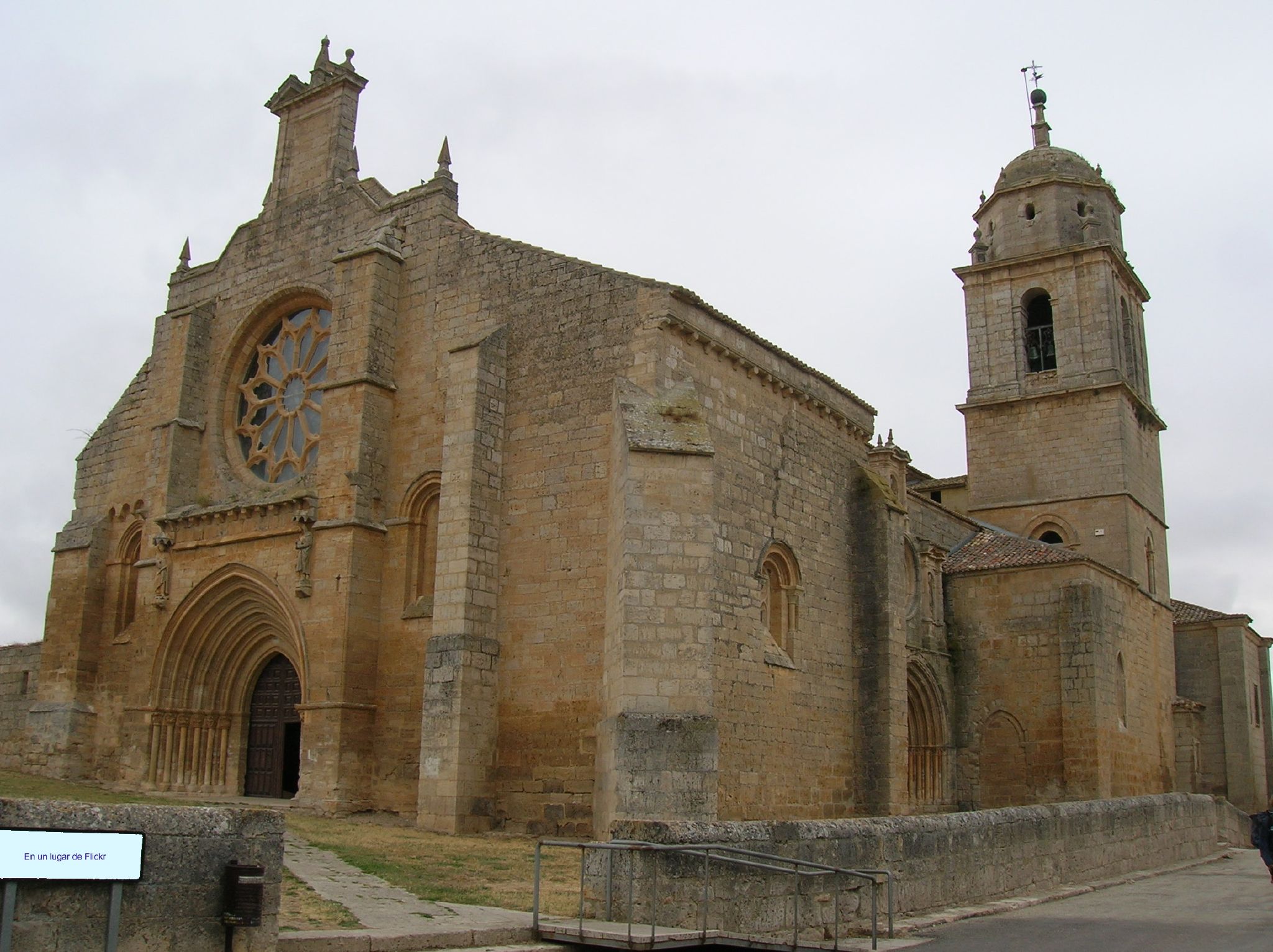
The first building you encounter entering the town from the east is the collegiate church of Santa María del Manzano — a large church begun in the 13th century in Romanesque style, with Gothic roof vaulting added in the 15th century and further expansion in the 17th. Inside, the principal object of interest is a Gothic carving of the Virgin said to have been found inside the trunk of a large apple tree (manzano) that stood at the edge of the town. A hermitage was built around the discovery, then enlarged into the church you see today. The sculpture became famous for performing miracles and was so well known that Alfonso X “the Wise”, the 13th-century king and poet, included several of these miracles in his Cantigas de Santa María — the great Galician-Portuguese verse collection dedicated to miraculous apparitions of the Virgin.
The streets of Castrojeriz are arranged in parallel terraces on the hillside, connected by perpendicular staircases. Cyclists follow the main pedestrian thoroughfare through town, which passes the church of Santo Domingo (Gothic body, deceptively concealed behind a Plateresque tower from the 16th century), the long colonnaded Plaza Mayor, and at the far end the church of San Juan.
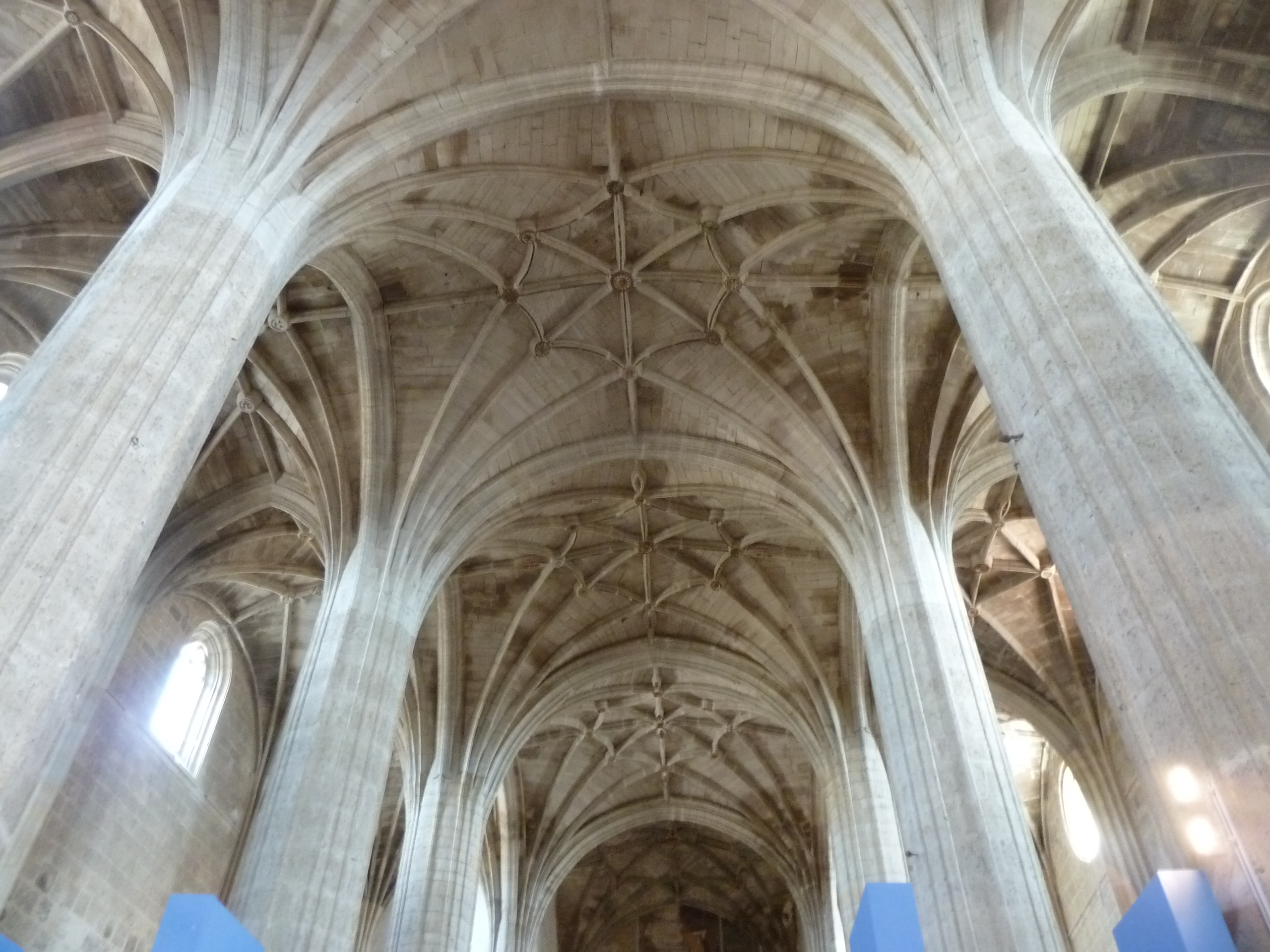
Enter the church of San Juan if it is open. It was designed by Rodrigo Gil de Hontañón, one of the most important architects of 16th-century Spanish Gothic — he also contributed to the cathedrals of Salamanca and Segovia and worked on the cathedral of Plasencia. What he did here is remarkable: a three-nave interior in which all three naves share exactly the same height, covered by ribbed vaults that spring directly from columns without capitals, spreading across the ceiling like the branches of trees. The effect is one of unusual openness and harmony — a space that feels simultaneously Gothic and almost Modernist. It is the kind of interior that architects study.
The Alto de Mostelares: the hardest climb of the stage (km 41–52)
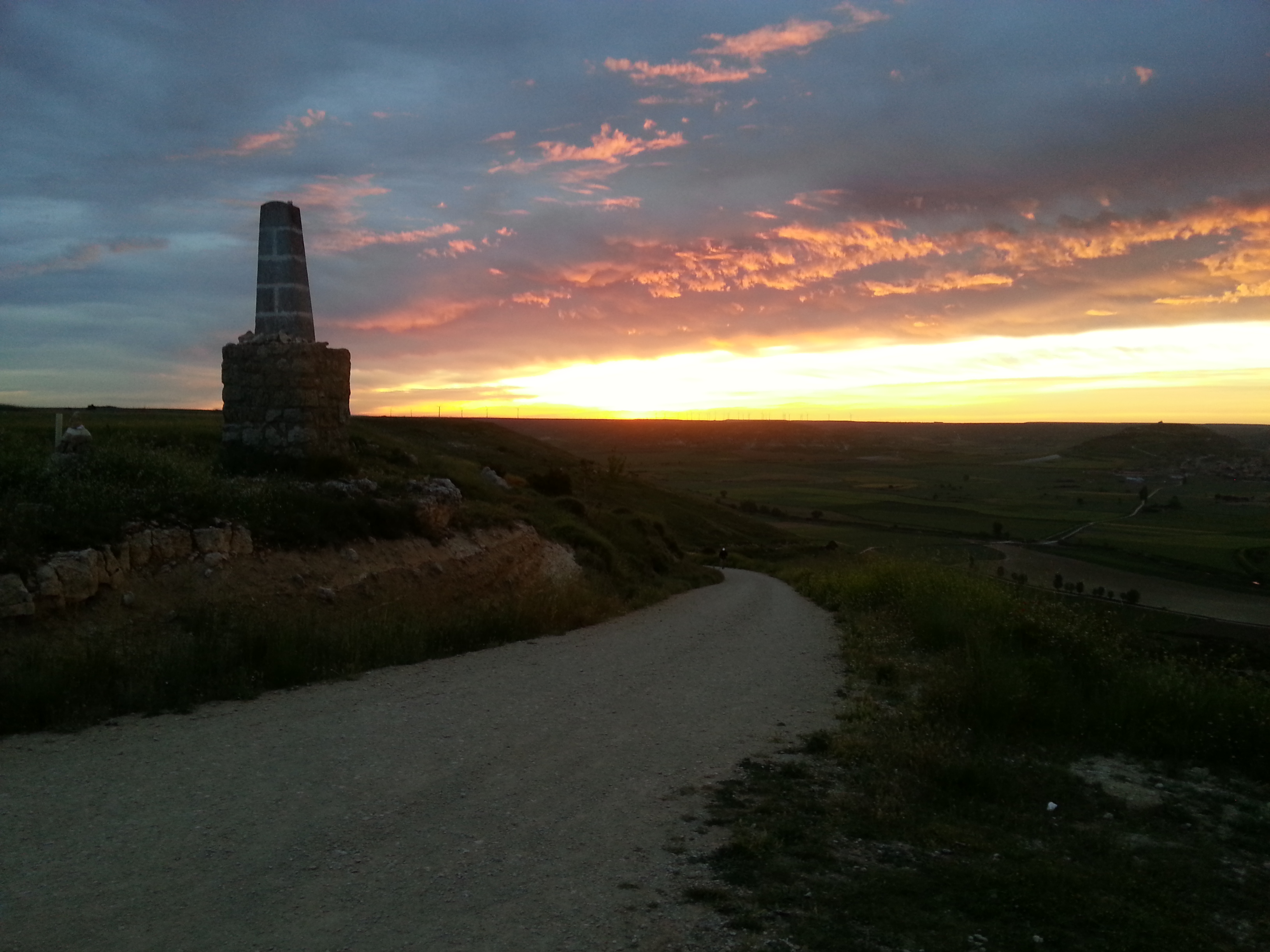
Leaving Castrojeriz on a dirt and stone track, you immediately face the Alto de Mostelares — the most significant climb of the stage. After crossing the Odrilla river on a wooden bridge, 140 m of elevation are gained in just over 1 km, with an average gradient of 11–12%. The combination of the gradient, the exposed surface and, in summer, the direct sun and wind, makes this the toughest physical moment of the day. It is brief, but intense.
The views from the top are the reward: a wide panorama over the Burgos countryside and the Tierra de Campos ahead, with Castrojeriz and its castle hill behind you and the immensity of the Meseta stretching to León. The descent is steep — about 115 m in 1.5 km, partially paved — and requires care on the loose surface sections. From the bottom, 3 km of trail leads to a regional road junction, from which the path to Puente de Itero is signposted to the left.
The hermitage of San Nicolás and the bridge into Palencia (km 52)
Before reaching the bridge, on the right, a small ancient building marks one of the most distinctive overnight stops on the French Way. The Hermitage of San Nicolás de Puente Fitero was abandoned for over two centuries until an Italian professor promoted its rehabilitation as a pilgrim hostel. The hostel operates on strictly medieval principles: dinner is communal and every night a ritual washing of feet is offered to the pilgrims staying there — a practice common among medieval monks based on the Gospel account of Christ washing the disciples’ feet. Whether you stay or not, the building and its story are worth knowing.
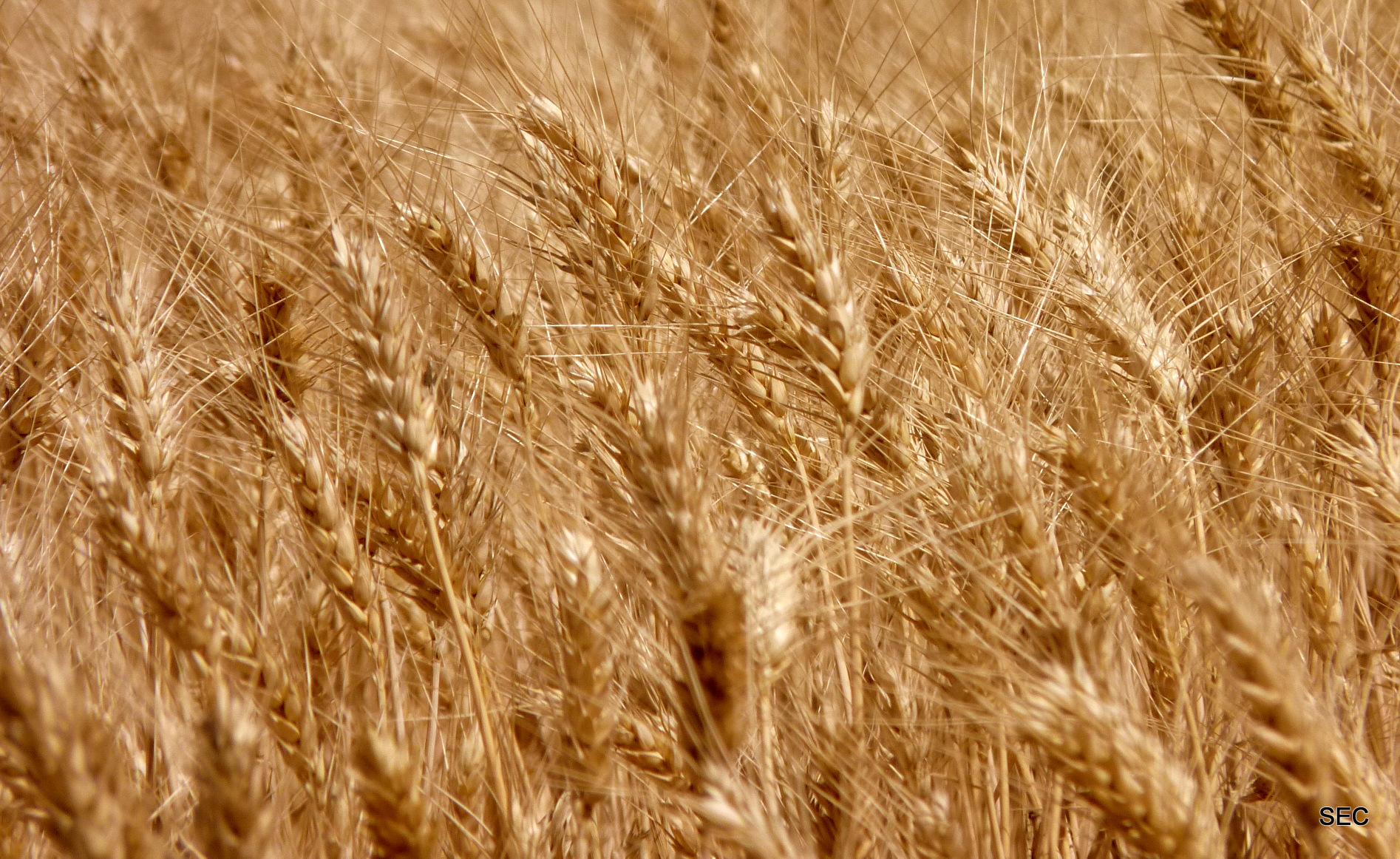
The Puente de Itero — or Puente Fitero — is one of the longest bridges on the French Way, with eleven arches spanning the Pisuerga river. It was built in the 11th century and restored in the 17th century while preserving its original form, in excellent quality ashlar masonry. The river beneath it marks the boundary between the provinces of Burgos and Palencia. The name Itero comes from the Latin petra ficta — fixed stone, a milestone — expressing the village’s historic function as a border marker on the river meadow (vega). Crossing the bridge you enter the Tierra de Campos: the great cereal plain shared between Palencia, Valladolid, Zamora and León, which together produce so much grain that they are called the Granary of Spain.
Boadilla del Camino: the jurisdictional roll (km 60)
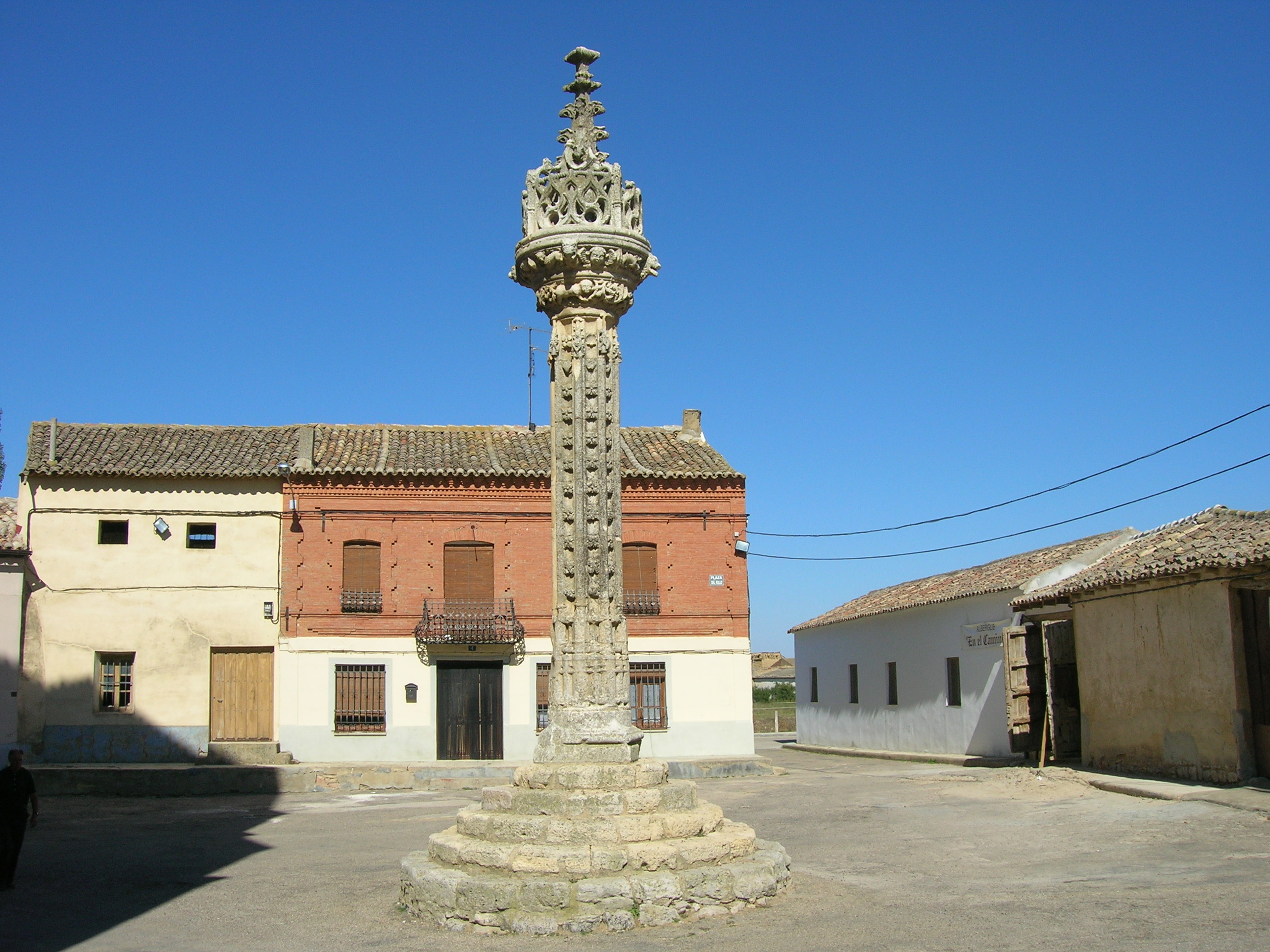
Eight km of trail between fields from Itero de la Vega bring you to Boadilla del Camino (km 60), a small village with all services and a genuinely unusual monument at its centre: a tall decorated stone column standing in the square. This is a rollo jurisdiccional — a jurisdictional roll.
These columns were placed in villages to indicate the administrative status of the settlement and, more specifically, to mark the territorial reach of local judicial power. They could only be erected in places where a lord had the authority to condemn to death. In practice, criminals were chained to the column and exposed publicly before being judged — the roll was both a declaration of sovereignty and a place of punishment. This particular one, from the 16th century, specifically declared the independence of Boadilla’s residents from the jurisdiction of neighbouring Castrojeriz.
What makes this column remarkable is the fact that it survived. The Constitution of Cádiz (1812) — the liberal constitution drawn up during the Napoleonic occupation — abolished feudal jurisdictions and ordered all jurisdictional rolls to be destroyed, as they were physical symbols of precisely the kind of aristocratic power the constitution sought to end. Most were demolished. Only those in places that refused to comply survive today. The roll of Boadilla del Camino is one of the finest in Spain, both for its height and its sculptural decoration.
Behind the roll, the church of Our Lady of the Assumption is Romanesque in origin but largely rebuilt in the 15th–16th centuries, with a notable main altarpiece. The original Romanesque baptismal font, large and richly decorated, survives inside.
The Canal de Castilla and into Frómista (km 60–65)
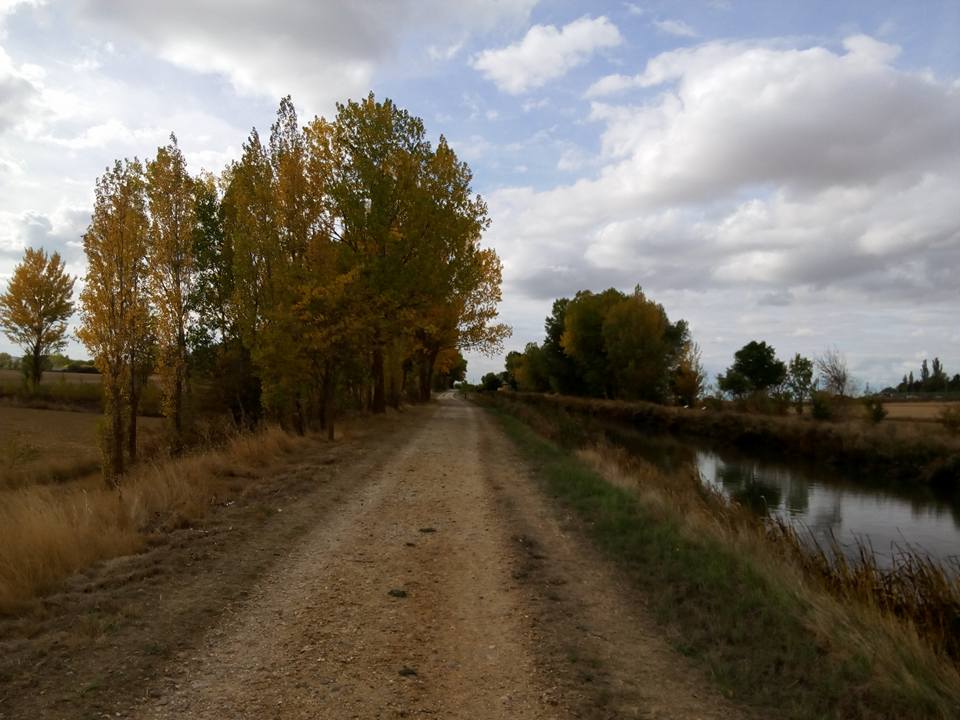
From Boadilla, about 1 km out of the village, a left turn brings you to the bank of the Canal de Castilla — the Canal of Castile — one of the most ambitious engineering projects of 18th-century Spain.
The canal was conceived by Ferdinand VI (1713–1759) and his reforming minister the Marquis de la Ensenada as an Enlightenment solution to a practical problem: the Castilian plateau produced a vast surplus of cereal, but the roads connecting it to the coast were so poor that the grain could not be moved economically. The plan was to build a navigable canal from the Castilian interior all the way to the Cantabrian Sea at Santander — a project that would have been, if completed, one of the great infrastructure works of the era. It was not completed. The ambition proved greater than the resources and the political will, and the project was eventually abandoned. But 207 km of canal were built, with barges pulled by horses carrying grain and goods along the water. It became a vital engine of the Castilian economy — the first real sign of industrialisation in the region — until the arrival of the railways in the 19th century made it obsolete. Today it is used for hydroelectric power, irrigation and recreation.
You follow the canal bank for 3.2 km on a perfectly flat path before reaching the Frómista lock — a manual 18th-century lock that saved 14 metres of elevation difference. There are steps at the lock, so cross on the road bridge a short distance further on and enter Frómista from the south.
Frómista: the finest Romanesque church in Castile (km 65)
Frómista has fewer than 1,000 inhabitants but a cultural heritage entirely disproportionate to its size. It is known locally as the villa del milagro — the town of the miracle — after a legend concerning a man who was excommunicated for allegedly failing to repay a loan to a Jewish creditor, despite having done so. He died, and when a priest tried to administer the last rites, the metal cylinder used for anointing stuck to the paten and could not be moved — until the misunderstanding was resolved and the excommunication lifted. The story is told as a local curiosity but reflects the close economic and legal entanglement between Christian and Jewish communities in medieval Castilian towns.
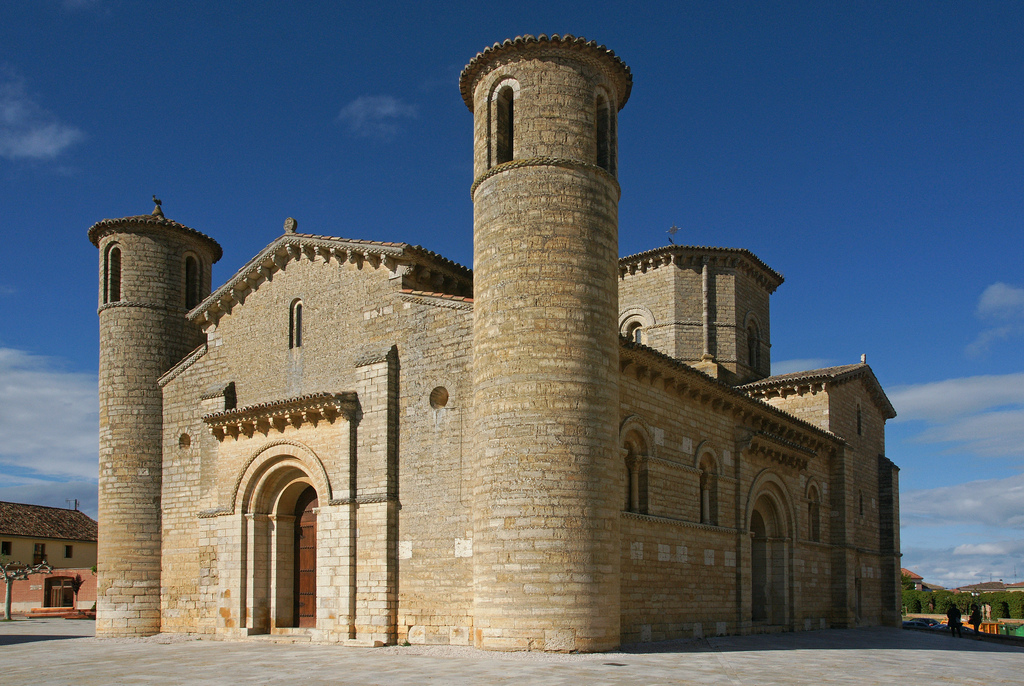
The main reason to stop in Frómista is the church of San Martín. It is one of the canonical examples of Spanish Romanesque and appears in every textbook on medieval European architecture. Dating from between the late 11th and early 12th centuries, it underwent a controversial but thorough restoration in the 19th century — the original capitals were removed to a museum and replaced with copies, a decision that still generates argument among art historians, but which preserved the building’s structural integrity. What you see today is the closest surviving approximation to what a major Romanesque pilgrimage church of this period looked like when new.
Three things make San Martín exceptional. First, its proportional clarity: three naves, semicircular apse, barrel vaulting throughout, the masses and volumes in precise balance. Second, the two circular towers on the west facade — quadrangular towers were the norm; these circular ones recall Carolingian or German Romanesque, a reminder of the international connections of the Camino. Third, the sculptural decoration: every canecillo (corbel at the eaves) carries a carved figure, the exterior mouldings mark every level of the building, and the capitals inside are rich in narrative detail. Even the copies placed in the 19th century are excellent work.
Frómista’s other notable monument is the church of San Pedro on the central avenue — Gothic in structure, Renaissance in its portal, with the local parish museum occupying part of the interior. And on the same avenue: a sculpture of San Telmo, the patron saint of Frómista, born in this town in the 12th century. He spent his life preaching in Asturias and Galicia, mainly to fishermen — which is why, in the middle of the Castilian cereal plain, the statue represents him standing in a boat.
Frómista to Villalcázar de Sirga: the Templars’ church (km 65–78)
From Frómista, the Camino runs permanently parallel to the P-980 road — 20 km to Carrión de los Condes with a village roughly every 4–6 km. The gravel trail alongside the road is usable but narrow; most cyclists choose the road itself. The profile is very gentle, almost imperceptibly uphill for the first 17 km then slightly downhill to Carrión.
You pass through Población de Campos (all services; a river variant for foot pilgrims branches off here), Revenga de Campos (the church tower is a regular nesting site for storks) and Villarmentero de Campos (the church of San Martín de Tours has a Mudéjar coffered ceiling — the geometrically precise wooden ceiling created by Muslim craftsmen working for Christian patrons, a style found throughout Castile and barely noticed by most pilgrims passing through).
The last stop before Carrión, and the most significant, is Villalcázar de Sirga. From a distance the church of Santa María la Blanca surprises by its size — it is enormous for a village of this scale. Up close it surprises by its delicacy.
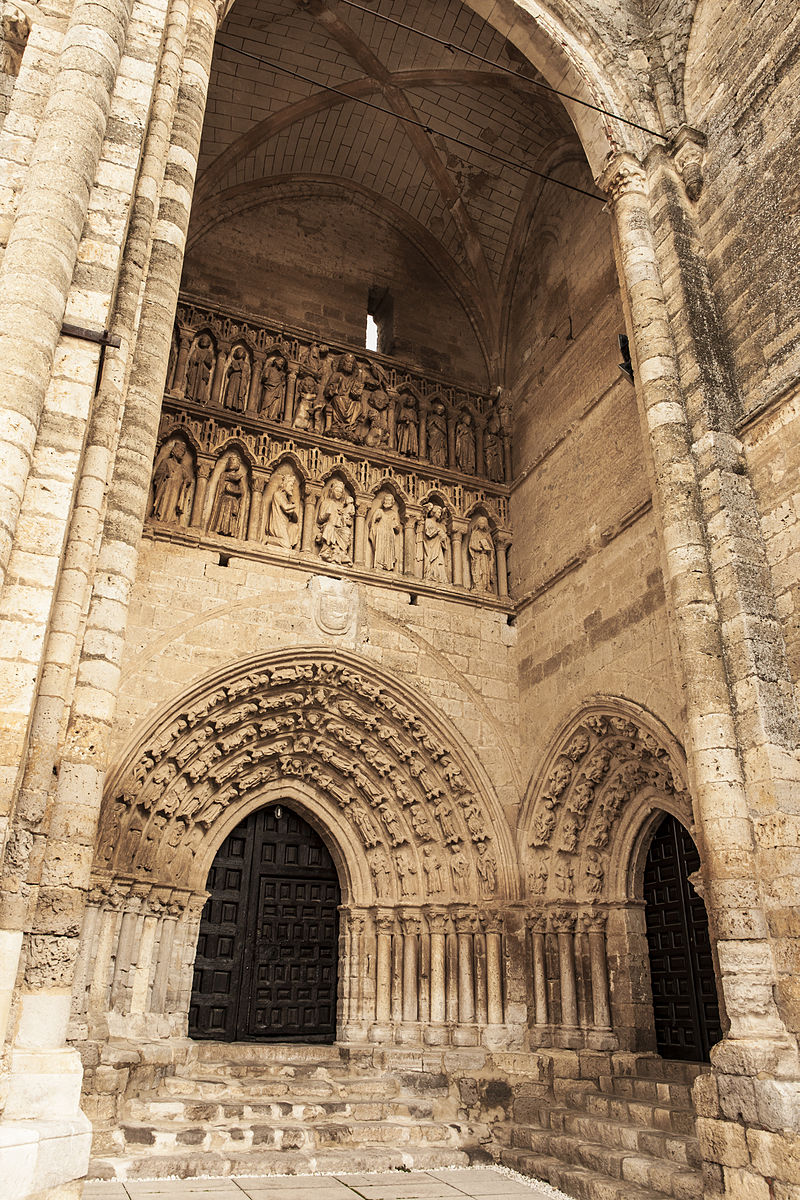
The church was built from the 12th century onwards under the patronage of the Order of the Temple — the Knights Templar — who held the town during their period of greatest power. The Templars were a military-religious order founded in 1118, originally to protect pilgrims in the Holy Land, who accumulated extraordinary wealth and political influence across two centuries. The Virgin of Santa María la Blanca venerated here was the subject of twelve of Alfonso X “the Wise’s” Cantigas de Santa María — miraculous stories in verse dedicated to the Virgin — which gives a measure of how significant this shrine was at the height of its fame.
The story of the Order’s end is one of the more dramatic episodes of medieval history. By the early 14th century the Templars had accumulated so much wealth and power that Philip IV of France — who owed them an enormous personal debt — saw them as a threat. In 1307 he had the French Templars arrested, tortured into confessions of heresy and burned. He pressured Pope Clement V to dissolve the Order, which was accomplished in 1312. The church of Santa María la Blanca was transferred to a noble family after the dissolution. The violence and speed of the Templars’ destruction — a powerful international organisation eliminated in five years — generated legends that have persisted for seven centuries.
Enter the church if possible: the main altarpiece is impressive and the polychrome sepulchres, covered in carved reliefs, are among the finest funerary sculpture in Palencia. Entry approximately €1.50; usually open daily.
When you arrive: Carrión de los Condes
Carrión de los Condes is a town of barely 2,000 people that once had 6,000 inhabitants, fifteen pilgrim hospitals and a position at the centre of Castilian political life. Much was destroyed in the Napoleonic Wars, but what survives is remarkable — and remarkably dense for the size of the place. Allow 90 minutes for the walking tour below; two hours if you visit the monastery of San Zoilo properly.
From a Trojan horse to a medieval capital
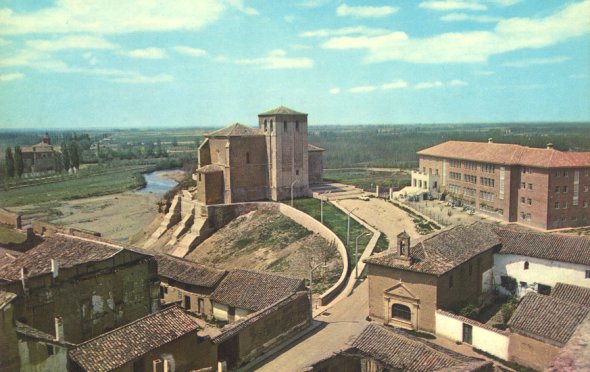
The site has been occupied since prehistoric times; the first recognisable urban settlement was Celtiberian. In the 1st century BC the Romans arrived, destroyed what was there and built their own settlement, which passed to the Visigoths when the Western Empire fell in the 5th century. The Visigoths built a castle on the north-west bank of the river Carrión — of which nothing remains above ground.
The Arabs captured the castle in the 8th century, renaming it Monte Argel. The story of its recovery by Christian forces is one of the town’s founding legends — and it borrows, with no apparent embarrassment, directly from Homer. In the Iliad, the Greeks penetrated Troy by hiding soldiers inside a hollow wooden horse left at the city gate. Here, according to the legend, Christian warriors disguised themselves as coalmen and hid weapons in their coal carts, requesting entry to sell their merchandise. Once inside, they opened the panniers, armed themselves, and created enough chaos to allow the Christian army waiting outside to take the fortress. Whether the legend is historical or invented as a flattering parallel to the Trojan War, it signals the pride the town took in its founding moment.
Around this recovered castle the town developed rapidly. It became a condado — a county, governed by a count dependent on the royal family — and attracted multiple noble lineages competing for control. The name de los Condes (of the Counts) derives from the 15th-century pact between three rival comital families not to lose power to a fourth. Medieval Carrión had 15 hospitals for pilgrims and the sick, a thriving weekly market, numerous monasteries and convents, and 6,000 inhabitants — a significant city by the standards of the time.
Among the town’s most prized possessions were the relics of San Zoilo — a young man martyred in Córdoba in the 4th century for preaching Christianity when it was still persecuted — brought here by a noble family in the 11th century and housed in the monastery that still bears his name.
The 16th century brought recession: plague, excessive taxation, the decline of pilgrimage traffic. The population fell to around 600. A royal grant of a tax-free weekly market, secured by the abbess of the Convent of Santa Clara, began the recovery. By the 17th century Carrión was trading with Flanders and France again.
The catastrophe came in the Napoleonic Wars. When French forces occupied Spain, the leader of the Castilian resistance made a radical decision: rather than let the French use the town’s important buildings as strongholds, he ordered them burned. Convents and churches were set on fire, and with them all the town’s historical archives. The physical destruction and the loss of documents that would have allowed historians to reconstruct the town’s medieval life are, in different ways, irreparable losses. What survived the fires was subsequently emptied by the 19th-century disentailment. The town was rebuilt, partly from the materials of the burned and abandoned buildings, and what you see today is a superimposition of that modern reconstruction over the medieval skeleton.
The walking tour (90 minutes)
Start at the south-east edge of town, near the P-980 entry, at the Real Monasterio de Santa Clara — the Royal Monastery of Santa Clara.
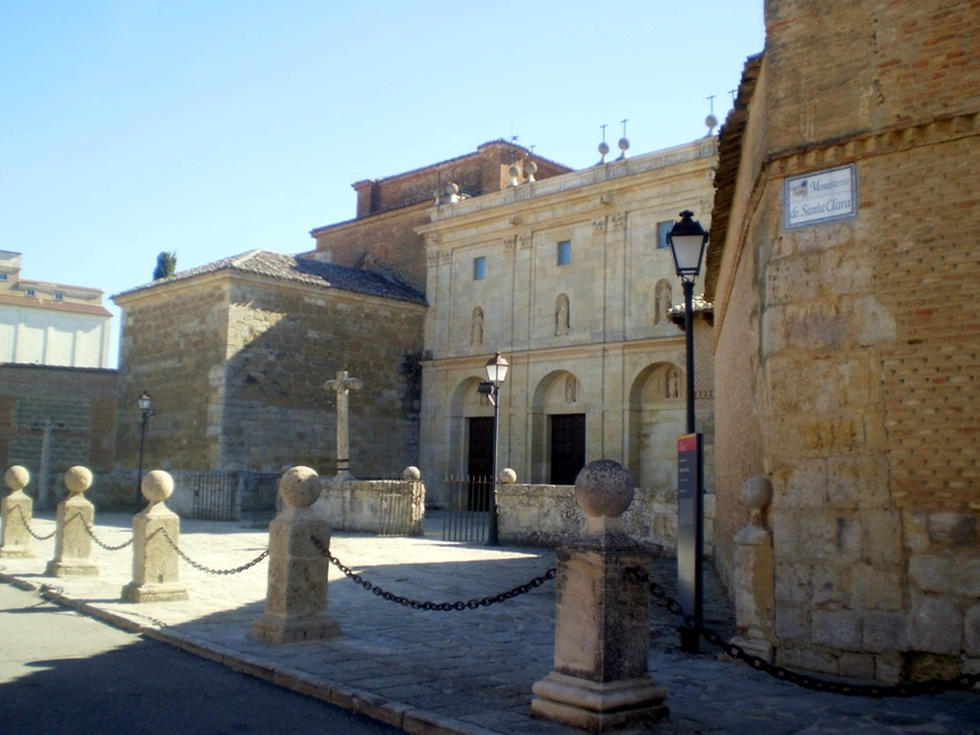
Santa Clara was an Italian mystic who, in the 13th century, became the first woman in history to write a monastic rule specifically for women — not adapting a pre-existing male rule, but writing an entirely original document for her community. Two of her direct disciples founded this convent in 1231, making it one of the oldest Franciscan convents in Spain. Its operation has been almost uninterrupted since then.
What you see today architecturally is largely 17th-century — the period when the convent reached its greatest influence, under the management of Sor Luisa de la Ascensión, an abbess of extraordinary political skill. She was the woman who secured the royal grant of a tax-free market that revived the town’s commerce after the 16th-century recession. The story of the convent’s survival during the Napoleonic Wars is characteristic of her tradition: the nuns reportedly made a pact with the French occupiers, offering them a daily cup of hot chocolate in exchange for leaving the monastery intact. Whether true or not, the building survived the war unharmed, and the nuns who live there today continue to make traditional sweets.
The convent houses a museum whose centrepiece is an extraordinary collection of nativity scenes from around the world, gathered over centuries. The church is also worth visiting for the altarpiece presided over by a sculpture of Santa Clara. At the north gate, a well is known as the Well of the Pilgrims or Well of Health — it was long believed to mark the exact midpoint of the Camino from France, though modern calculations place that point somewhat further on, past Sahagún.
Follow Calle Santa Clara across the road, past the tourist information office, to the church of Santa María del Camino. A 12th-century Romanesque temple of notable size, it holds a daily pilgrim blessing mass in the afternoon — one of the few places on the Camino where this tradition has been maintained without interruption.
The church of Santiago: a medieval encyclopaedia in stone
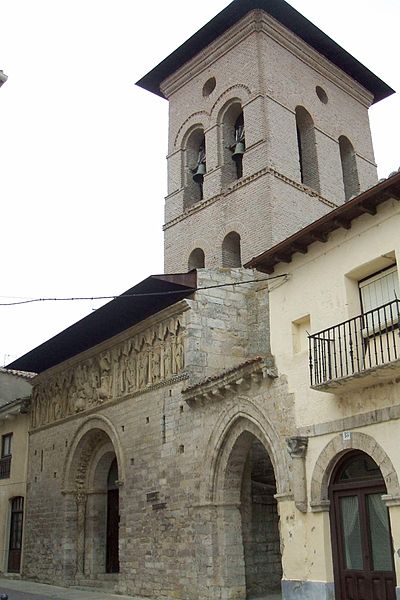
Continue along the pedestrian street to the church-museum of Santiago. The building was originally part of a 12th-century monastic complex that also included a pilgrim hospital. It was one of the buildings most damaged in the 1811 fire, but a significant portion survived and was declared a Historic Monument in 1931. The reconstruction in 1849 used material from other destroyed buildings; the Plaza Mayor and the town hall opposite were created at the same time.
The museum collection inside is interesting, but the reason to stop is the main medieval portal. The arch itself is Romanesque — a semicircular arch with an upper horizontal frieze running across the full width of the facade. What makes it exceptional is the subject matter of the carving.
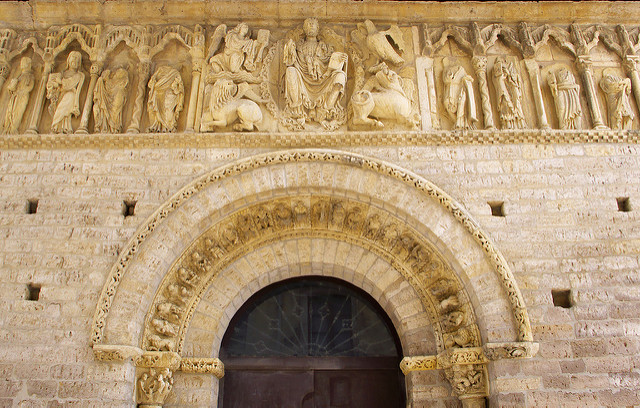
The archivolt is filled with 22 human figures, each representing a different medieval trade or profession: a blacksmith wearing a Jewish cap (identifying his religious community), an alchemist, a cobbler, a minstrel, a scribe, a monk, a harpist, a judge, a warrior, a mourner, a tailor. It is a visual encyclopaedia of the working life of a medieval Castilian town — the people who actually populated Carrión and built its prosperity, represented with equal dignity alongside each other on the portal of a church. One figure, typically noted with some amusement by visitors, appears to be a ballet dancer or contortionist, in an almost impossible pose and conspicuously revealing clothing.
The two columns flanking the door carry capitals with a stark moral opposition. On the left, the Good: two protective figures preventing a lion (representing the devil) from seizing a human soul while angels carry it to heaven. On the right, the Evil: a naked man being bitten by dogs continuously, in permanent torment without the mercy of death.
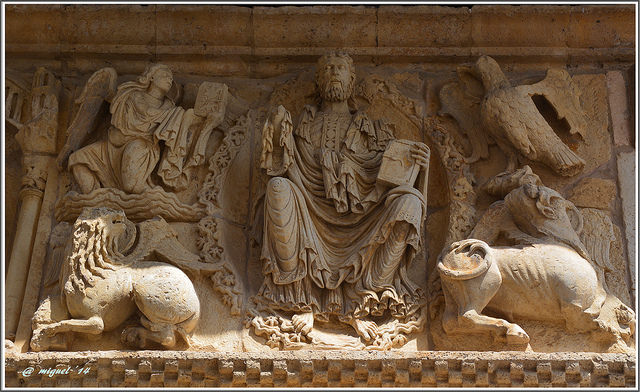
Above the arch, the horizontal frieze carries a Pantocrátor — Christ as universal ruler, book closed (the Final Judgement has not yet come), surrounded by the symbols of the four Evangelists: Matthew as an angel, Mark as a lion, Luke as an ox, John as an eagle. To either side the twelve apostles stand in groups of six. The wall, taken as a whole, is a cosmological diagram: Christ and the saints above, society in its daily trades below, the moral choice — Good or Evil — at the threshold between the two worlds. Medieval visitors read all of this immediately; it was, as Tournride’s original text puts it, the equivalent of today’s traffic signs. We understand our signs; a medieval person would find ours entirely opaque.
San Andrés, the Puente Mayor and the monastery of San Zoilo
From the pedestrian street, turn right onto Calle Hortaleza to visit the church of San Andrés, known as the Cathedral of Carrión. Designed in the 16th century by Rodrigo Gil de Hontañón — who also designed the church of San Juan in Castrojeriz — it is a large, bright interior that demonstrates his characteristic ability to fill a Gothic space with light.
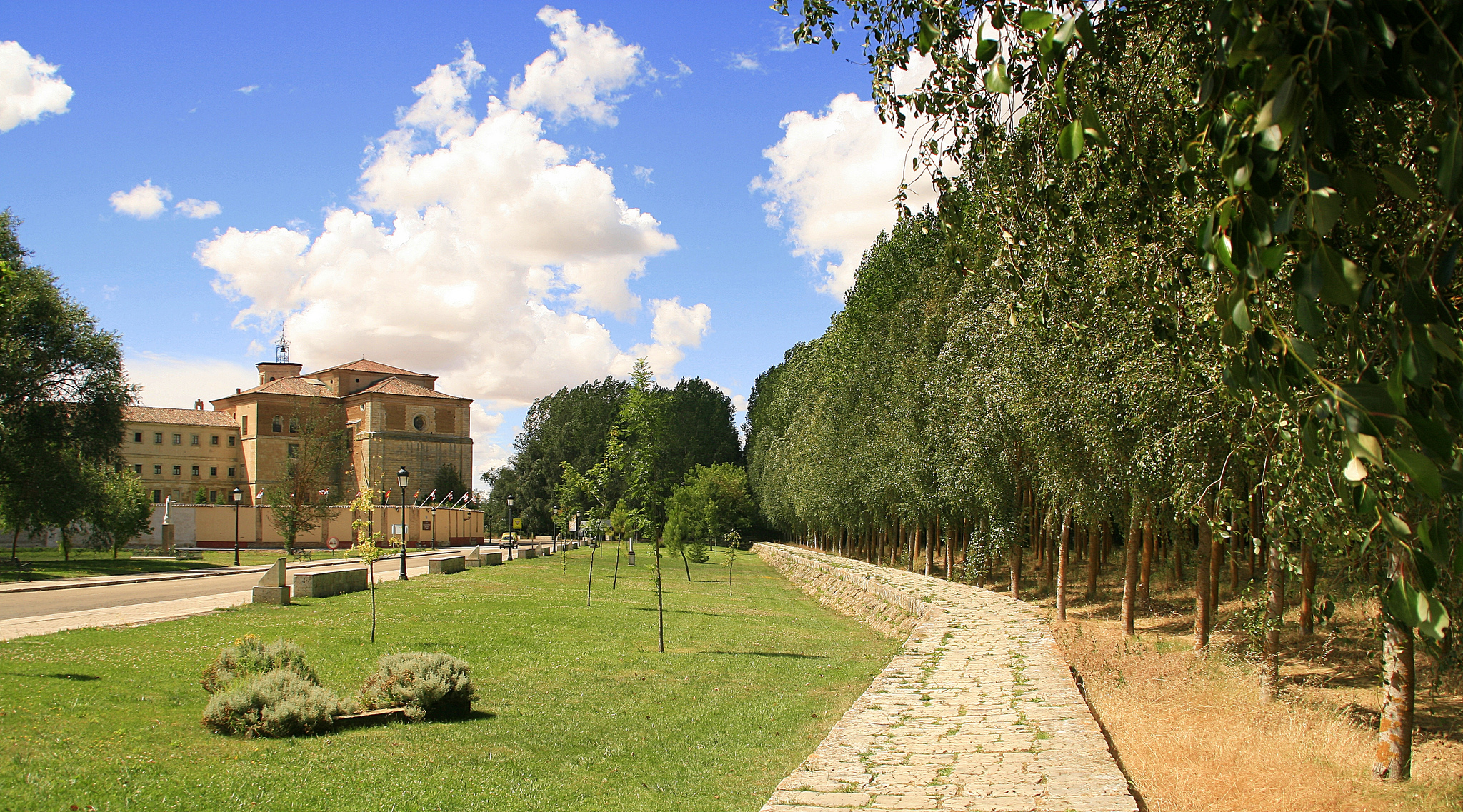
Follow Calle Hortaleza to its end at the Puente Mayor — a 16th-century reconstruction of an 11th-century bridge built to connect the town with the monastery of San Zoilo. The original bridge had gates at both ends where tolls were charged, from merchants and pilgrims alike. Some medieval townspeople left money in their wills specifically to pay the toll for a given number of poor pilgrims — a form of posthumous charity that was also understood as an act of piety.
Cross the bridge and 200 metres ahead is the Baroque facade of the Monastery of San Zoilo, now a hotel. In the Middle Ages this monastery was famous along the entire Camino for giving pilgrims all the bread and wine they wanted, free of charge — a level of generosity that rivalled the wine fountain of Irache on Stage 4. Kings visited and in the 13th century Fernando III “the Saint” was married here.
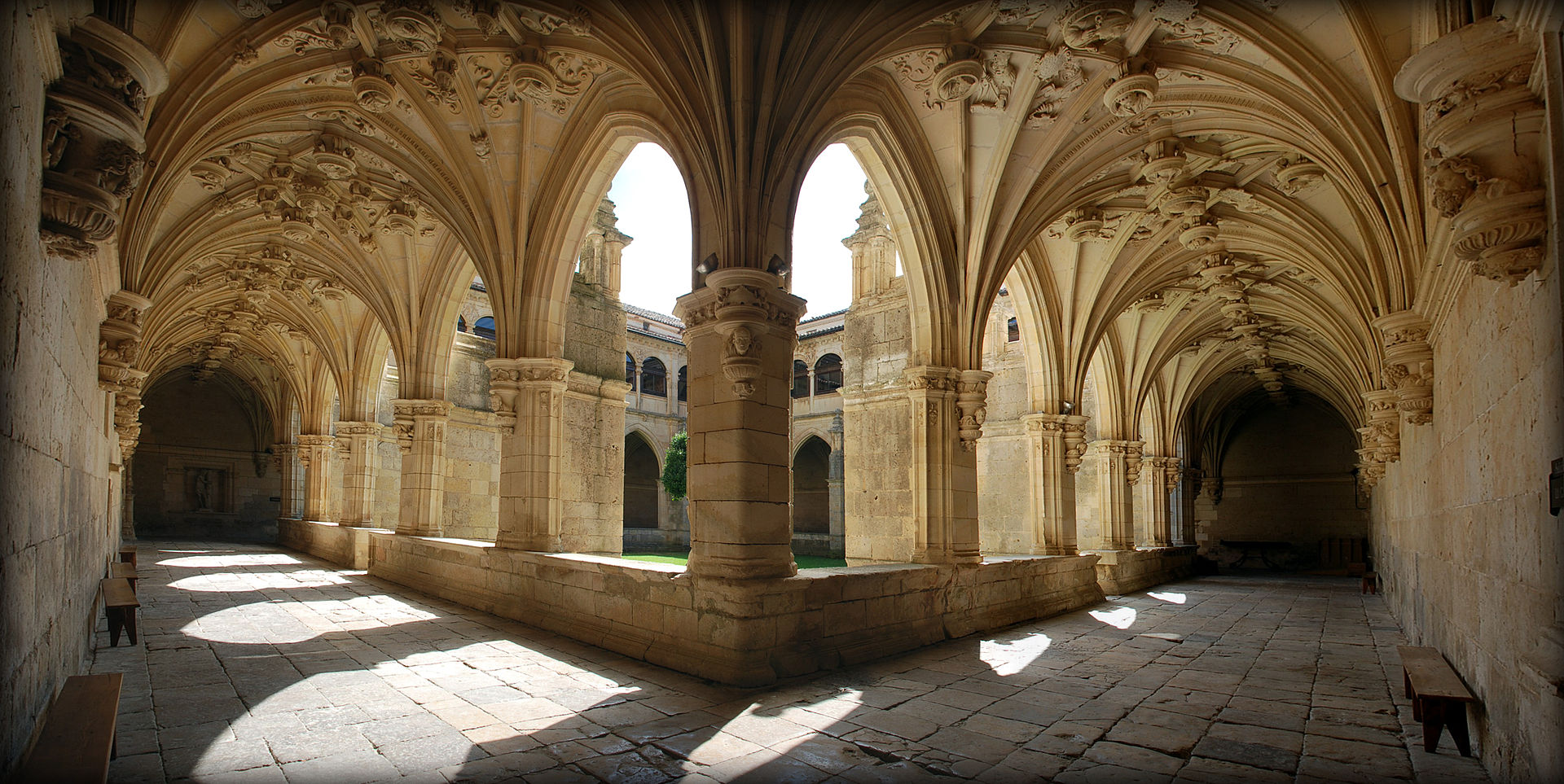
Little of the original medieval building survives above ground, but the cloister from the 16th century is exceptional: profusely carved columns and capitals, with a vaulted portico running the entire perimeter, the stone covering decorated with a continuous programme of sculpture. The cloister is accessible to non-guests. Ask at the hotel reception.
Return to the Plaza Mayor and dinner
Cross back over the bridge and turn right along the river bank. On Calle Ruiz Girón, a few metres along, is one of the few noble houses to survive the fire of 1811: the Casa Girón, an 18th-century palace with family shields above the doorway and ornate window grilles.
Return to Adolfo Suárez Street and left to the Plaza Mayor, where the town hall built in 1868 stands on the site of the previous one destroyed in the fire. Its foundations use stone from demolished abbeys and convents — the town rebuilding itself from its own ruins. The plaza is the natural gathering point for the evening and the surrounding streets have a good concentration of bars and restaurants. Palentine gastronomy here means roast meats (lamb and suckling pig), cangrejos del Pisuerga (freshwater crayfish from the local river, a regional speciality), and for those with a sweet tooth, the garrapiñadas (sugar-coated almonds) and hojaldre (puff pastry) for which Carrión is particularly known — a sweet-making tradition inherited from the convents whose kitchens were among the finest in medieval Castile.
Worth the detour: Aguilar de Campoo
About 40 km north of Carrión de los Condes, in the foothills of the Cantabrian mountains, Aguilar de Campoo is the unofficial capital of Palentine Romanesque — a concentration of medieval religious architecture in a small town that justifies the detour for anyone interested in the style. It is best done as a rest-day excursion from Carrión by bike (flat to rolling), or by car in half a day.
A town built from Romanesque stone
Aguilar sits at the confluence of the rivers Pisuerga and Camesa, in a strategic position that has been inhabited since the Bronze Age. In the Middle Ages it was a significant noble seat — the Manrique de Lara family, one of the great Castilian dynasties, had their power base here — and the wealth generated by that noble patronage and the surrounding monasteries produced a remarkable density of Romanesque and early Gothic construction. The town itself is medieval in structure, with a long arcaded main street, a castle above it (now largely a ruin, but with good views), and several churches clustered around the centre.
What to see
The collegiate church of San Miguel, on the main square, is the centrepiece: a large Romanesque-Gothic building from the 12th–13th centuries with exceptional carved capitals in the interior and an outstanding collection of medieval funerary sculpture in the attached museum, including the sepulchres of the Manrique de Lara family. The church of Santa Cecilia, a few streets away, has a beautifully preserved Romanesque apse and tower. The Monastery of Santa María la Real on the edge of town — now a hotel and study centre — has a Gothic cloister and houses the Romanesque Foundation, whose documentation work covers every significant Romanesque monument in Castile and León and whose archive is an invaluable resource.
The surrounding area within a 20 km radius of Aguilar has an extraordinary density of Romanesque hermitages and rural churches — many accessible only by dirt track, some rarely visited. If you have a full day and a bike, the circuits through the Campoo valleys offer some of the finest rural Romanesque in Spain in complete solitude.
Practical notes
The San Miguel museum and the Romanesque Foundation are open Tuesday to Sunday; entry approximately €3. The monastery hotel restaurant is one of the better places to eat in the area. By bike from Carrión the route north is straightforward on the P-980 and local roads — about 40 km each way with around 200 m of climbing in the final approach. Allow a full day if combining the town with any rural Romanesque circuits. Aguilar also has a train station on the Palencia–Santander line, making it accessible from Palencia (and therefore from Carrión by bus) without a car.
Practical notes for Stage 7
Water and supplies on the Meseta
This is the stage where water management matters most. The distances between services are significant: from Hornillos to Hontanas (11 km) there is nothing reliable except the San Bol hostel detour at km 6. From Hontanas to Castrojeriz (10 km) the only intermediate option is the San Antón hostel if it is open. In summer, in direct sun with no shade, 11 km can mean 45 minutes of exposure — carry at least 1.5 litres from each village. After Castrojeriz the density increases: Frómista is 23 km away but with Itero de la Vega (km 52) and Boadilla (km 60) in between. From Frómista to Carrión the villages come every 4–6 km.
Surface and bike type
Most of the stage is on dirt tracks between fields — generally compact and well-drained, but muddy after rain. The exceptions are the Alto de Mostelares descent (stony, technical), a short section from Hontanas toward Castrojeriz (hillside trail, narrow), and the final section from Frómista to Carrión (mostly road or good gravel). An MTB or gravel bike handles the full stage without difficulty. A road bike should follow the road alternatives for the technical sections. An e-bike makes the Mostelares ascent much less demanding but the loose descent requires the same care regardless of motor. The Canal de Castilla path is flat and smooth — the pleasantest stretch of surface of the day.
Starting in Burgos
Burgos has excellent connections: Renfe trains (Rosa de Lima station) from Madrid, Bilbao and Valladolid; Alsa and regional buses from all major Spanish cities. The airport is on the edge of the city but has had no commercial flights in recent years — the nearest operational airports are Bilbao (1h 30m by bus) and Madrid (2h 30m). Tournride delivers bikes to your accommodation in Burgos the evening before departure.
Summer heat warning
In July and August the Meseta between Burgos and Carrión can reach 38–40°C by midday, with no shade for kilometres. Start before 7 a.m. to complete the most exposed sections by 11 a.m. Sunglasses, a cap, sunscreen and more water than you think you need are not optional. The Canal de Castilla path has some tree cover and is the most comfortable riding of the day in heat.
Frequently asked questions about Stage 7
How far is Stage 7 of the Camino Francés by bike?
85 km from Burgos to Carrión de los Condes. The stage is mostly flat across the Meseta — the main challenge is distance and, in summer, heat and exposure rather than elevation. Total climbing is around 400 m, all accumulated gradually except for the Alto de Mostelares (140 m in 1 km) just outside Castrojeriz.
Is Stage 7 difficult for cyclists?
Rated medium difficulty. The Meseta is psychologically demanding — flat, exposed, with long gaps between villages — but not technically difficult except for the Mostelares ascent and descent. The real risk is underestimating the heat and distance in summer. An early start is essential in July and August.
Is the Aguilar de Campoo detour worth doing?
Yes, if you have any interest in Romanesque architecture. Aguilar is the capital of Palentine Romanesque and the surrounding area has an exceptional density of rural medieval churches. Best done as a rest-day excursion from Carrión — a 40 km round trip with good roads and manageable climbing.
Where can I sleep between Burgos and Carrión de los Condes?
The main options for mid-stage stops are Hornillos del Camino (km 21), Hontanas (km 32), Castrojeriz (km 41) and Frómista (km 65). Frómista is the most common split point for cyclists turning an 85 km stage into two more comfortable days — it has a good range of hostels and a hotel.
Can I rent a bike in Burgos and return it in Santiago?
Yes. Tournride delivers your bike to any accommodation in Burgos the evening before your departure and collects it in Santiago de Compostela when you finish. Luggage transfer between stages is also available. See all bike models and check availability here.
Cycle the Camino de Santiago at your own pace.
Plan this stage by bike


