STAGE 6: FROM SANTO DOMINGO DE LA CALZADA TO BURGOS
Xavier Rodríguez PrietoStage 6 is where the Camino changes character. You leave La Rioja — wine country, red earth, the soft south-facing slopes of the Ebro valley — and enter Castile. The landscape opens and flattens, the towns grow further apart, and the sky gets bigger. At 69 km it is the first genuinely long day of the French Way, with a serious mountain crossing through the Montes de Oca and a technically demanding descent over the Sierra de Atapuerca. The reward at the end is Burgos: one of the great medieval cities of Europe, with a Gothic cathedral that has been a World Heritage Site since 1984 and enough to fill two days if you let it.
Planning the full route? Our the full Camino de Santiago cycling route page maps every stage, with distances and planning tips.
| Distance | Elevation gain | Estimated time | Difficulty | Distance to Santiago |
|---|---|---|---|---|
| 69 km | +900 m cumulative | 6–7 hours riding | 🟡 Medium–high | ~562 km |
Rent your bike for the Camino: from €22/day (conventional bike) or €33/day (e-bike) on a one-week trip. 2027 rates, bike transport not included.
See availability and priceKey stops: Grañón (km 7) · Redecilla del Camino (km 9) · Belorado (km 22) · Villafranca de Montes de Oca (km 35) · San Juan de Ortega (km 47) · Atapuerca (km 55) · Burgos (km 69)
Optional detour: Santo Domingo de Silos (+60 km from Burgos — Benedictine monastery, finest Romanesque cloister in Spain, best as a rest day)
Route profile and key milestones
Leaving Santo Domingo: the bridge that made the saint famous (km 0–7)
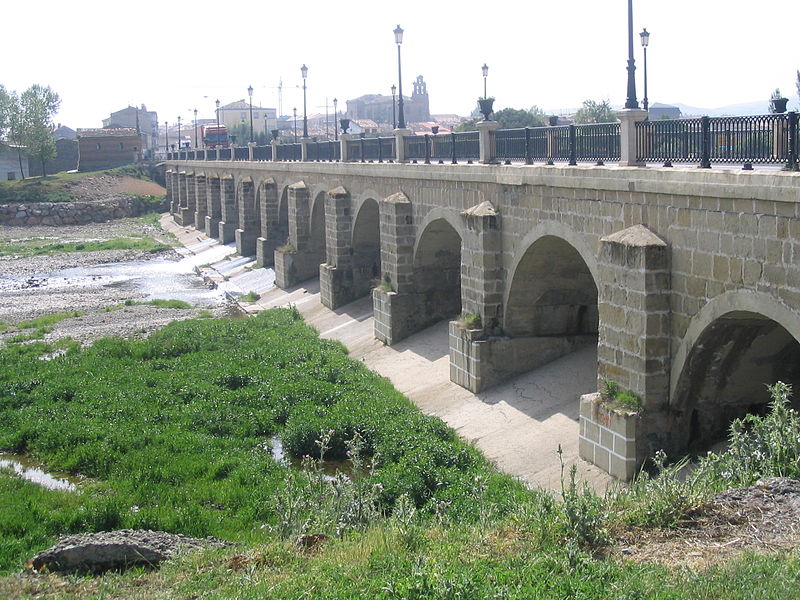
The stage begins on the bridge over the river Oja — the very bridge that made Domingo García’s name. You already know the story of the saint from Stage 5, but the bridge itself deserves a moment. The current stone structure with its sixteen arches is not the one Domingo built in the 11th century: the original was a wooden board on stone pillars, replaced by a stone bridge of around 25 large arches, which was then repeatedly reformed from the 16th to the 19th century as floods and wear took their toll. What you are crossing is a palimpsest — layer on layer of centuries of repair — but the crossing has been here, serving pilgrims, since the Camino was at its medieval height.
One of Domingo’s miracles is set on this bridge. A pilgrim sleeping here was struck by a cart and killed; the saint, according to the story, gave him back his life. The bridge is not just infrastructure — on the Camino, nothing ever is.
After crossing, you can follow the original trail parallel to the road to Burgos or take the road itself. The trail is well-signed; for the first 2 km it runs close to the N-120 before the path becomes independent. Start early — this is a long day and arriving in Burgos with afternoon light and energy makes a significant difference to how much of the city you can absorb.
Grañón: the last town in La Rioja (km 7)
The climb from the valley into Grañón involves a notable ramp over the final 2 km to the centre of the village, which sits at the highest point of the Cerro de Mirabel. The effort is worth it: from the balcony at the end of the main street — which is also where the yellow arrow directs you to turn left — there are good views over the surrounding countryside. The town once had a castle here for exactly this reason, commanding the borderland between La Rioja and Castile. Nothing of it remains.
Grañón is the last town in La Rioja. After the steep descent from the village you cross into Castile and León — a regional boundary that in the Middle Ages was a genuine political frontier, fought over for centuries. A large road sign marks the crossing.
Redecilla del Camino and the most remarkable baptismal font on the French Way (km 9)
In 1.5 km you reach the first Castilian village: Redecilla del Camino. Like many villages along this section, it has the town-street configuration typical of Jacobean settlements — the road through the village is the Camino itself, and the main street is the spine around which everything else was organised when the pilgrimage was at its height.
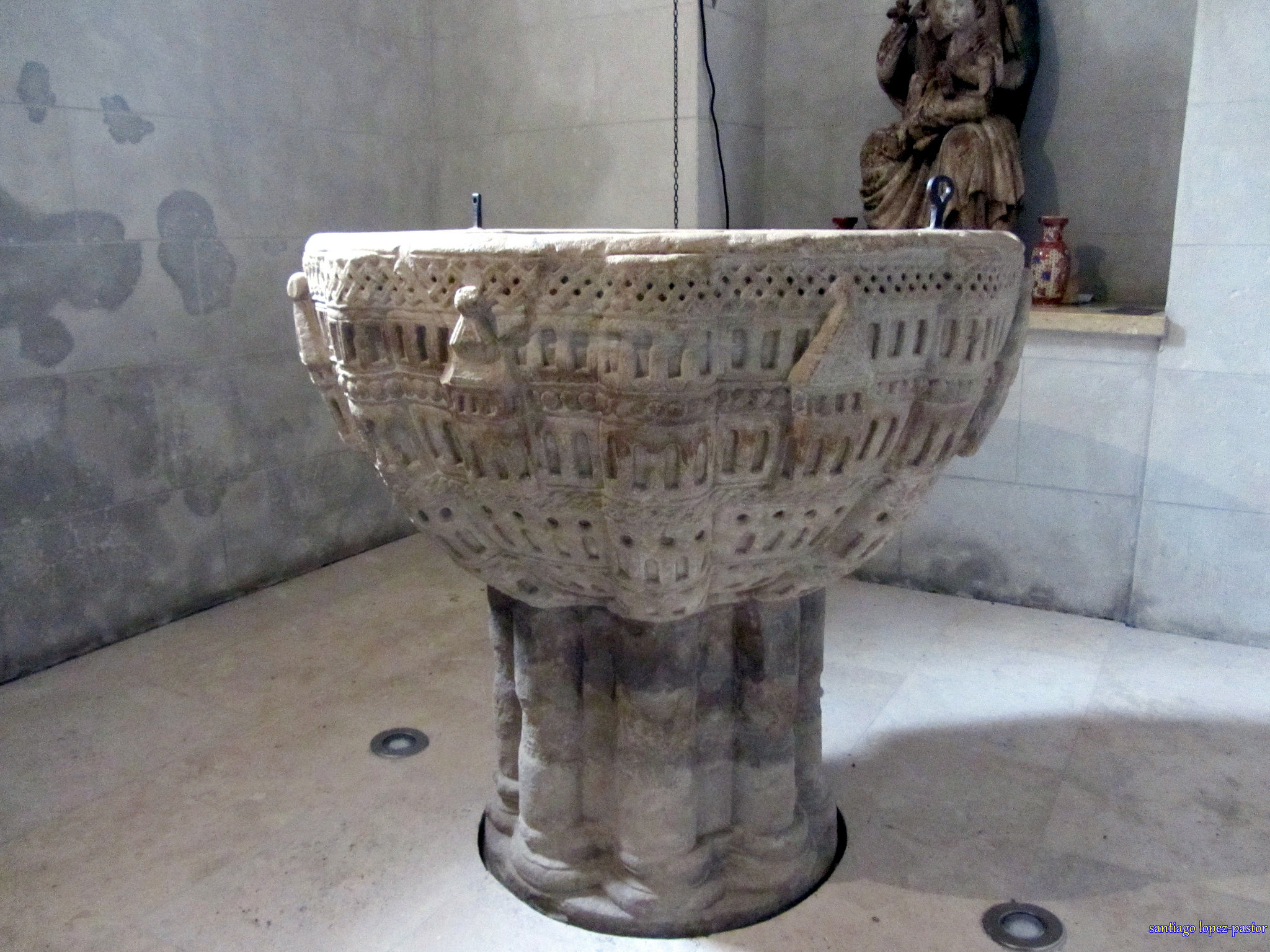
The village church of Nuestra Señora de la Calle contains what many consider the finest baptismal font on the entire French Way — and one of the most extraordinary pieces of Romanesque sculpture in northern Spain. It is nearly one metre in diameter, carved from a single block of stone, and its exterior is covered in a dense, precisely executed relief representing a fortified city: battlements, windows of different shapes, eight carved towers that taper into columns at the base.
This is a 12th-century work, and what makes it remarkable is the combination of monumental force and miniaturist detail. Experts have linked the style to the Mozarabic tradition — the art produced by Christians living under Muslim rule, strongly influenced by the geometric precision of Al-Andalus — and to the illuminated codices of the nearby monastery of San Millán de la Cogolla (which you may have visited as a detour from Stage 5). The subject itself is charged with symbolism: the fortified city the font represents is understood to be the Celestial Jerusalem. Baptism, in this reading, is the first step on the journey that might eventually end there — a meaning that resonates in a building on the Camino to Santiago with particular force.
It is the kind of object that rewards stopping for. The church is usually open during the day.
Castildelgado and Viloria de Rioja: where Santo Domingo was born (km 11–14)
From Redecilla, either the trail or the N-120 takes you through Castildelgado in under 2 km. Here the yellow arrows offer a variant through Viloria de Rioja, adding a short detour from the road. Most cyclists skip it; those who take it discover the village where Domingo García was born in 1019. The church of Our Lady of the Assumption preserves the baptismal font where the future saint received his first sacrament — a neat echo of the font you saw in Redecilla, and another thread in the story that has been running since Santo Domingo de la Calzada. Whether you go through or not, the trail rejoins at Villamayor del Río a few kilometres further on — a village whose name, locals are fond of pointing out, contains three lies: it is not a villa, not mayor (larger), and there is no river.
Belorado: the oldest documented fair in Spain (km 22)
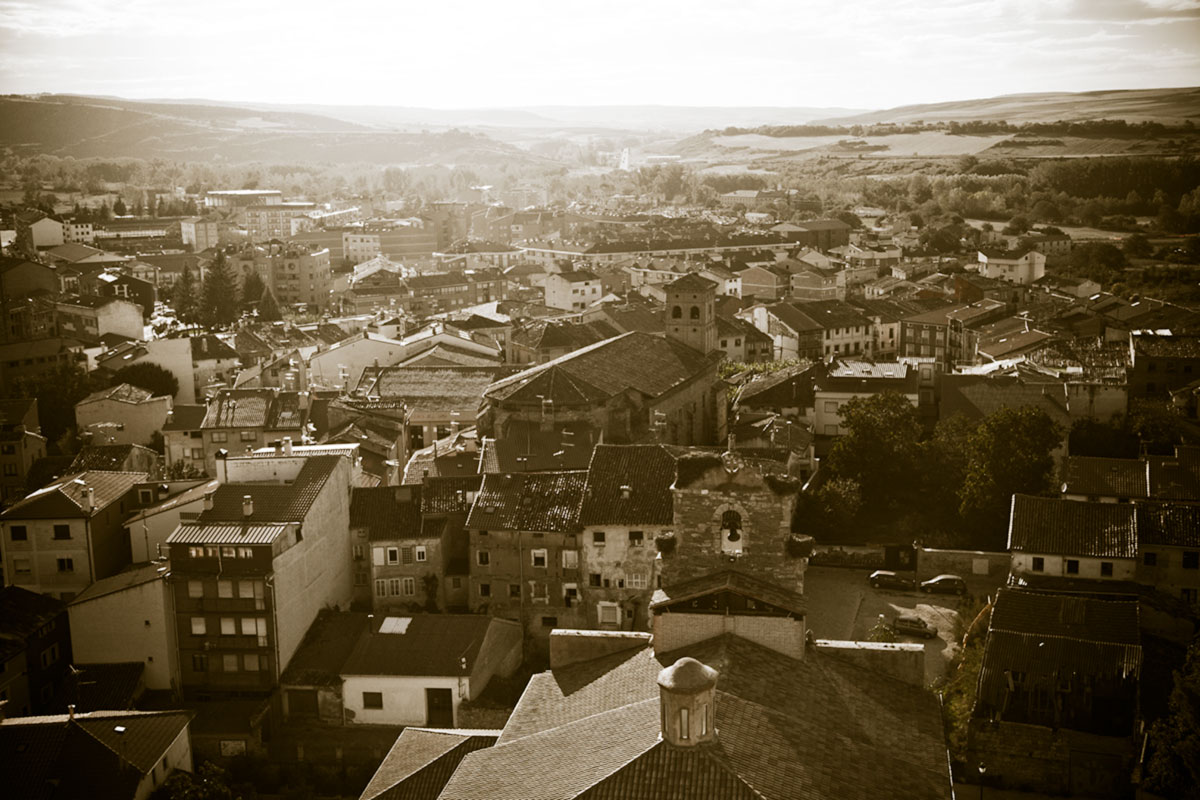
In about 4 km you reach Belorado, a town of around 2,000 inhabitants in a position that was once strategically vital — it sits between the Ebro valley and the Castilian plateau, controlling the pass between them. When the first Arab armies pushed north after 711, King Alfonso I had a castle built here; the remains of what is believed to be the tribute tower still stand on the hill above the town.
The town’s real splendour came in the 11th century, when Sancho III the Great rerouted the Camino to pass through here and thousands of pilgrims began flowing through annually. Aymeric Picaud, the 12th-century cleric whose Codex Calixtinus was the first Camino guidebook, mentions the town by the Latin name belforatus — “beautiful hole” — perhaps because it sits in a slight depression below the surrounding terrain. By 1116 Belorado had been granted the right to hold a fair, and the documents recording that grant make it the oldest documented fair in Spain. In the Middle Ages, fairs were not simply markets: they were the primary sites of long-distance trade, social exchange and credit transactions. The Belorado fair attracted Frankish and Jewish merchants, both groups vital to the medieval economy of the Camino corridor. After the expulsion of the Jews from Spain in 1492, the town began its long decline.
Today the main things worth seeing are the church of Santa María (with the parish hostel attached) and the church of San Pedro on the Plaza Mayor — medieval in origin but heavily reformed in the 17th century. The town also has the International Museum of Radio Communications Inocencio Bocanegra, housed in a former grain silo (the only building of its type fully restored in Spain), with a collection of over 450 original pieces and Europe’s largest interior recreation of a First World War trench at 619 square metres — an unexpected find on the Camino. Belorado is a natural water and food stop before the long climb through the Montes de Oca.
Tosantos to Villafranca de Montes de Oca: hermitages and the foot of the mountain (km 22–35)
From Belorado, 12 km of gentle, sustained climbing — mostly on trail or quiet road — lead to Villafranca de Montes de Oca. Along the way you pass through Tosantos, from where you can see across the valley to the Hermitage of the Virgen de la Peña carved into the cliff face — a series of rooms and dependencies excavated directly into the rock, of eremitic origin, which has been a place of devotion for centuries.
The variant through Villambistía (adds about 2 km from Tosantos, on dirt tracks) passes the church of San Esteban and a four-pipe fountain whose water, according to local tradition, cures the fatigue of pilgrims — though only when applied to the head, not drunk; the water is not potable. Whether you take the variant or the road, both options arrive at Espinosa del Camino before the final approach to Villafranca.
Villafranca de Montes de Oca (km 35) sits at the foot of the mountains and has all the services you need before the toughest section of the stage. The church of Santiago el Mayor on the left as you begin the ascent was built largely in the 17th century and is worth a brief stop for its stonework and the holy water stoup — a single enormous natural shell. Almost opposite, a former pilgrim hospital from 1377, built by order of a queen of Castile, now operates as a hostel and three-star hotel under the name Hotel San Antón Abad.
Montes de Oca: bandits, a Civil War monument and a bar in the woods (km 35–47)
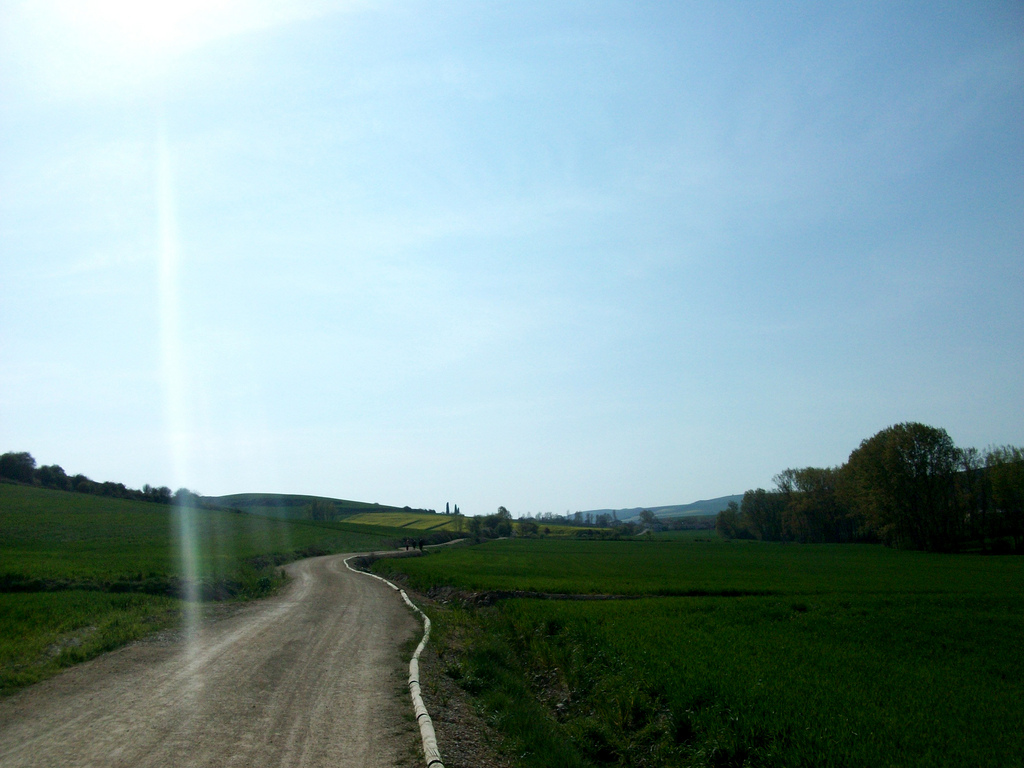
The Montes de Oca are a semi-mountainous territory dividing the river basins of the Duero and the Ebro — and for centuries, one of the most feared stretches of the entire Camino. The poet Fernán González described them as the eastern frontier of primitive Castile. Aymeric Picaud, in the 12th-century Codex Calixtinus, names them Nemus Oque — from the Latin nemus, a word specifically used for forests with sacred or numinous connotations, suggesting that even the medieval guidebook writer felt something particular about this place.
What pilgrims feared was not the supernatural but the practical: 12 km of dense woodland with no water and poor tracks — easy terrain for bandits, who made a living preying on the constant stream of people passing through with valuables, credence letters and foreign coinage. Medieval pilgrimage was an act of faith that required physical courage as well as spiritual conviction. Riding this section today, with good tracks and no particular danger, it is worth pausing to register what it cost people to do this in the 12th century.
The climb from Villafranca begins on a fairly narrow path with a mixed surface — the first 1.8 km are the most demanding, with large loose stones and gradients occasionally reaching 6–8%. After that the trail widens and the slope eases (maximum 3%). The surface can be problematic after rain: if conditions are bad, the road variant from Villafranca rejoins the trail at the Alto de la Pedraja (1,150 m), the highest point of the stage.
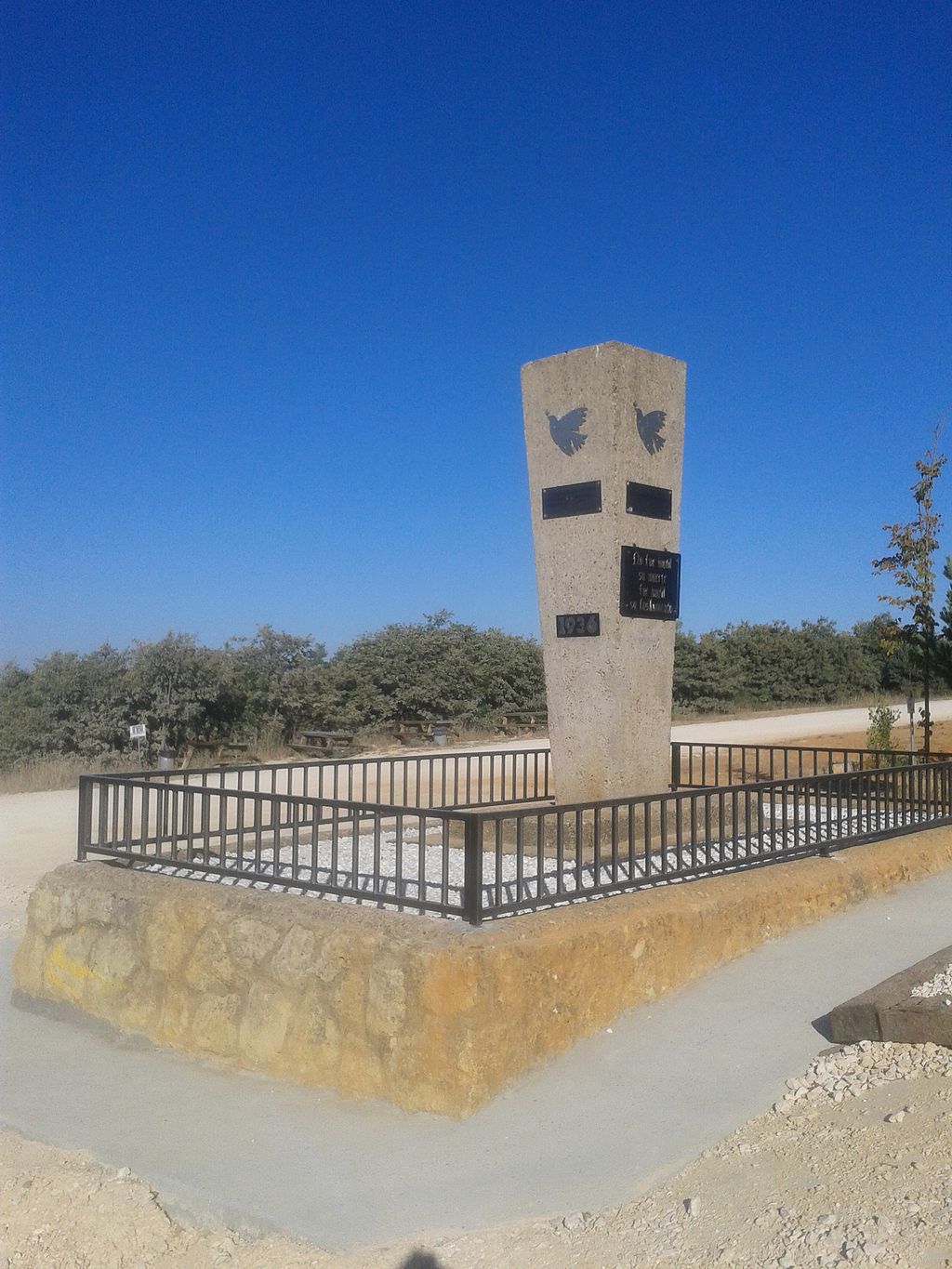
About halfway through the mountains, the trail passes a monument to the victims of the Spanish Civil War. It was erected by the families of more than 300 people who were shot here after the Francoist uprising in 1936 and buried in a mass grave — one of the largest in the province of Burgos. Pilgrims from across the world leave messages here in dozens of languages. It is a quiet place after the exertion of the climb, and the messages are sometimes extraordinary.
Just beyond the monument is a short but sharp descent and re-ascent over the río Carratón — 22 m down and 37 m back up in about a kilometre, with a ramp at the start steep enough that most cyclists with panniers push. After this the trail levels and widens toward the Alto de la Pedraja.
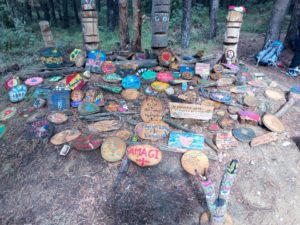
From the Alto de la Pedraja to San Juan de Ortega it is 7 km on wide, firm dirt tracks through pine forest. Near the high point, depending on the season, you may find the Oasis del Camino — an improvised outdoor bar with chairs and tables made from painted tree trunks, run on a voluntary contribution basis. It is not permanent, and in winter or early spring it may not be there. When it is, it is exactly what you need after the Montes de Oca.
San Juan de Ortega: the miracle of light and 800 years of service to pilgrims (km 47)
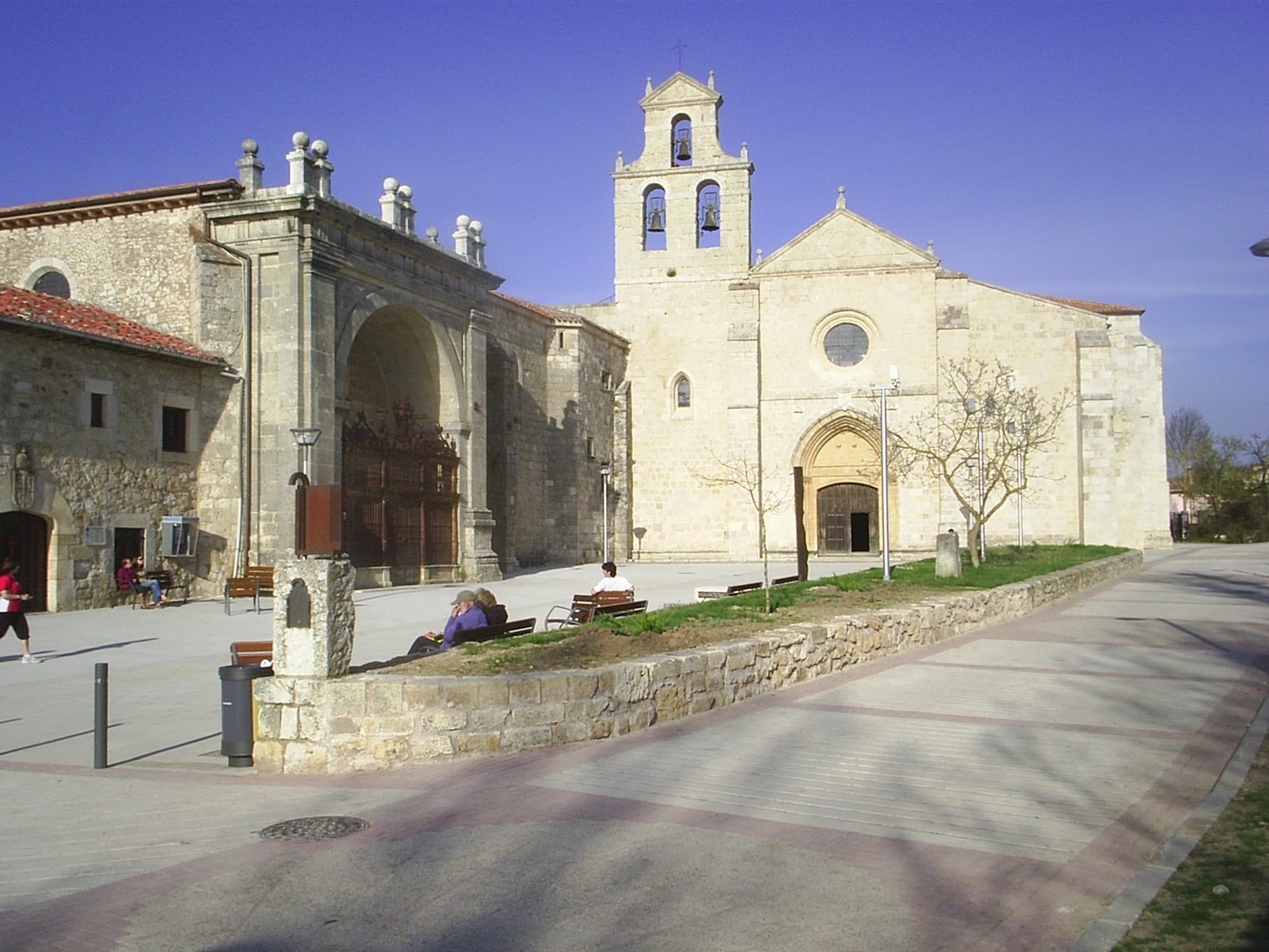
The monastery of San Juan de Ortega opens to your right as you enter the village — a sudden, unexpected architectural presence in the middle of the forest. The village takes its name from the man who founded it: Juan de Ortega, born in 1080 in Quintanaortuño, near Burgos.
Juan was a disciple of Santo Domingo de la Calzada — and like his teacher, he dedicated his life to building infrastructure for pilgrims rather than to contemplative monasticism. He is today the patron saint of road builders in Spain. He travelled to Jerusalem, was caught in a violent storm at sea that nearly killed him, and on surviving made a vow to build a chapel to San Nicolás on the most dangerous stretch of the Camino he knew — this forest in the Montes de Oca, called urtica for the dense nettles that grew there. He built the chapel, then a hospital, and a monastic community grew up around them. Juan died in 1163 in Nájera at the age of 83; his remains were brought back here, and the growing importance of the saint transformed the place into a pilgrimage destination in its own right.
The monastery was first managed by Dominicans, then by Hieronymites who greatly expanded it in 1476. Its most famous visitor was Queen Isabella of Castile, who came here to pray for children after six years without a pregnancy following the birth of her daughter Isabel. The following year she gave birth to a son, whom she named Juan in the saint’s honour. A year later she had another child — Juana, later known as Juana la Loca. It is hard not to see in those names a very deliberate act of gratitude.
The church itself is exceptional in two ways. First, the architecture: Juan died before the church was finished (construction always began with the apse, so mass could be said before the building was complete), and the work was interrupted for centuries before being resumed in the late 15th century. The result is a building where the apse is Romanesque — round arches, flared windows, the characteristic gravity of the style — while the nave and entrance are late Gothic. These are not compromises or inconsistencies; they are two different centuries expressing what they knew about space and light.
Second, the Miracle of the Light. Twice a year, at the spring and autumn equinoxes, at five o’clock in the afternoon, the setting sun sends a beam of light through a specific window that illuminates a capital in the northern apse — the Nativity capital, carved with a Romanesque Annunciation scene. The beam falls on the central figure of the Virgin with her two palms raised. It is an astronomical phenomenon that was engineered deliberately into the building’s orientation in the 12th century. Whether you are there at the equinox or not, look at the capital: it is a jewel of Romanesque carving, full of narrative detail, in near-perfect condition.
In the centre of the church stands a Gothic baldachin tomb — a canopied stone monument of great delicacy, housing a pair of important nobles who sponsored the monastery’s reconstruction. The tracery on the upper canopy is so fine it is hard to believe it started as solid stone. The saint’s own tomb, in the chapel of San Nicolás, is Romanesque, covered in carved scenes from his life.
Agés and the approach to Atapuerca (km 50–55)
From San Juan de Ortega a good gravel track through dense pine forest leads to a viewpoint — a wide esplanade where the trees open and the cultivated fields of Burgos spread out below you — before a slide descent into Agés.
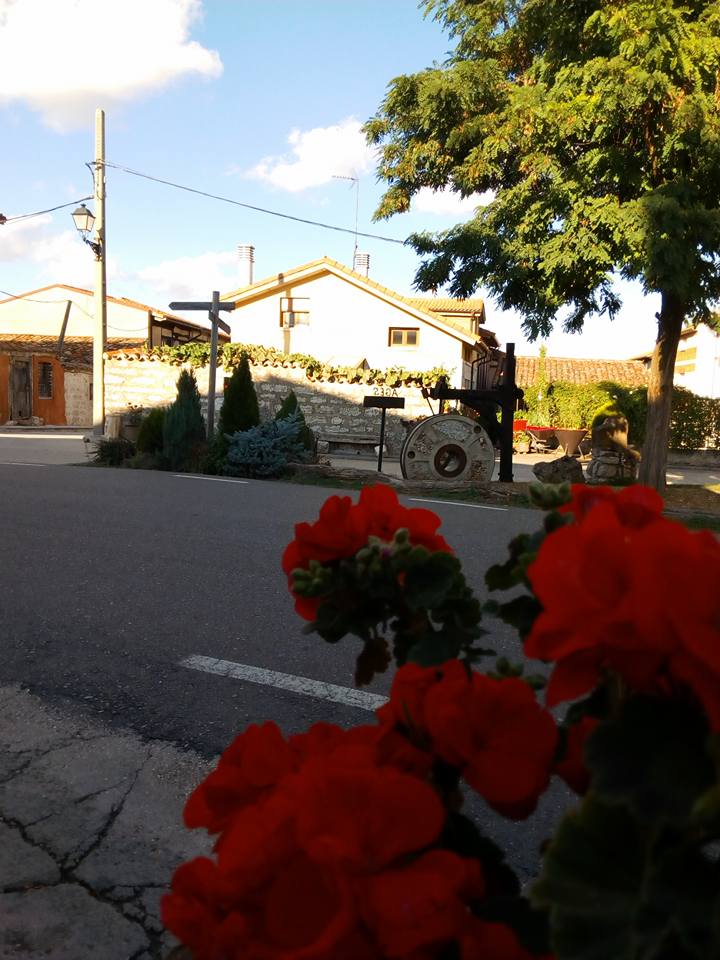
Agés is a village of barely 50 inhabitants today, but it was born in the 12th century as a frontier post on the border between Christian Castile and the territories still contested with the Moors — a military function that has left almost no visible trace. What remains is a tight cluster of stone houses and a well-regarded restaurant-shop called El Alquimista, run by Amapola and her husband, which serves traditional dishes from the area and opens for breakfast from 6 a.m. for early-rising cyclists. Three hostels make it a viable overnight stop if you want to split the stage.
From Agés the local road leads 1.6 km to the junction for the Atapuerca interpretation centre — a signposted track of about 600 m takes you directly to the entrance — or a further half kilometre to the village of Atapuerca itself, where the Camino trail begins the climb over the sierra.
The Sierra de Atapuerca: one million years of human history underfoot (km 55)
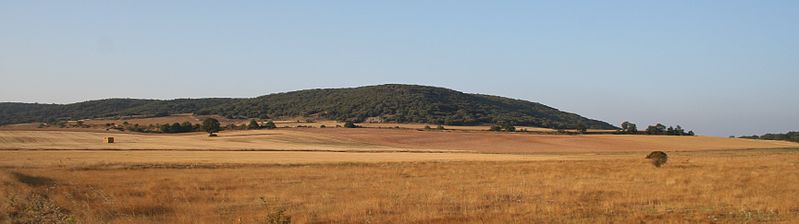
The Atapuerca archaeological sites have been a UNESCO World Heritage Site since 1999 and are among the most significant prehistoric sites in the world. The network of caves in this sierra has yielded the remains of at least four different hominid species — including Homo antecessor, a species identified here that may be ancestral to both Neanderthals and modern humans — along with tens of thousands of artefacts spanning more than a million years. Excavations beginning in the 1970s have transformed understanding of early human presence in Europe. Among the discoveries: evidence of what appears to be the earliest ritual behaviour in Europe, including deliberate burial and, controversially, the only documented example of ritual cannibalism on the continent, dating from the Bronze Age.
The sierra crossing itself is the most technically demanding section of the stage. From the village of Atapuerca, the trail climbs for 2.5 km with a height gain of 117 m — gradients reaching 9% at points, and a surface of large loose stones and natural rock steps that makes it genuinely difficult with panniers. Most cyclists push for parts of it. If conditions are wet, consider the road bypass via Olmos de Atapuerca, which avoids the technical section entirely and rejoins the Camino at Villalba.
At the top of the sierra (1,072 m) a large cross marks the highest point of the stage, with stones piled at its base by generations of pilgrims. A sign here quotes Luciano Huidobro, the historian who wrote one of the great 20th-century studies of the Camino: “Since the pilgrim ruled Burguete the mountains of Navarre and saw the vast plains of Spain, he has enjoyed no more beautiful view than this.” The descent — 2.5 km, 138 m, gradients between 3% and 8.5% — is also loose and requires care. After Villalba the road becomes tarmac and the profile softens considerably for the approach to Burgos.
You can visit the Atapuerca sites in three ways: organised visits from the interpretation centre (Tuesday to Sunday, hourly from 10:00 to 13:00); a daily bus from the Agés hostel that collects pilgrims for a guided visit; or from the Museum of Human Evolution in Burgos, which organises site visits and provides essential scientific context. If prehistoric archaeology interests you at all, the Burgos museum visit is the more rewarding option — the exhibition is excellent and prepares you to understand what you are seeing at the site itself.
Entering Burgos: industrial estate or river park (km 60–69)
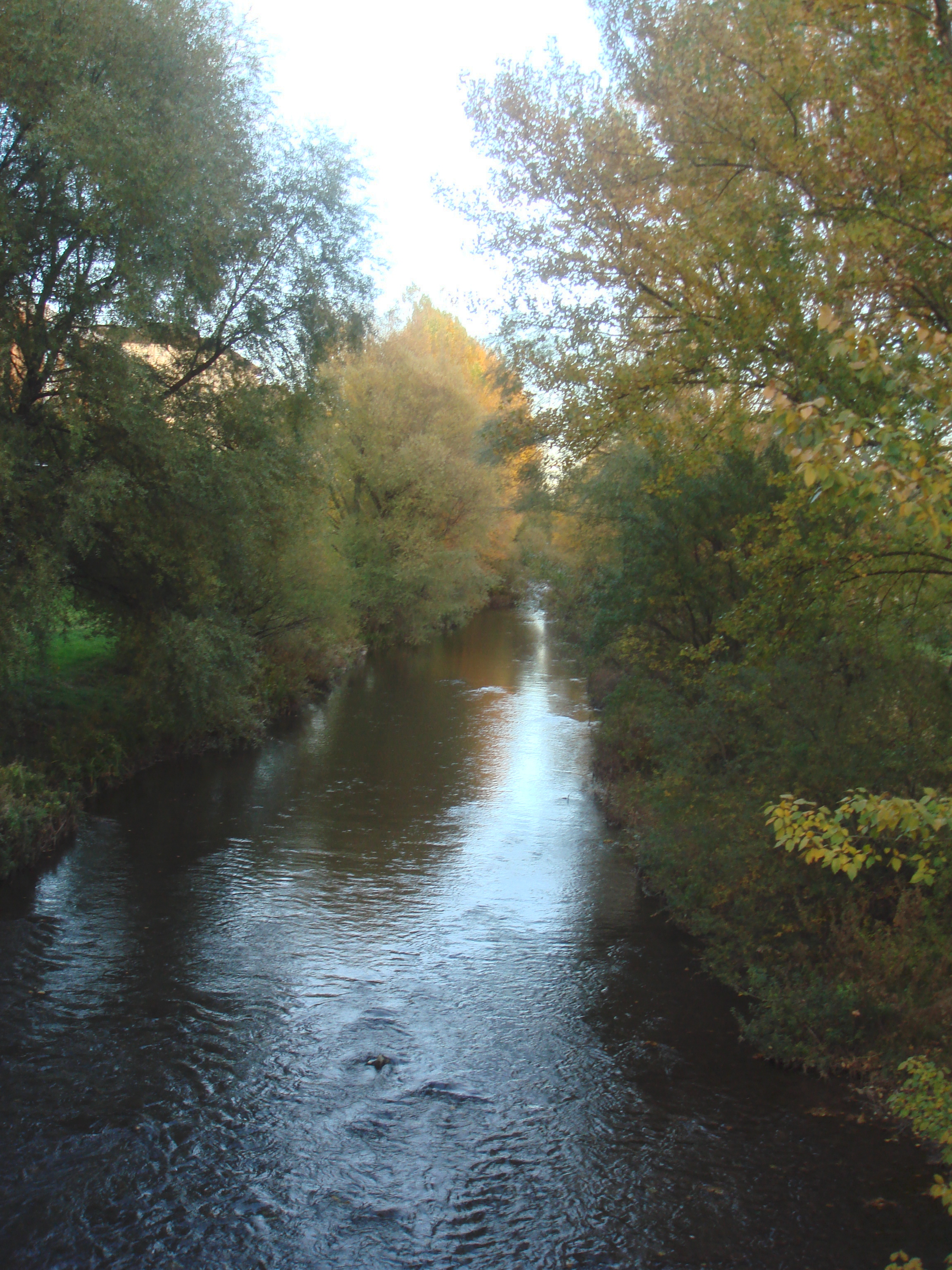
After Villalba the profile softens and the road becomes pleasant tarmac through Cardeñuela Riopico and Orbaneja Riopico. Beyond Orbaneja you cross the motorway on an overpass and face the city of Burgos ahead — with the airport between you and it.
Two options for the final approach. The original Camino borders the airport on the right and enters Burgos through the Gamonal industrial estate — 7 km of heavy traffic, trucks and suburban sprawl before reaching the cathedral. It is long and tedious and has nothing to recommend it except historical fidelity.
The Arlanzón river park variant is strongly recommended unless conditions are very muddy. To take it, turn left about 250 m after crossing the motorway overpass at the entrance to a residential area — the detour is marked with arrows on the asphalt. A gravel path borders the airport fence, leads through Castañares (cross the road carefully here), and enters the river park of the Arlanzón. About 4.5 km along the south bank of the river, a pedestrian bridge on the right takes you across and into the heart of Burgos in under 2 km. The cathedral appears at the end of the walk in a way that rewards the approach.
When you arrive: Burgos
Burgos is a genuinely monumental city — one of the great medieval cities of Europe — and it deserves more time than most cyclists give it. A full afternoon and morning is the minimum to do justice to the cathedral and the castle viewpoint. If you can spare an extra day, the Monastery of Las Huelgas, the Cartuja de Miraflores and the Museum of Human Evolution between them require another four to five hours. The city is also, after a week of villages and small towns, a pleasure to simply be in: good food, a proper bar scene, the Paseo del Espolón along the river.
How a military outpost became a Gothic capital
The city was founded in the 9th century in the context of the Reconquest, when King Alfonso III instructed a count named Diego Rodríguez to establish a fortified settlement on the Arlanzón river with the mission to populate rather than conquer — populare non expugnare. The count built a castle on the hill above the river and encouraged settlers by offering ownership of any land they cleared and farmed, asking only their loyalty in return. It was a dangerous offer in a dangerous territory, but people came. The early Burgos was a cluster of peasant houses around a military castle, essentially agrarian.
Everything changed in the 11th century. Sancho II used the castle as a prison for his brothers after seizing their kingdoms from them — the first royal attention the city received, and not particularly flattering. But subsequent kings came for better reasons, and over the following five centuries Burgos lived through a period of splendour that gave it nearly all the great buildings you see today. It was the city of El Cid, seat of the royal court, setting for royal weddings. The cathedral was enlarged and decorated. Monasteries appeared. The city’s economic centre shifted from the military hill to the commercial space around the cathedral — Burgos became a trading city, vital to the wool trade with Flanders and northern Europe, and the Camino brought craftsmen and merchants from all over the continent. In 1499 the Catholic Monarchs granted it the monopoly on the Spanish wool trade. It was, by any measure, one of the great cities of medieval Europe.
The 16th century brought everything down at once: plague, the discovery of America (which redirected trade), the wars in Flanders (which ended the wool exports) and the weakening of the Camino itself. The city did not begin to recover until the 19th century, when it was named provincial capital. The 20th century brought industry and strategic infrastructure. Today Burgos is a city of around 170,000 people — compact, walkable, and unexpectedly rich for its size.
The walking tour (allow 2 hours minimum)
Start at the castle viewpoint (mirador del castillo) at the top of the hill. The castle itself charges for entry and most of the interesting parts are underground — more than 300 metres of military galleries that can only be visited in the morning, so plan accordingly if you want to go inside. The viewpoint is free and accessible at any time, and offers the best overview of the city: the cathedral with its two Gothic spires, the squares around it, the medieval street grid, the Arlanzón and its parkway, and beyond, the vast plains of Burgos. Understanding the topography from here makes everything you walk through below make more sense.
Descend via Valentín Palencia Street, passing the Contemporary Art Centre of Burgos (CAB) on the left and the church of San Esteban on the right — a Gothic building of military appearance that houses the Museum of the Altarpiece, worth a look if ornate retables are your thing.
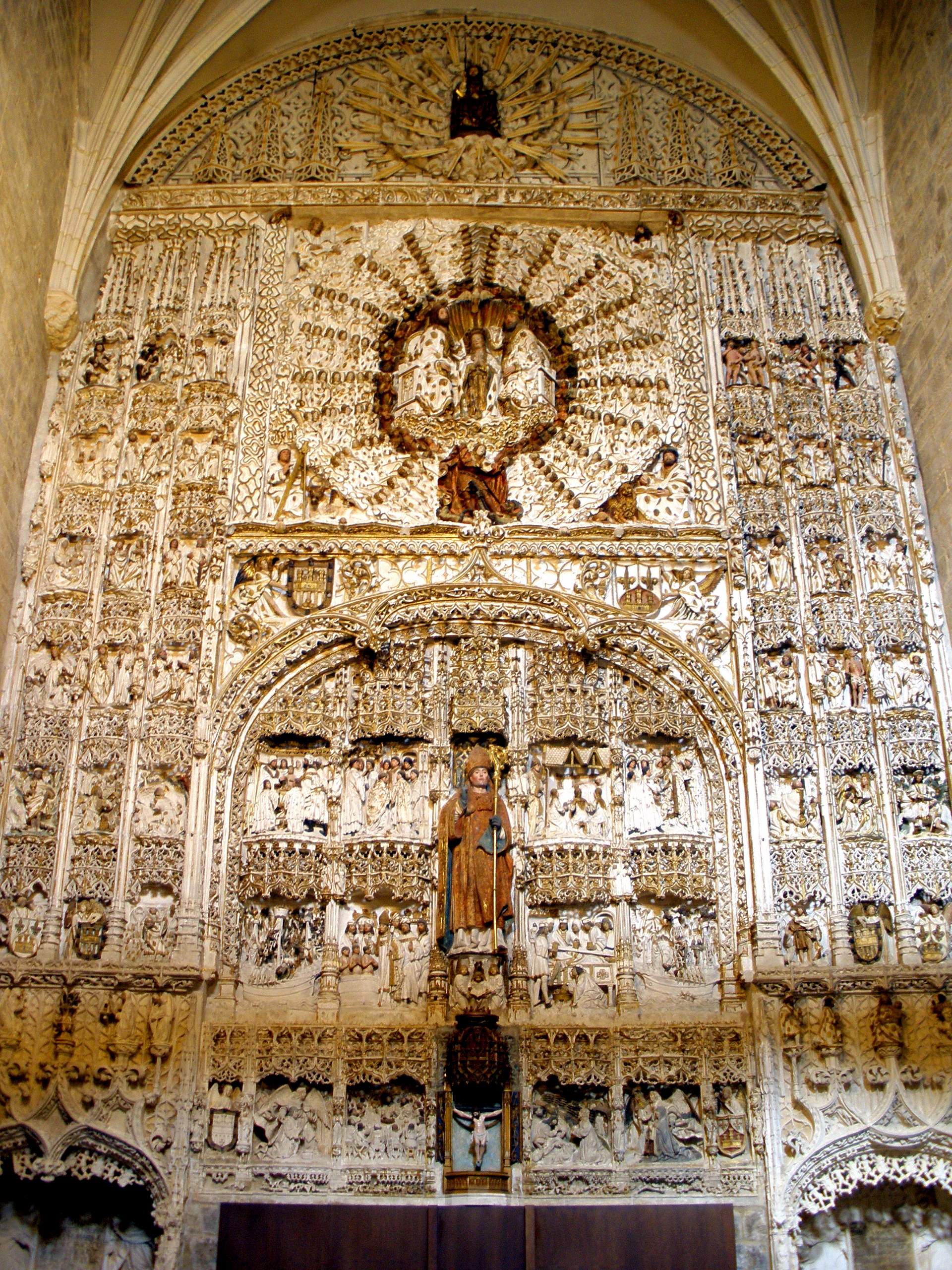
Continue down Fernán González Street to the church of San Nicolás de Bari — do not miss this one. Entry costs €1.50 but what it contains is disproportionate to the price: a stone altarpiece commissioned in the early 16th century from Francisco de Colonia, a sculptor born in Burgos but descended from a dynasty of German master craftsmen who shaped the decoration of Spanish Gothic cathedrals for generations. The altarpiece fills the entire east wall of the church and is carved in stone with the density and narrative detail of an illuminated manuscript. It is one of the finest pieces of Spanish Renaissance sculpture in existence and almost no one outside Burgos knows it is there.
The cathedral of Santa María: the best Gothic building in Spain
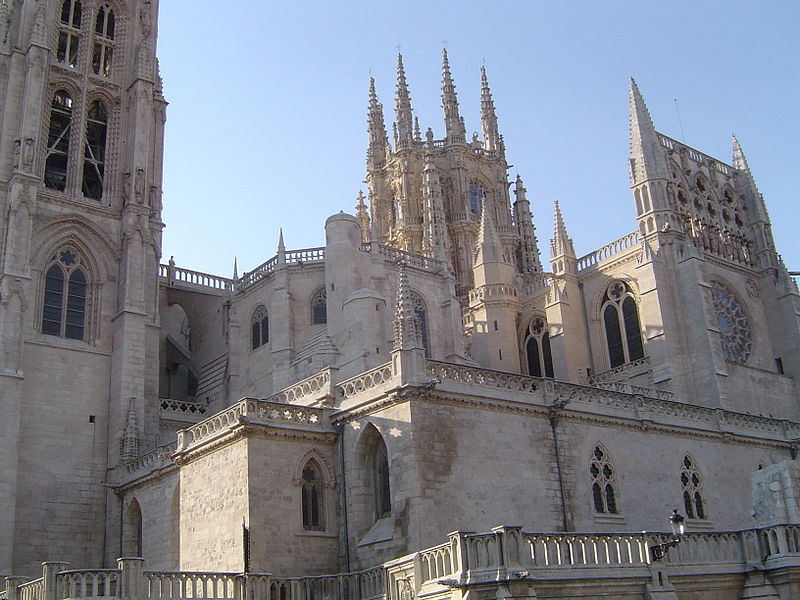
Cross the plaza of Santa María and buy your ticket in the plaza of San Fernando. Cathedral entry costs around €7 (reduced with the pilgrim credential). This is one of the most important Gothic buildings in the world and has been a World Heritage Site since 1984 — budget at least 90 minutes inside.
Construction began in 1221, at the height of classical Gothic — the same style and the same moment as the cathedrals of Paris, Chartres and Reims. Gothic had evolved from the earlier Romanesque style by replacing the massive walls and small windows of Romanesque with a skeletal structure of ribbed vaults and external buttresses that allowed the walls to become thin, light and filled with stained glass. The goal was to fill the interior with coloured light — God made perceptible through architecture. The Burgos cathedral, begun in this spirit, accumulated additions and alterations over five centuries, each layer reflecting the style of its moment.
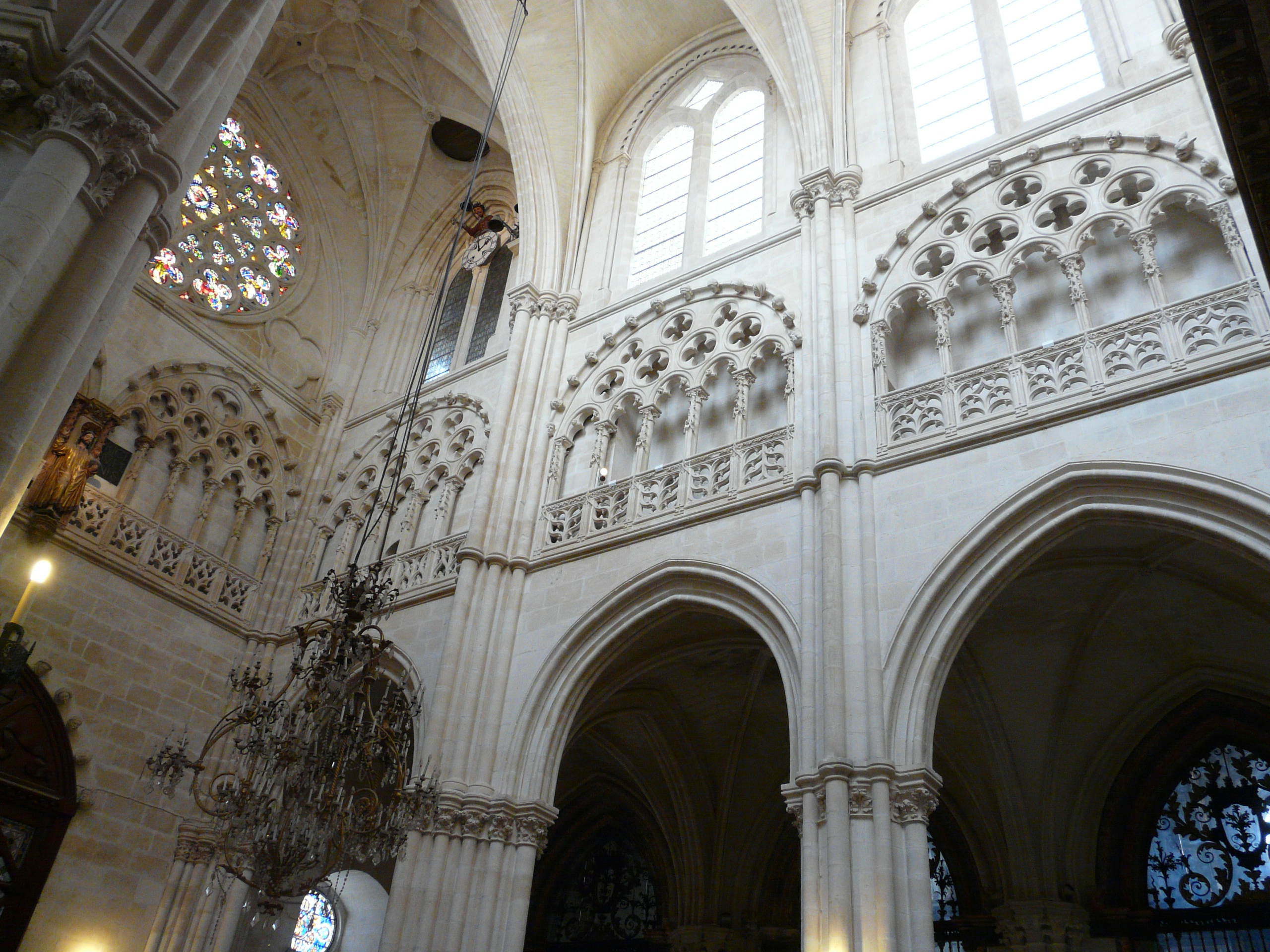
The twin spires of the main facade are the most visible addition: designed in the 15th century by Juan de Colonia — father of the sculptor who made the San Nicolás altarpiece — in the late Flamboyant Gothic style, they are covered in lace-like tracery that dissolves the solid stone into something that appears to be woven rather than carved. Juan de Colonia also designed the central lantern tower (the dome over the crossing, where all the naves intersect) — rebuilt after collapse in the 16th century in a star-vaulted design of extraordinary complexity. Below it, in the floor of the crossing, is the tomb of El Cid and Doña Jimena.
The Capilla del Condestable (Chapel of the Constable), at the far end of the cathedral, was built by Simón de Colonia — son of Juan, grandson of the German founder of the dynasty — and is perhaps the most beautiful room in the building: an octagonal late-Gothic chapel with a pierced star vault open to the sky, and tombs of the Constable of Castile and his wife of exceptional quality. The cloister is large, graceful, and contains the cathedral museum. The sculptural decoration throughout the building — on portals, capitals, choir stalls and chapels — would take days to read properly.
The Arco de Santa María and the statue of El Cid
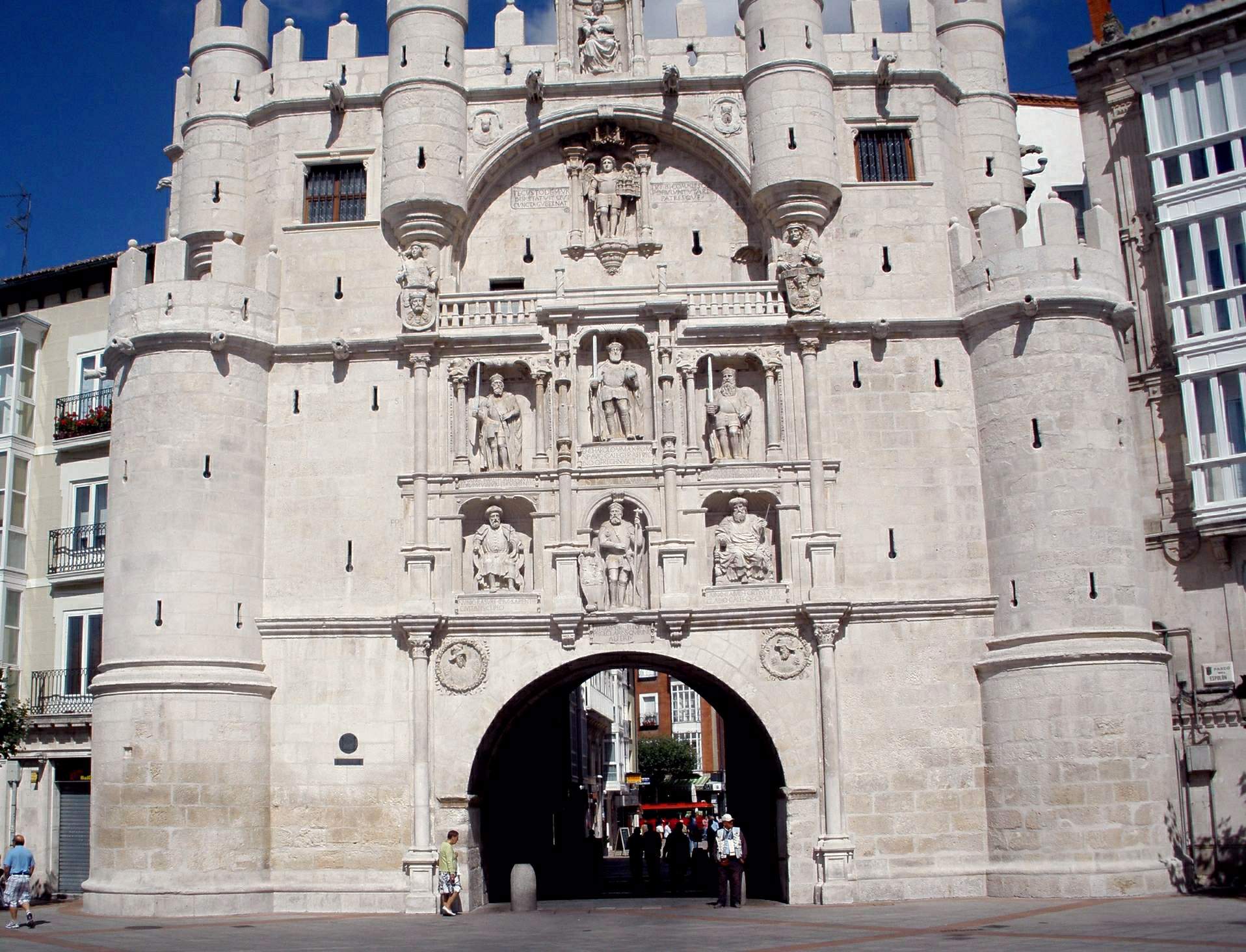
Leave the cathedral through the plaza of San Fernando and cross the Arco de Santa María — one of the twelve original gates of the medieval city wall, remodelled in the 14th to 16th centuries into a triumphal arch-cum-stone altarpiece, with carved figures of kings, warriors and saints filling its facade. The arch is mentioned in the Poema del Mío Cid, which means there was already something significant here in the 12th century. The interior, which once housed the town hall, has a free exhibition space. Entry free; opening hours vary.
Cross through the arch to the Paseo del Espolón — the main riverside promenade, redesigned in the 19th century and still the social centre of the city in summer evenings. Follow it north to the Plaza Mayor (which has had five different names over the centuries and is currently the location of a neoclassical town hall built over what was the old Puerta de Carretas) and then back south to the equestrian statue of El Cid, cast in bronze in 1947 by Juan Cristóbal González Quesada.
Rodrigo Díaz de Vivar — El Cid — was a historical figure: a knight of the Reconquest who conquered Valencia and held it as an independent lordship until his death in 1099, then his wife Jimena held it until 1102 when it reverted to Moorish control. Around this real person grew one of the great medieval legends, crystallised in the 12th-century Cantar del Mío Cid — the oldest major work of Castilian literature, and a text that served the same nation-building function in Spain that the Iliad served in Greece. Whether the real Rodrigo was the paladin of Christianity the poem describes, or a skilled mercenary who fought for whoever paid most (he served both Christian and Muslim rulers at different points), is a matter historians still debate. What is not in doubt is his cultural importance to Castile. The bronze statue on the Espolón, 4 metres tall, with his coat billowing in an imaginary wind, captures the legend rather than the man — which is what statues usually do.
Gastronomy in Burgos
The streets around the Plaza Mayor — particularly Calle San Lorenzo and the parallel Calle Sombrería — are where you find the best concentration of bars and restaurants. Burgos has a strong food culture centred on a few specific things: morcilla de Burgos (blood sausage with rice, mild and deeply savoury, nothing like any other blood sausage you may have tried), queso fresco de Burgos (a soft fresh cheese, eaten on its own or with honey), and lechazo (milk-fed lamb, roasted in a wood oven, the signature dish of the Castilian meseta). For the lamb you need to book a restaurant that specialises in it; for the sausage and cheese, any bar in the old city will do. A glass of local Ribera del Duero red with the morcilla is the combination that most Burgalese would recommend.
If you have an extra day: Las Huelgas, the Cartuja and the Museum of Human Evolution
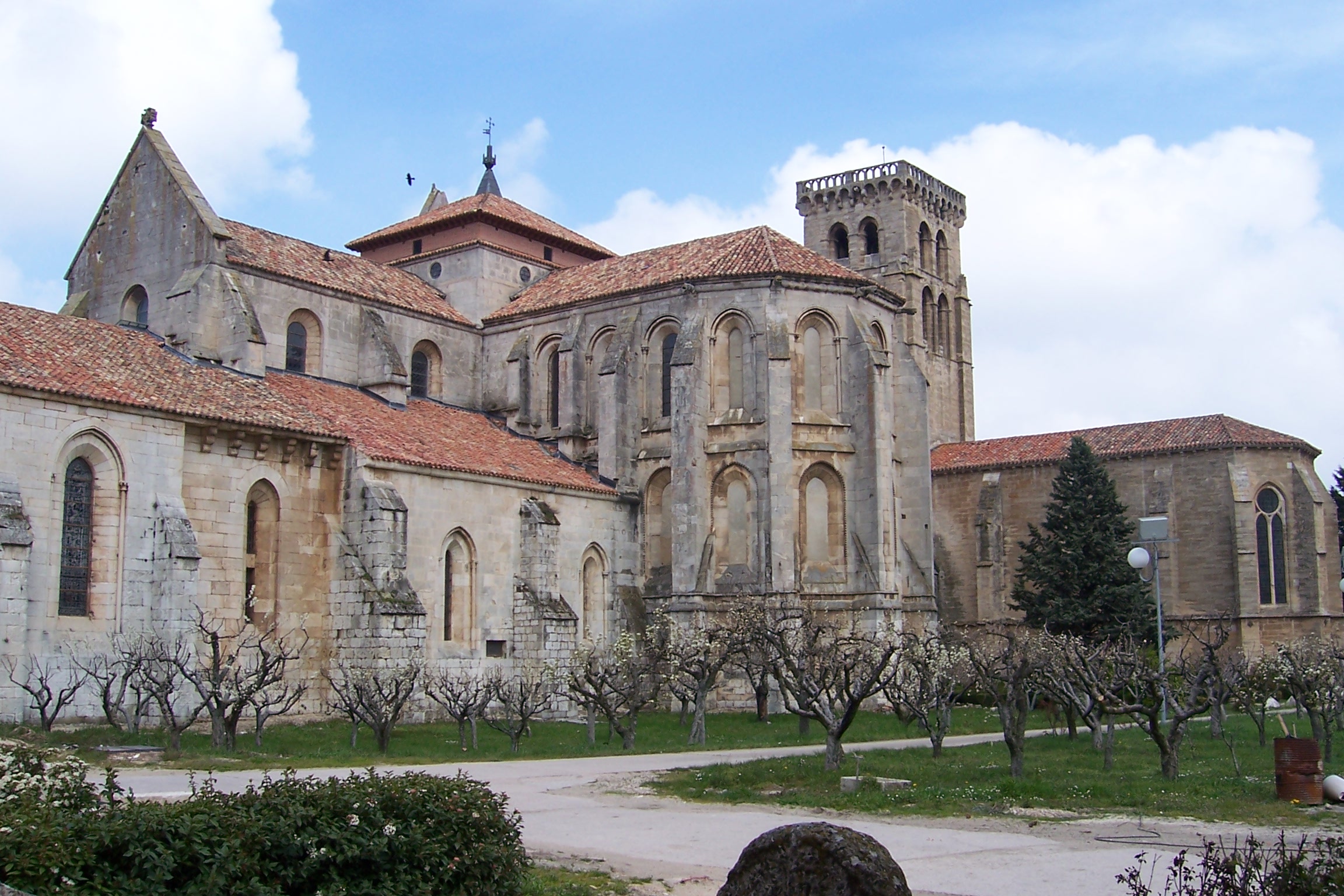
The Monastery of Las Huelgas, to the west of the city on the south bank of the Arlanzón, is the most important Cistercian monastery in Spain and one of the most significant royal foundations in medieval Europe. It was commissioned directly by Alfonso VIII and his queen, Eleanor of England (daughter of Henry II and Eleanor of Aquitaine), in 1187, dedicated to the Virgin Mary, and designed as both a religious house and a royal pantheon. The nuns — mostly high-born women, daughters of the nobility — answered only to the Pope, not to any bishop, and exercised authority over a network of subsidiary monasteries and estates. The queen who founded it, Eleanor, explicitly wanted women to hold the same ecclesiastical authority as men; in its early centuries, this monastery was one of the few places in medieval Europe where something approaching that was true. The royal pantheon holds the tombs of multiple Castilian and Leonese kings and queens, and the textile collections from the burials — preserved fabrics from the 12th and 13th centuries — are among the finest medieval cloth survivals anywhere. Entry is by guided visit only, with limited capacity. Closed Mondays.
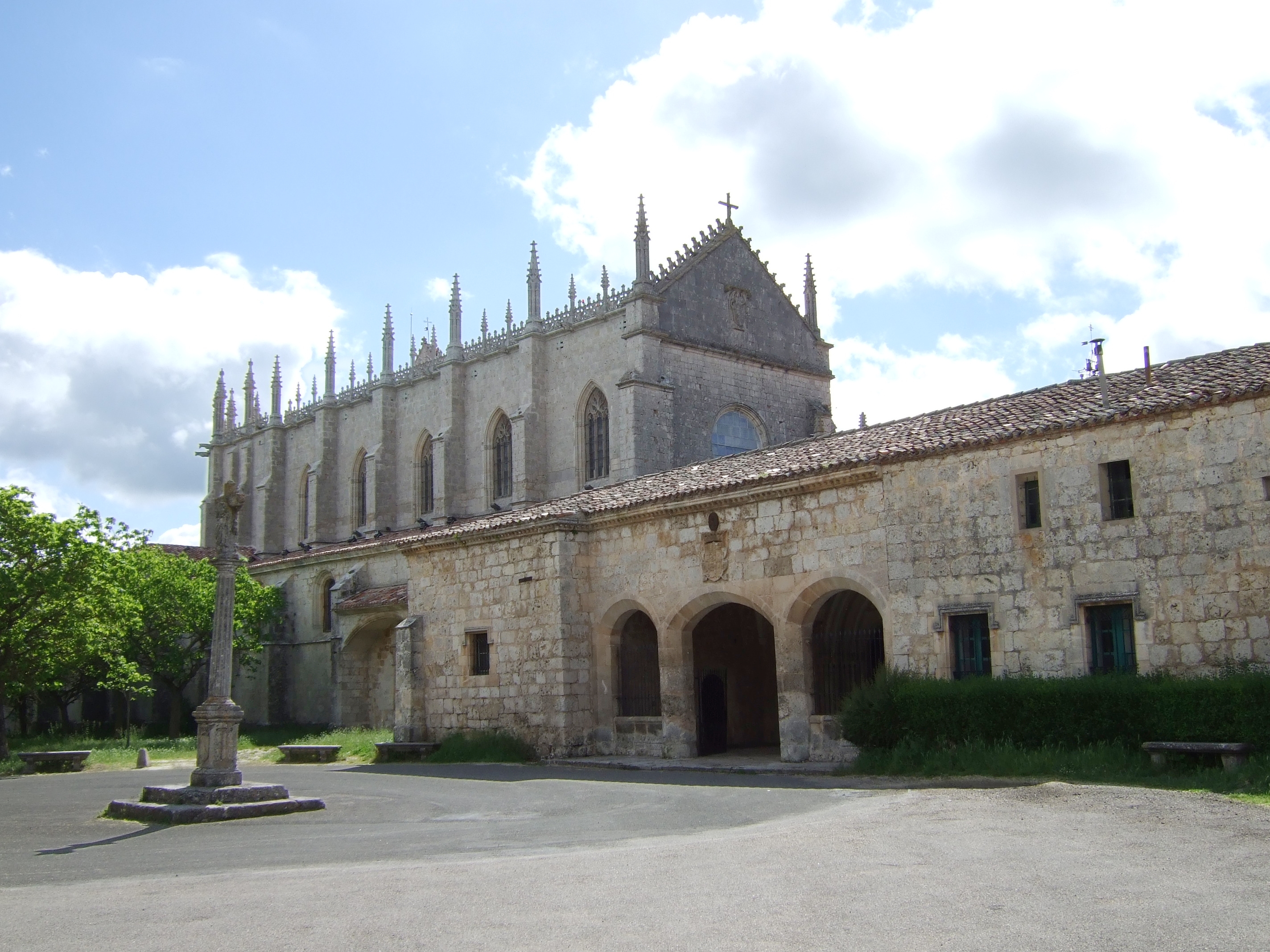
The Cartuja de Miraflores, to the east of the city in a park setting, is a Carthusian monastery founded in the 15th century and rebuilt entirely after a fire — which means the church is all late-Gothic, consistent in style in a way that the cathedral, with its centuries of additions, is not. The stained glass is exceptional. The tombs of Alfonso of Castile and his wife Isabel of Portugal — parents of the Catholic Monarchs — are the work of Gil de Siloé, one of the greatest sculptors of late medieval Spain, and their carved alabaster detail is extraordinary. Entry is free. The monastery is still active and the monks run a small shop selling honey and other products. Closed Sunday mornings.
The Museum of Human Evolution (Museo de la Evolución Humana), on the riverbank near the cathedral, is organised around the Atapuerca discoveries and is one of the best science museums in Spain. It does three things well: it presents the scientific significance of Atapuerca clearly enough for a non-specialist to understand, it places those findings in the context of a million years of human evolution, and it conveys the complexity and collaboration of the archaeological process. If you visited the Atapuerca interpretation centre on the trail, the museum fills in everything the brief site visit could not. It also organises guided transport to the excavation sites for those who want a more in-depth visit. Closed Mondays; entry free on Tuesdays and weekends after 16:30.
Worth the detour: Santo Domingo de Silos
About 60 km south of Burgos — roughly an hour by car or a long cycling day on its own — the Benedictine monastery of Santo Domingo de Silos contains what is generally considered the finest Romanesque cloister in Spain, and one of the finest in Europe. It is best done as a dedicated rest day from Burgos; combining it with Stage 6 is not realistic unless you are arriving very early and using an e-bike. For those with an extra day, it is one of the great cultural rewards of this part of the Camino corridor.
The monastery and its founder
The site has been a place of Christian monastic life since at least the 7th century, but the monastery as it exists today takes its name from Domingo de Silos, a Benedictine monk born in Navarre around 1000. Domingo had been prior of the monastery of San Millán de la Cogolla (the same monastery from Stage 5’s detour, one of the recurring threads of this section of the Camino) until a conflict with the King of Navarre forced him out. He was given the ruined monastery of San Sebastián de Silos by the King of Castile, Ferdinand I, in 1041, and spent the rest of his life rebuilding it and transforming it into one of the most important centres of Benedictine learning and art in medieval Spain. He died in 1073 and was canonised within decades. The monastery took his name.
The cloister: Romanesque sculpture at its finest
The lower cloister, built in the late 11th and early 12th centuries, is the centrepiece of any visit. It is a two-storey square arcaded courtyard, the columns carved with capitals of extraordinary quality — animals, biblical scenes, fantastic creatures, interlaced patterns of Mozarabic origin — but what sets it apart from any comparable Romanesque work are the eight large narrative relief panels set into the corner piers.
These panels depict scenes from the Passion and Resurrection of Christ and from the life of the apostles, carved in a style that is emphatically not what you expect from 11th-century sculpture. The figures have weight, individual expression, narrative drama — qualities usually associated with Gothic work of the 13th century or later. Art historians regard these reliefs as among the most advanced sculptural works produced anywhere in Europe in the Romanesque period, anticipating by over a century the innovations usually credited to Gothic. The carving of drapery, the rendering of spatial depth, the emotional engagement between figures — all of it is here, in a Benedictine cloister in a valley in the Sierra de la Demanda, in the late 11th century.
The upper cloister, added in the 16th century, is Renaissance in style and houses the monastery museum. The pharmacy, one of the oldest in continuous operation in Spain, is also open to visitors.
Gregorian chant and how to attend
The Benedictine community at Silos is one of very few in Europe that has maintained an unbroken tradition of Gregorian chant at the canonical hours. In 1994, their recordings became an unexpected international bestseller — Chant spent months in classical music charts in multiple countries — but the practice had nothing to do with the commercial moment and everything to do with a community that had been singing the same liturgy in the same place for nearly a millennium.
Visitors can attend the monastic offices in the church, where the community sings the daily hours. The most accessible for day visitors are Lauds (7:30 a.m.) and Vespers (7:00 p.m.). The experience of hearing polyphonic plainchant in the Romanesque church, after having spent time in the cloister, is one of those rare combinations of place and sound that stays with you. Plan your visit to include at least one office.
Practical notes
The monastery is open daily except Monday mornings. The cloister can be visited independently; guided tours of the museum and pharmacy are available at set times. Entry to the cloister is approximately €3.50. Vespers is free and open to all.
By car from Burgos the drive takes about an hour via the BU-903 south through Covarrubias (which is itself worth stopping in — a well-preserved medieval village with a remarkable collegiate church and another royal pantheon). By bike it is a 60 km round trip with significant climbing in the final approach to Silos; strong cyclists can do it in a day, but it is more enjoyably done slowly, spending the night in Silos or Covarrubias and returning to Burgos the following morning before Stage 7.
Practical notes for Stage 6
Water and supplies
Services are reasonably frequent until Villafranca de Montes de Oca (km 35), after which there is nothing reliable for 12 km through the mountains until San Juan de Ortega (km 47) — and even San Juan de Ortega is a very small village (hostel, basic bar). The Oasis del Camino near the Alto de la Pedraja exists seasonally and cannot be relied on. Fill your water bottles in Villafranca before beginning the Montes de Oca. Atapuerca village (km 55) has a bar and basic supplies. From there to Burgos (14 km) there is nothing significant until the city itself.
Surface and bike type
The stage mixes tarmac, compact dirt tracks, and two genuinely technical sections: the Montes de Oca climb (narrow, loose stones, gradients to 8%) and the Sierra de Atapuerca ascent and descent (large loose stones, steps, gradients to 9%). An MTB handles both without difficulty. A gravel bike manages but the Atapuerca section is uncomfortable with panniers. A road bike should take the road bypass for both sections. An e-bike makes the climbs much easier but the loose surface on both technical sections requires care regardless of power — disc brakes are important here. The Arlanzón river entry to Burgos is on gravel and becomes muddy after significant rain; in that case the Gamonal industrial route, though uglier, is more reliable.
Starting this stage in Santo Domingo de la Calzada
Santo Domingo has local bus connections from Logroño (46 km), Burgos, Zaragoza, Madrid and Barcelona. There is no train station; the nearest are Haro (21 km), Miranda de Ebro (38 km) and Logroño (46 km). If arriving from further afield, flying into Bilbao or Madrid and connecting by bus is the most practical option. Tournride delivers bikes to your accommodation in Santo Domingo de la Calzada the evening before your departure — and can transfer your luggage to Burgos while you ride.
Visiting the cathedral of Burgos
The cathedral closes at 19:30 in summer (18:00 in winter). If you arrive late, you can visit the exterior and the surrounding squares in the evening and return from 10:00 the following morning. Entry with the pilgrim credential is approximately €5.50. The Capilla del Condestable and the cloister museum are included. Allow 90 minutes minimum; two hours is better.
Frequently asked questions about Stage 6
How far is Stage 6 of the Camino Francés by bike?
69 km from Santo Domingo de la Calzada to Burgos. This is the first genuinely long day of the French Way and includes two technically demanding sections — the Montes de Oca crossing and the Sierra de Atapuerca ascent and descent. Start before 8 a.m. to arrive in Burgos with time for the cathedral.
Is Stage 6 the most difficult stage so far?
It is the longest and technically most varied. The Montes de Oca and Atapuerca sections involve loose, rocky surfaces and gradients of 6–9% that require care, particularly with panniers. The total elevation gain is around 900 m — less than Stage 1 in the Pyrenees, but more sustained. On an e-bike the climbs are manageable; the technical surface is the main challenge regardless of power.
Is Santo Domingo de Silos worth visiting from Burgos?
Yes — it contains the finest Romanesque cloister in Spain and a living Gregorian chant tradition that has been unbroken for nearly a thousand years. It is best done as a dedicated rest day from Burgos rather than combined with Stage 6. If you have any interest in medieval art, architecture or music, it is one of the most rewarding detours on the entire Camino corridor.
Where can I sleep in Burgos?
Burgos has a wide range: the municipal pilgrim hostel near the cathedral (basic, inexpensive, fills early in season), several private hostels in the old city, and a full range of hotels. The city is large enough that accommodation is generally available even in peak season, but the best-located options near the cathedral book up — reserve two to three days ahead in July and August.
Can I rent a bike in Santo Domingo de la Calzada and return it in Santiago?
Yes. Tournride delivers your bike to any accommodation in Santo Domingo de la Calzada the evening before your departure and collects it in Santiago de Compostela when you finish. Luggage transfer in a single leg, from the start to the end of the trip, is also available. See all bike models and check availability here.
Cycle the Camino de Santiago at your own pace.
Plan this stage by bike