
STAGE 5: FROM LOGROÑO TO SANTO DOMINGO DE LA CALZADA
Xavier Rodríguez PrietoStage 5 is one of the most rewarding cycling days on the French Way — not because of the physical challenge, which is modest, but because of what you ride through. Forty-seven kilometres of La Rioja wine country, three towns with deep Jacobean history, a medieval legend about giants, a royal monastery built on a miracle, and a cathedral with a live rooster and hen inside it. After the demanding stages through the Pyrenees and Navarre, this is the day the Camino starts to feel like a journey through time as much as a physical undertaking.
| Distance | Elevation gain | Estimated time | Difficulty | Distance to Santiago |
|---|---|---|---|---|
| 47 km | +350 m cumulative | 3.5–4.5 hours riding | 🟢 Low–medium | ~609 km |
Key stops: Navarrete (km 14) · Nájera (km 27) · Azofra (km 34) · Santo Domingo de la Calzada (km 47)
Optional detour: San Millán de la Cogolla (+21 km from Azofra — one of the great hidden rewards of the French Way)
Route profile and key milestones
Leaving Logroño: the Grajera reservoir (km 0–14)
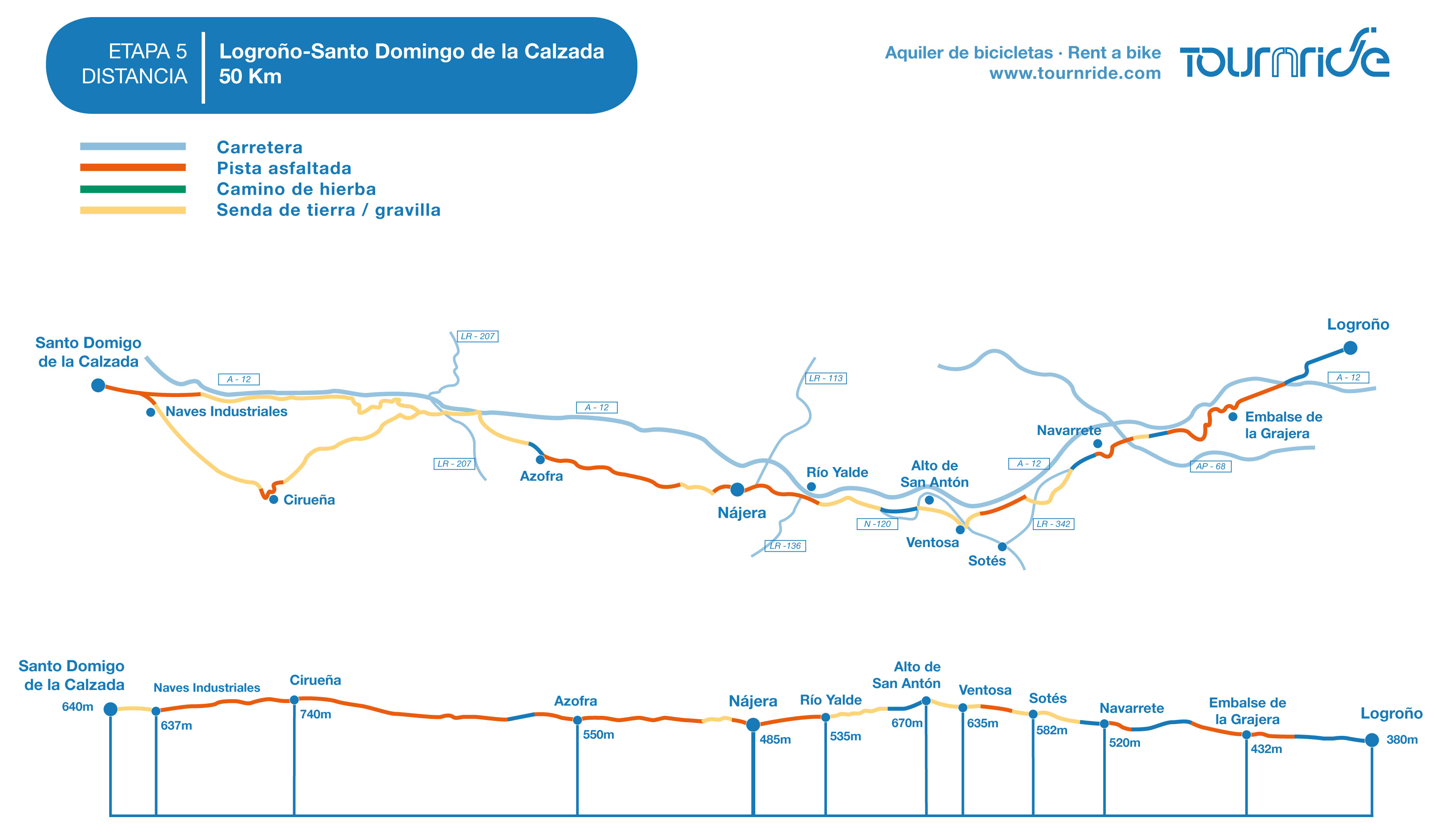
Leaving Logroño through the industrial outskirts, a well-signed cycle path leads you south-west along a gentle 1.5% ramp to the edge of the Grajera reservoir in under 2.5 km. The reservoir was built in 1883 to irrigate the orchards around the city and is now a protected natural area and park. The water looks inviting on a hot day — do not be tempted: it is an environmental protection zone and swimming is strictly prohibited.
You skirt the reservoir on the right, climb a short ramp to the edge of the A-12 motorway, and follow asphalted tracks and gravel paths parallel to it. The surface alternates between compact gravel and tarmac throughout the morning — comfortable for any bike type. After crossing the AP-68 via an overpass, the gradient settles into a gentle, sustained climb through vineyards for 9 km to the Alto de San Antón (km 20, 675 m altitude). This is the only real climb of the day.
Just before the pass, a fork gives you the option of detouring through Ventosa (adds roughly 1 km). Worth it if you need water: the village has a bar-hostel with secure bike storage. From the Alto de San Antón the road descends steadily for 7.5 km into Nájera — the town comes into view almost immediately and you will not lose sight of it for the rest of the descent.
Navarrete: pottery, Romanesque carving and a medieval legend (km 14)
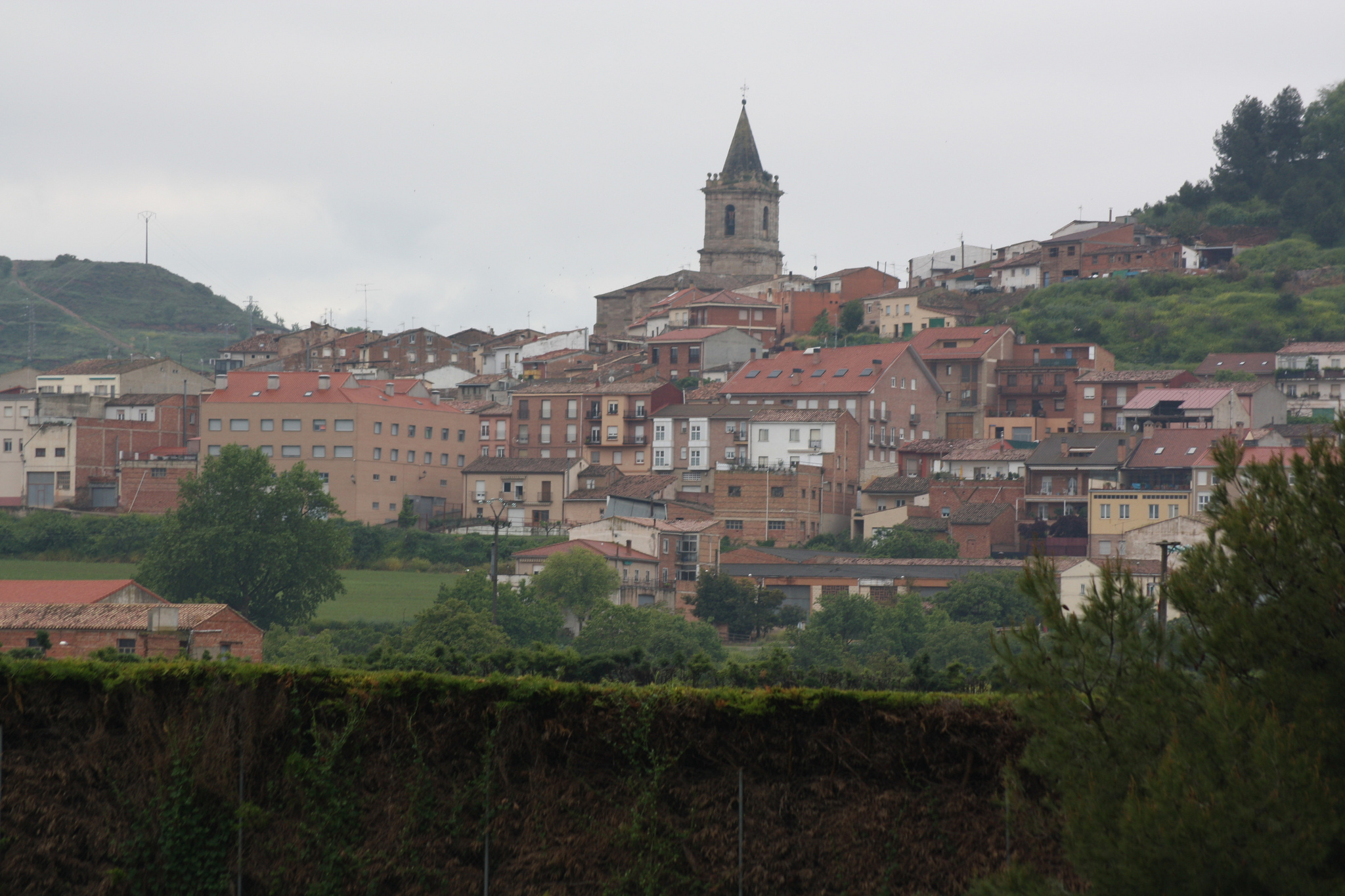
Navarrete sits on top of the Tedeón hill. This strategic position gave it a strongly defensive character until the 16th century — castle at the summit, surrounding walls, the Camino threading through it from east to west along two parallel main streets on the hillside. The castle and walls are gone, but the configuration of the town still follows that medieval logic.
The main monument is the Church of the Assumption of the Virgin in the town centre. Its exterior is restrained Renaissance — simple, almost austere — but step inside if you have the chance: the altarpiece and retable in Baroque style are extraordinary, carved entirely in gilded wood and covering the entire east end of the church. The contrast between the plain facade and the exuberant interior is one of the pleasures of Spanish religious architecture.
Navarrete is also one of the most important traditional pottery centres on the peninsula, a tradition going back to Roman times. The local clay from the Najerilla river was used to produce terra sigillata — the fine red ceramic ware the Romans exported across their empire — and the craft never entirely disappeared. You will notice the pottery shops and workshops as you ride through; the pieces for sale are the real thing, not tourist souvenirs.
On the way out of town, on your left, the cemetery incorporates the ornate carved portal of the old Hospital of San Juan de Acre, a 12th-century pilgrim hospital that was demolished in 1885. The stones were moved here piece by piece. Stop for a moment and look at the late-Romanesque carving in detail: it is surprisingly rich. Among the scenes you can make out Roland fighting the giant Ferragut (the same legend you will encounter again in a few kilometres), St George and the dragon, and tender angels embracing. The cemetery gate itself — originally the north door of the hospital church — is flanked by two large windows that once framed the head of the building. A plaque nearby commemorates Alice Craemer, a pilgrim killed by a truck on the Camino in 1986.
The road to Nájera: Roland, Ferragut and the Poyo de Roldán (km 14–27)
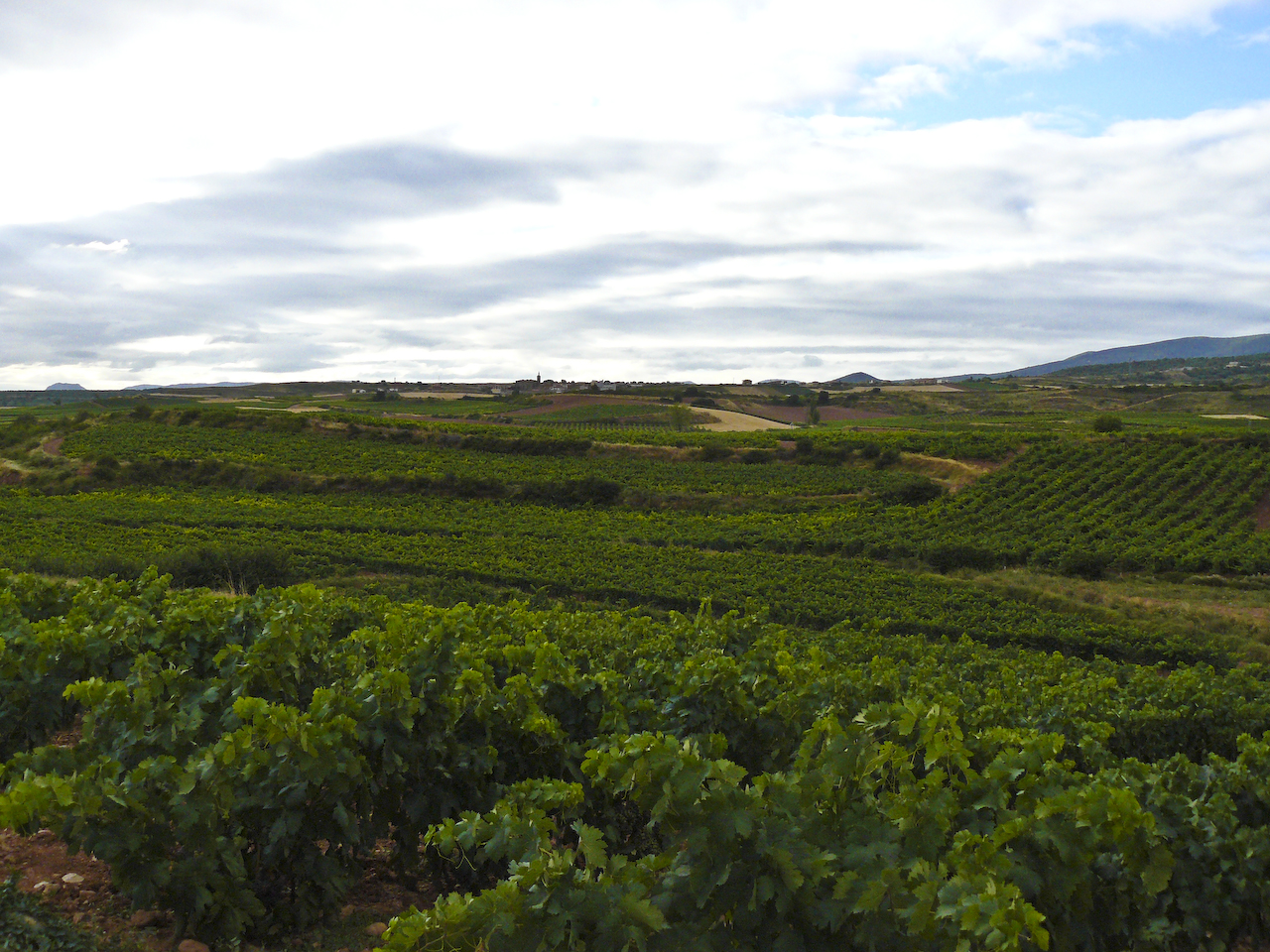
From Navarrete the route follows dirt tracks and quiet tarmac through fields and vineyards, crossing under the A-12 via an underpass and continuing with the motorway to the right. A few kilometres before Nájera, an explanatory board marks the Poyo de Roldán — the hill to your left where, according to one of the great legends of the Camino, Charlemagne’s nephew Roland fought the Muslim giant Ferragut.
Roland was a historical figure — a military commander who fought for Charlemagne and died at the Battle of Roncevaux in 778 — but his feats accumulated layers of legend over centuries. The story of Ferragut runs like this: word reached Charlemagne that in these lands a Syrian giant called Ferragut had declared the supremacy of Islam over Christianity. Charlemagne sent soldiers to fight him; none could defeat him. Roland asked permission to fight and they battled for two days and two nights. During a truce the two opponents began to talk — about faith, about their religions — and in this unexpectedly reflective moment, Ferragut made a fatal confession: his only vulnerable spot was his navel. When the fighting resumed, Roland struck there and the giant fell.
The legend fits its historical context precisely. It was created during the Reconquest as a symbolic narrative about Christian military supremacy — Roland as the champion of Christianity, his victory not simply physical but ideological. The scene you saw carved at Navarrete is the same story: the Camino is full of these threads connecting one place to the next if you know where to look.
Shortly after the Poyo de Roldán a sign welcomes you to Nájera: “Pilgrim: in Nájera, you are from Nájera.” It is painted on the wall of a farmhouse at the village entrance — a small, warm thing.
Nájera: the royal pantheon and the monastery of Santa María la Real (km 27)

You enter Nájera from the east and cross the Najerilla river on the stone bridge attributed to San Juan de Ortega — the 11th-century pilgrim infrastructure builder whose own monastery you will pass on Stage 6. The bridge has been reformed repeatedly over the centuries but the crossing has been here since the Camino was in full flower.
Do not ride straight through Nájera. The Monastery of Santa María la Real, on the west bank of the river, is one of the finest stops on this entire section of the Camino — and one of the most overlooked because many cyclists just follow the yellow arrows and miss it.
The monastery was founded in 1052 by King García Sánchez II after he conquered the territory from the Moors. The founding story involves a royal hunt: the king, pursuing a partridge, followed it into a cave and found inside a statue of the Virgin, a vase of lilies and a bell. He took this as a divine sign and built a church on that spot, dedicating it to the Virgin. The cave is still visible at the foot of the church — you can stand inside the cave where the legend says this happened, which is a genuinely strange and moving experience.
The monastery became the royal pantheon of the kings of Navarre. The pantheon contains twelve royal tombs from the 10th to 12th centuries, carved with an intricacy and expressiveness that makes them among the finest Romanesque funerary sculpture in Spain. The carved figures recline on the lids of the tombs with a gravity that 900 years has not diminished. Many nobles are also buried in the cloister, which is itself a jewel — Gothic tracery, beautifully preserved, buzzing with carved detail.
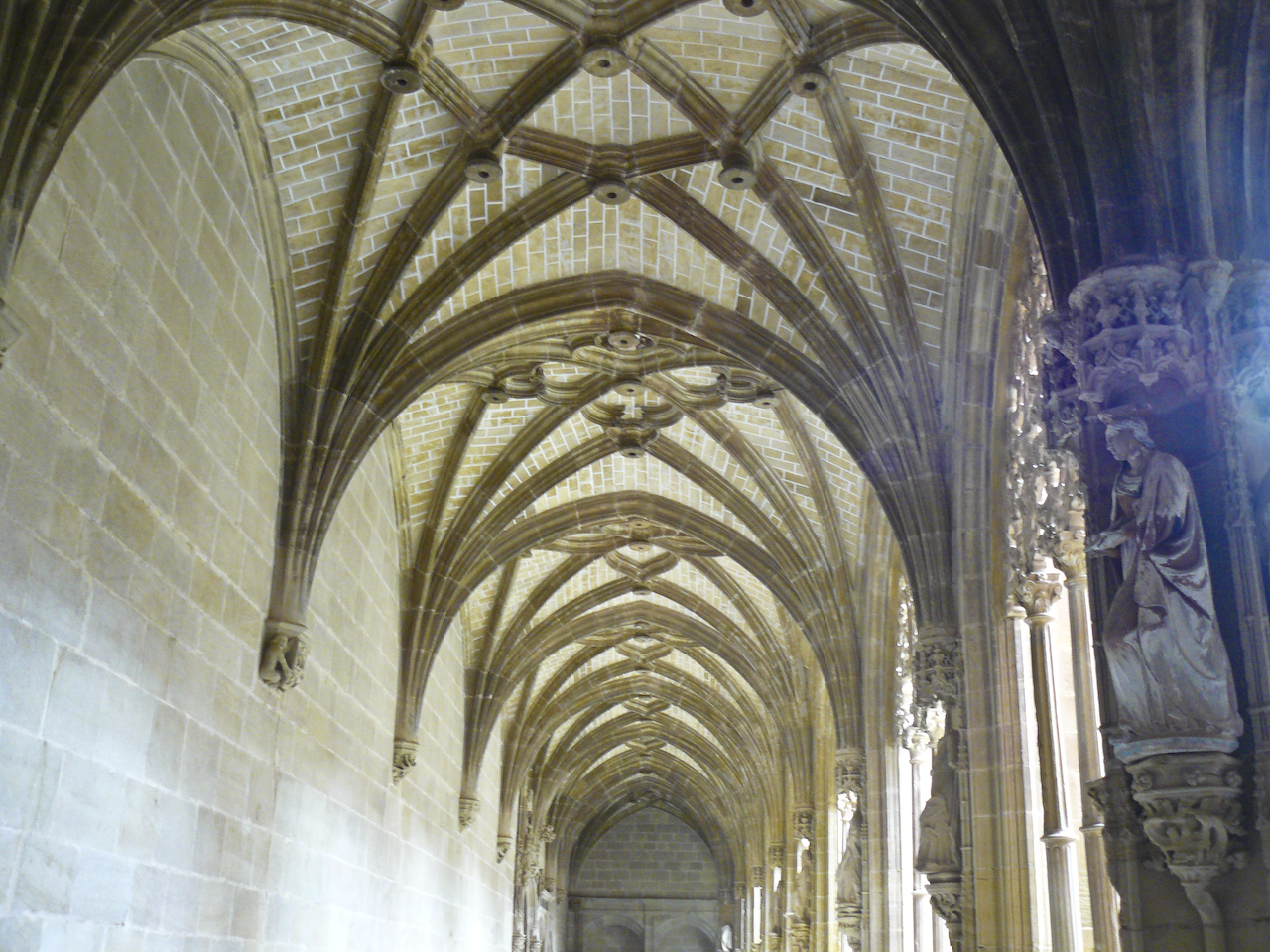
The monastery passed from Cluny management to the Franciscans in the 19th century and is still active today. Entry costs around €4. Closed Mondays.
Nájera is also worth a brief exploration beyond the monastery. The Najerilla river runs below impressive vertical walls of red earth — ochre and terracotta sandstone rising directly from the water — and the combination of the natural gorge with the medieval stone buildings above it is one of the more visually striking settings on the whole French Way. If you have the energy, the ruined Nájera castle on the hill above the town offers the best views; its origin, like so many things here, is Moorish, and it was later rehabilitated as a palace in the 16th century before falling into disrepair. The views are worth the short climb even if the castle itself is largely gone.
Nájera at km 27 is the natural lunch stop of the stage — good bars and restaurants along the main street, and a natural halfway point before the easy run to Santo Domingo.
Nájera to Azofra: the decision point (km 27–34)
Leaving Nájera uphill on Costanilla Street, the route transitions quickly to a good dirt track with a smooth, gentle profile through open fields and vineyards. In 5.5 km you reach Azofra (km 34), a small village with a fountain, bar and hostel. You enter through its main street — which, as in many Jacobean villages, coincides with the Way itself, making the Camino the literal spine of the settlement.
Azofra is the key decision point of the stage: continue directly to Santo Domingo (12 km) or take the detour to San Millán de la Cogolla (adds 21 km)? See the full detour section below. If you are going straight, note that after crossing the A-12 you have a fork: the direct option hugs the highway on gravel, while the scenic variant loops through Cirueña on vineyard tracks. The Cirueña route adds about 2 km but is significantly more pleasant. Both converge before Santo Domingo.
Into Santo Domingo de la Calzada (km 47)
You enter the town on Calle San Roque from the east. The total elevation gain for the stage is around 350 m accumulated gradually — no single climb is demanding. In good conditions on any bike type this is a 3.5 to 4.5 hour riding stage, leaving a full afternoon for the town.
When you arrive: Santo Domingo de la Calzada
Santo Domingo de la Calzada rewards arriving early and staying curious. The town was effectively created by one man, in one lifetime, out of nothing — and understanding that story makes everything you see here make sense. Give yourself at least 90 minutes for the walk described below; two hours if you want the cathedral museum and the tower.
The man who built the town: Domingo García
In the 11th century, this stretch of the Camino was a dense oak forest beside the river Oja. Almost nothing was here. A hermit named Domingo García — who had been turned away from the Benedictine monastery of San Millán de la Cogolla — settled in that forest and began doing something quietly extraordinary: he started building infrastructure for pilgrims.
First a wooden bridge over the Oja to replace the dangerous ford. Then a stone bridge when the wooden one wore out. Then a shelter for pilgrims who had nowhere to sleep. Then a church. Then a paved road — a calzada — to replace the muddy track that turned to bog every winter. Domingo worked on all of this for decades, sometimes alongside a bishop who shared his mission, and later with his disciple Juan de Ortega, who continued the work after Domingo’s death in 1109 and whose own monastery you will pass on Stage 6.
King Alfonso VI recognised the economic and strategic value of all this infrastructure and appointed Domingo to oversee road construction across a wider section of the Camino. For this legacy, Domingo García is today the patron saint of civil engineers in Spain. The town that grew up around his works — and that is still organised around the bridge, the church and the hospital he built — took his name.
The walking tour (90 minutes)
Enter Calle Mayor from the east — this is the main street and it follows the exact line of the Camino through town, as it has done for a thousand years. A few hundred metres along on your left, a large stone building: the Monastery of Nuestra Señora de la Asunción, a 17th-century Cistercian abbey that still operates. The nuns run a small guesthouse and sell homemade produce; the pilgrim hostel attached to the monastery is free.
Continue along Calle Mayor to the House of the Brotherhood of the Saint — a complex of buildings from the 16th century to the present, with a permanent exhibition on the life of Domingo García. This is also where the roosters and hens destined for the cathedral are raised before they are taken there; the birds are changed every fortnight. Opposite the Brotherhood house, the shaded Alameda square is a natural rest stop.

The street opens into the Plaza del Santo, anchored by three things: the Exenta Tower, the cathedral, and the Parador. The Exenta Tower is the tallest in La Rioja and stands completely detached from the cathedral — an unusual arrangement explained by the instability of the ground near the river, which could not support the combined weight. Before the current Baroque tower there was a Romanesque one and then a Gothic one, each destroyed in turn by fire or structural failure. Local tradition holds that animal bones were mixed into the foundations to improve stability. You can climb the tower; the ticket can be combined with cathedral entry and the views over the surrounding countryside and the town are excellent.
The small hermitage of Our Lady of the Plaza, beside the tower, is said to have been built on the site of a small oratory that Domingo García constructed with his own hands. The current building dates from various phases between the 14th and early 18th centuries.
The Parador facing the tower occupies what was Domingo’s original pilgrim hospital. It is now one of Spain’s historic Parador hotels — worth walking into the lobby even if you are not staying, for the Gothic arches and the panelled wooden ceiling of the entrance hall.
The cathedral: where the hen sang after being roasted
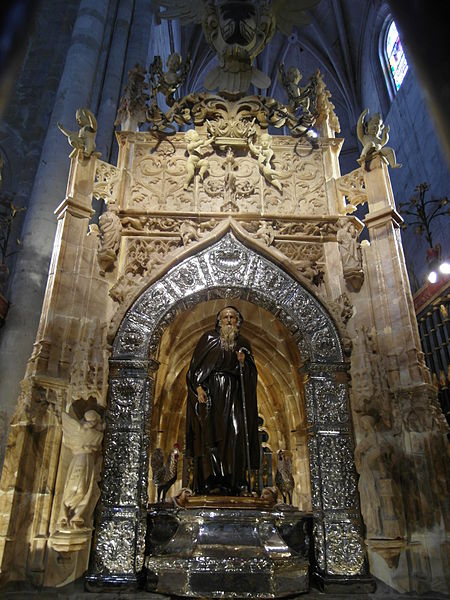
The cathedral of Santo Domingo de la Calzada began as the simple church Domingo García built beside the river in the 11th century. As the Camino grew in importance and the town with it, successive building campaigns transformed it into the large Gothic-Romanesque structure you see today. In 1106 its rank was raised to collegiate church; in the 13th century the episcopal seat moved here from Calahorra and it became a cathedral. The result is a building that mixes Romanesque, Gothic and Baroque elements in a way that, rather than being incoherent, reads as a layered record of eight centuries of continuous use and care.
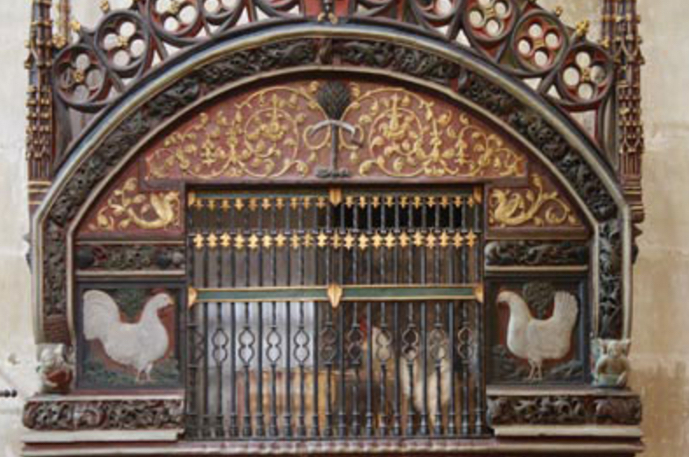
Two things make this cathedral unlike any other on the Camino. The first is what you notice immediately on entering the south arm: a Gothic cage on the wall containing a live rooster and a live hen. The birds are changed every fortnight and have been kept here, without interruption, for centuries. The reason is the town’s most famous miracle — and its motto.
The story runs like this. A German family — father, mother, young son — stopped here on their way to Santiago. The innkeeper’s daughter fell for the son; he did not return her interest. Scorned, she hid a silver goblet in his bag and then accused him of theft. He was found guilty and hanged. His parents continued to Santiago in grief and on their return stopped again at the gallows — and found their son alive, still hanging but sustained, he told them, by Santo Domingo, who had held him up with his own hands. They ran to the magistrate to report the miracle. The magistrate — who was at that moment about to eat a roasted chicken — dismissed them: “Your son is no more alive than the chicken on my plate.” At that moment the chicken stood up, sprouted feathers and crowed. The town motto has been, ever since: “where the hen sang after being roasted.”
The second exceptional thing is the carved decoration on the capitals of the apse. Experts consider this late-Romanesque iconographic programme one of the finest and most complete of its era anywhere in Spain. Look carefully: biblical scenes, fantastic animals, representations of legends. The carving is both precise and expressive in a way that centuries of weathering in other buildings have taken away from comparable work elsewhere — here, protected inside, it survives in remarkable condition.
The cathedral museum occupies the cloister on the north side and is worth visiting if you have any interest in medieval sacred art and the history of the Camino. Cathedral and tower combined entry costs approximately €7 with the pilgrim credential. Opening hours vary seasonally — check before visiting.
Completing the walk: medieval walls, a Franciscan convent and dinner
Cross through the apse of the cathedral and you reach the Plaza de España, where the town hall occupies a building whose ground-floor arcades were once the stalls of merchants selling under cover, sheltered by the wall behind them. The upper floors expanded over centuries in the Baroque style you see today.
From the square, Burgos Avenue follows the line of the old medieval wall. The original perimeter was more than 1.5 km, with walls averaging 12 metres high, 38 turrets and seven gates. What you see on Burgos Avenue are the remains of one of those towers and a section of the thick stone walls that once enclosed the entire town — surprisingly well preserved.
Continue to the Parador Bernardo de Fresneda — a second Parador in this remarkably well-endowed town, occupying a former 16th-century Franciscan convent. Abandoned during the 19th-century disentailment and later restored, it now functions as a hotel and art restoration workshop. The attached Church of San Francisco holds the tomb of Fray Bernardo de Fresneda, who served as confessor to both Charles V and Philip II and invested heavily in the construction of his own funerary chapel. The Renaissance transept is the architectural highlight — calm and precisely proportioned in a way that contrasts pleasantly with the exuberance of the cathedral.
End the walk on Juan Carlos I Avenue, where most of the town’s restaurants are concentrated. Rioja cuisine here means cod prepared in the local style, patatas a la riojana (potatoes with chorizo, onion and paprika), and caparrones (the local red beans, richer than you expect). To drink, obviously, a glass of Rioja. After the stage and the walk, you have more than earned it.
Worth the detour: San Millán de la Cogolla

From Azofra, a 21 km detour south-east into the Sierra de la Demanda takes you to one of the most historically significant monastic complexes in Spain — a UNESCO World Heritage Site since 1997, and the place where the Spanish language was first written down. If you have any interest in history or culture, this detour is one of the great rewards of the French Way that most pilgrims never make time for.
The detour adds approximately 33 km to the total day (taking the route Nájera–Azofra–San Millán–Cirueña–Santo Domingo) compared to the standard 47 km direct. Most cyclists do it as a dedicated rest-day excursion from Nájera or Santo Domingo rather than combining it with the stage itself — but on an e-bike, starting early from Logroño, it is manageable in a single day.
The origins: a hermit, a cave and a mixed community
The site’s origins lie in the 5th century, when a man called Emiliano — later canonised as San Millán — was born in these Rioja highlands. He spent his life as a hermit dedicated to Christianity, becoming known across the region for his holiness. After his death, his remains were placed in the cave where he had lived, which became first a church and then the nucleus of a monastic community.
This early community was unlike the monasteries we know today: it followed the Mozarabic rule — the tradition of Christians living under Muslim rule, deeply influenced by the art and culture of Al-Andalus — and it was mixed, housing both men and women. This was entirely normal in the Iberian Peninsula until the 9th century, when Roman ecclesiastical norms gradually imposed gender separation.
Suso and Yuso: two monasteries, one golden age
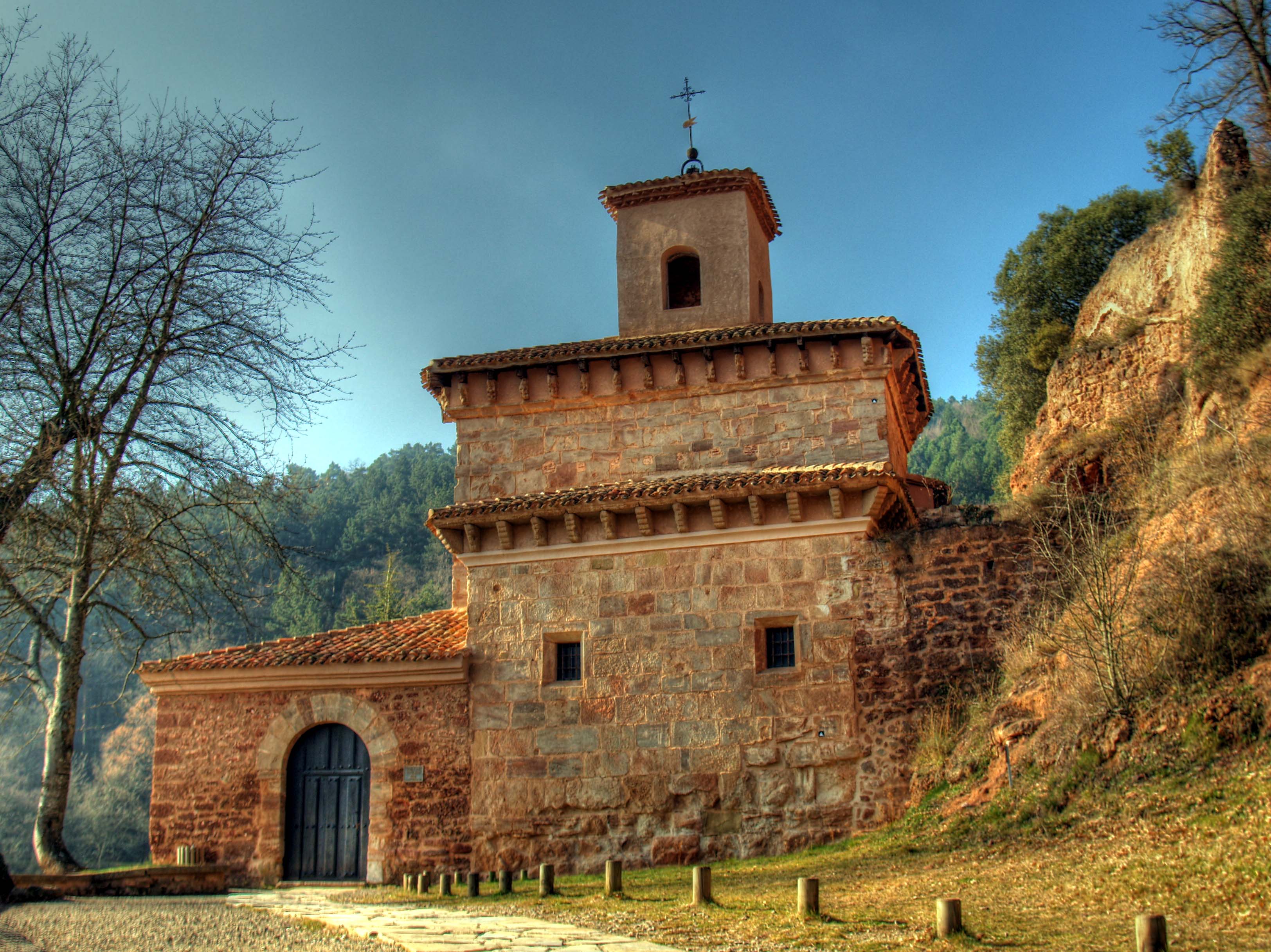
Suso (the upper monastery) is the older of the two and the one containing the original cave. The church you can visit today is largely pre-Romanesque — Visigothic and Mozarabic elements predominate, with horseshoe arches and a carved Romanesque tomb of the saint of exceptional quality. It is a small building but its antiquity is palpable.
In the 11th century, King García Sánchez II — the same king who founded Santa María la Real in Nájera — decided to move San Millán’s remains to Nájera. The bearers tasked with this job found themselves literally unable to move once they reached the spot where the monasteries now stand. This was interpreted as the saint’s wish to remain, and the king accepted it. He commissioned a new monastery to be built below Suso to house the remains: this was Yuso (the lower monastery), following the Benedictine rule and exclusively male. The two communities coexisted until 1100, when they merged and entered their most productive period.

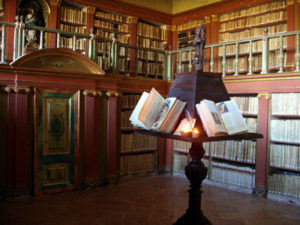
That golden age produced something of world significance: an extraordinary scriptorium and library where monks illuminated codices with miniatures of exceptional quality, showing the influence of both Mozarabic art (with its geometric precision) and the emerging Romanesque style. But the library’s greatest significance lies in something apparently small: in the margins of one of these Latin codices, a monk wrote brief glosses — explanatory notes — in the vernacular language spoken by the people around him.
These marginal notes are the earliest known written Castilian. Latin was the language of learning, the Church, and all formal writing. Castilian — the popular spoken language that would become Spanish — was not written, not regulated, not codified. When this anonymous monk at San Millán began writing it down, he began the process of making it a language in the full sense. The Spanish you hear spoken around you today has its written origins in this monastery, in this scriptorium, in the 10th century. The library, with many original codices still on display, is part of the Yuso guided tour.
The setting adds to the experience. The two monasteries are built against a wooded hillside in a valley of the Sierra de la Demanda, the yellow stone of Yuso glowing warm against the green of the slopes above it. The guided tour of Yuso (obligatory, approximately 45 minutes, around €6, in Spanish with multilingual booklets) covers the church, the sacristy — which holds a collection of 11th-century ivory carvings of remarkable delicacy — and the library. Suso requires a separate visit by minibus from Yuso; arrive early as access is limited.
The site’s importance was recognised by UNESCO in 1997, which described it as a key monument in the formation of the Romance languages and in the cultural identity of the Iberian Peninsula. Of the many cultural detours available on the French Way, this one earns its extra kilometres more convincingly than almost any other.
Practical notes: Both monasteries are closed on Mondays. Yuso opens Tuesday to Sunday 10:00–13:30 and 16:00–18:30 (shorter hours in winter). Allow 2–3 hours for both. The road from Azofra to San Millán involves a steady climb of about 200 m over 10 km — manageable but not trivial with panniers. The return to Santo Domingo via Cirueña is a pleasant descent through vineyard country.
Practical notes for Stage 5
Water and supplies
From Navarrete to Nájera there are 13 km with no services unless you pass through Ventosa (which adds ~1 km but has a bar-hostel). If you skip Ventosa, stock up on water before leaving Navarrete. Nájera (km 27) is the natural lunch stop — good selection of bars and restaurants on the main street. Azofra (km 34) has a fountain, bar and basic supplies. Santo Domingo de la Calzada has everything.
Surface and bike type
The stage alternates between compact gravel tracks and tarmac throughout, with short sections of looser dirt near Navarrete and after Azofra. An MTB or gravel bike handles everything comfortably. A road bike can manage on the tarmac variants but will need to bypass the dirt sections — meaning it misses some of the nicest riding. An e-bike makes the Alto de San Antón climb effortless and leaves energy in the legs for the afternoon in Nájera and Santo Domingo.
Starting in Logroño
Logroño is well connected: Renfe train connections from Madrid, Bilbao and Zaragoza; Alsa and regional buses from most Spanish cities; and a small regional airport 9 km from the centre with mainly Madrid connections (taxi or car needed from the airport). Tournride delivers bikes to your accommodation in Logroño the evening before your departure.
Frequently asked questions about Stage 5
How far is Stage 5 of the Camino Francés by bike?
47 km from Logroño to Santo Domingo de la Calzada. Taking the San Millán de la Cogolla detour from Azofra brings the total to approximately 68 km for the day.
Is Stage 5 difficult for cyclists?
It is one of the most accessible stages on the French Way. The total elevation gain is around 350 m spread across the whole day with no single demanding climb. The main physical challenge is the sustained gentle ramp from Logroño to the Alto de San Antón (km 20, 675 m altitude). Everything beyond that is either flat or downhill.
Is the San Millán de la Cogolla detour worth doing?
Yes — particularly if you have any interest in history, art or language. The UNESCO monasteries of Suso and Yuso are exceptional and the birthplace of written Castilian is a genuinely significant place. Most cyclists do it as a rest-day excursion from Nájera or Santo Domingo rather than combining it with the stage — but it is possible on an e-bike with an early start from Logroño.
Where can I sleep in Santo Domingo de la Calzada?
The town has an excellent range: a free Cistercian monastery hostel, the Casa de la Cofradía del Santo (pilgrim hostel run by the Brotherhood of the Saint), several private hostels and guesthouses, and two Paradores in historic buildings. The Paradores are a genuine treat — book well in advance in peak season (July–August).
Can I rent a bike in Logroño and return it in Santiago?
Yes. Tournride delivers your bike to any accommodation in Logroño the evening before your first stage and collects it in Santiago de Compostela when you finish. Luggage transfer between stages is also available so you ride with only what you need. See all bike models and check availability here.


