
STAGE 14: FROM MELIDE TO SANTIAGO DE COMPOSTELA
Erea FabeiroThis is the last stage. In 51 km you cross the final stretch of Galician countryside, pass the airport that was built through the middle of the ancient pilgrimage route, climb to the hill where medieval pilgrims wept at their first sight of the cathedral towers, and descend into Santiago de Compostela through streets that have been receiving pilgrims for a thousand years. The feeling is documented in the medieval sources and has not changed: a combination of joy and something harder to name, the simultaneous arrival at a destination and the end of the purpose that got you there.
| Distance | Elevation gain | Estimated time | Difficulty | Distance to Santiago |
|---|---|---|---|---|
| 51 km | +600 m cumulative | 5–6 hours riding | 🟡 Medium | 0 km |
Key stops: Santa María de Melide church (km 1.1) · Castañeda (km 7.9) · Ribadiso da Baixo (km 11) · Arzúa (km 14) · O Pedrouzo (km 33) · Lavacolla (km 42) · O Monte do Gozo (km 48) · Santiago de Compostela (km 51)
Route profile and key milestones
Leaving Melide: a Romanesque church and a medieval grid (km 0–1.1)
From the central roundabout of Melide, head north following signs for the Museo Terra de Melide. Pass the town hall with successive left and right turns, climb a short but steep ramp on the main street, and follow arrows onto a dirt and gravel path that deposits you on the N-547. After crossing the road, signs indicate the church of Santa María de Melide on the right (km 1.1).
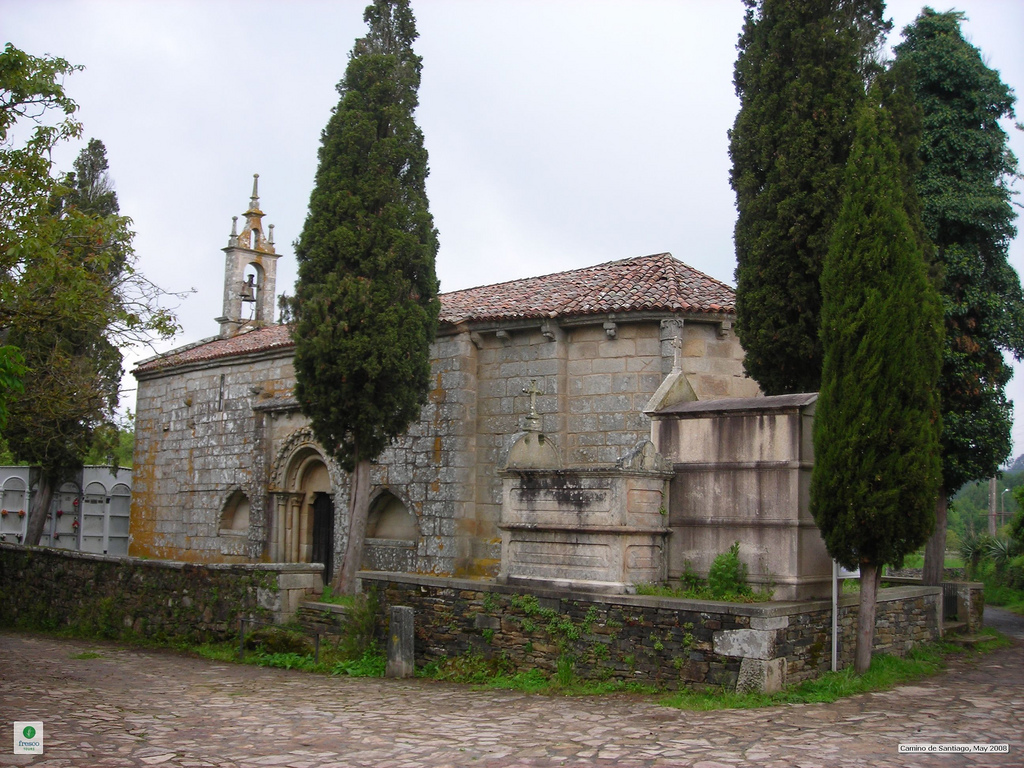
Stop here. The church is small and has been substantially modified, but its carved decoration repays attention. The archivolts carry chequered patterns, small rectangles, geometric motifs and forms recalling ancient Celtic symbols — triskeles, spirals, swastikas. The capitals hold lions and beasts in the same protective-and-threatening function we discussed at Barbadelo on Stage 13. But the most remarkable object in this church is kept in the modern sacristy.
The Romanesque altar is decorated with small arches below which original polychrome paint is preserved — a rare survival from the 12th century. More extraordinary still: a wrought-iron grid from the 12th century, its spirals and patterns suggesting the same metalworking tradition as the church’s stone carving. You might ask what possible historical significance a grid can have.
A great deal. The grid is the only one of its kind surviving in all of Galicia, and it is a document of how the medieval Church organised social life through architecture. In the High Middle Ages (to the 12th century), the church was the primary social gathering place and the building physically encoded the hierarchy of society. The most sacred part — the apse, facing east toward the rising sun — was accessible only to priests. In the naves, the wealthy occupied the front; in many churches men and women were separated. At the entrance, unbaptised people could not even cross the threshold — which is why the baptismal font was always at the door. Social progression through the sacraments determined your physical position in the building: baptism let you into the naves, confirmation and first communion moved you forward, ordination placed you in the apse. Walking from the entrance to the altar was a representation of the path toward God.
In the absence of civil registers or ID documents, the parish books were the official social record. Being unbaptised excluded you from certain occupations, certain neighbourhoods, certain rights — Jewish communities lived in designated areas partly because this spatial logic was totalising. To reinforce these divisions, spaces were often physically separated by wooden structures or metal grids. The grid was the material form of the social order. In the Gothic period, when cities grew and the bourgeoisie emerged, these physical separations began to dissolve — the Gothic cathedral opened its walls to light and reconceived the sacred space as shared. Most of the grids and wooden screens that recorded the medieval order were removed and lost. This grid of Santa María de Melide is the only one that remains in Galicia. As historical documents go, it is worth at least as much as the carved animals on the facade.
Castañeda, Ribadiso and Arzúa: the last 100 km of Galicia (km 2–14)

Leave the church and follow a gravel track into dense forest — a continuous up-and-down through oaks, chestnuts, pines and, increasingly from here onward, eucalyptus. The eucalyptus is an Australian species introduced to Galicia from the 1980s when many city-dwellers who had inherited small forest plots ceded their exploitation rights to pulp and paper mills. Eucalyptus grows extraordinarily fast, which makes it valuable for paper production, but it absorbs enormous quantities of soil moisture and colonises surrounding land aggressively. Little by little it has displaced the native Atlantic and riparian species — oak, chestnut, birch — that need much more water but grow more slowly and are worth far less to the industry. The Xunta of Galicia has maintained a moratorium on new plantations since 2021, extended to 2030 — but with flexibilisations that farming unions and the opposition describe as «political window-dressing» that opens a back door to covert expansion of monoculture; actual planted area has continued to grow despite the theoretical ban. The forest you are riding through illustrates the argument: each time you see a stand of eucalyptus beside a stand of oaks, you are looking at an unresolved question about what Galicia wants its landscape to be.
Cross streams and the maximum height of the stage (470 m near Parabispo) before touching the N-547 shoulder at Raído (km 3.5) and re-entering the trees. Through Boente (km 5.7) — the church of Santiago has Romanesque origins but was largely rebuilt in the 19th century; the carved Pilgrim Santiago on the main altarpiece is notable — and into the forest again, crossing the N-547 by tunnel, to Castañeda (km 7.9).
Castañeda is where the lime kilns stood that received the stones carried by medieval pilgrims from the mountains around Triacastela (Stage 12). Every pilgrim who passed through those mountains was expected to carry a piece of limestone and deposit it here to be burned into the mortar that built the cathedral. It was an act of collective construction: thousands of anonymous contributors, each carrying their stone across hundreds of kilometres, building the house of the Apostle one load at a time. The kilns are gone but the logic persists — the Camino has always been a collective project.
Descent to Ribadiso da Baixo (km 11), a single-street village on the Iso river crossed by a simple one-arch stone bridge colonised by vegetation. The public hostel here occupies a restored medieval pilgrim hospital — one of many along the route whose name records this former function. The ramp out of Ribadiso is one of the sharpest of the day (average 8%), ending in a tunnel under the N-547 before a paved track leads to Arzúa (km 14).
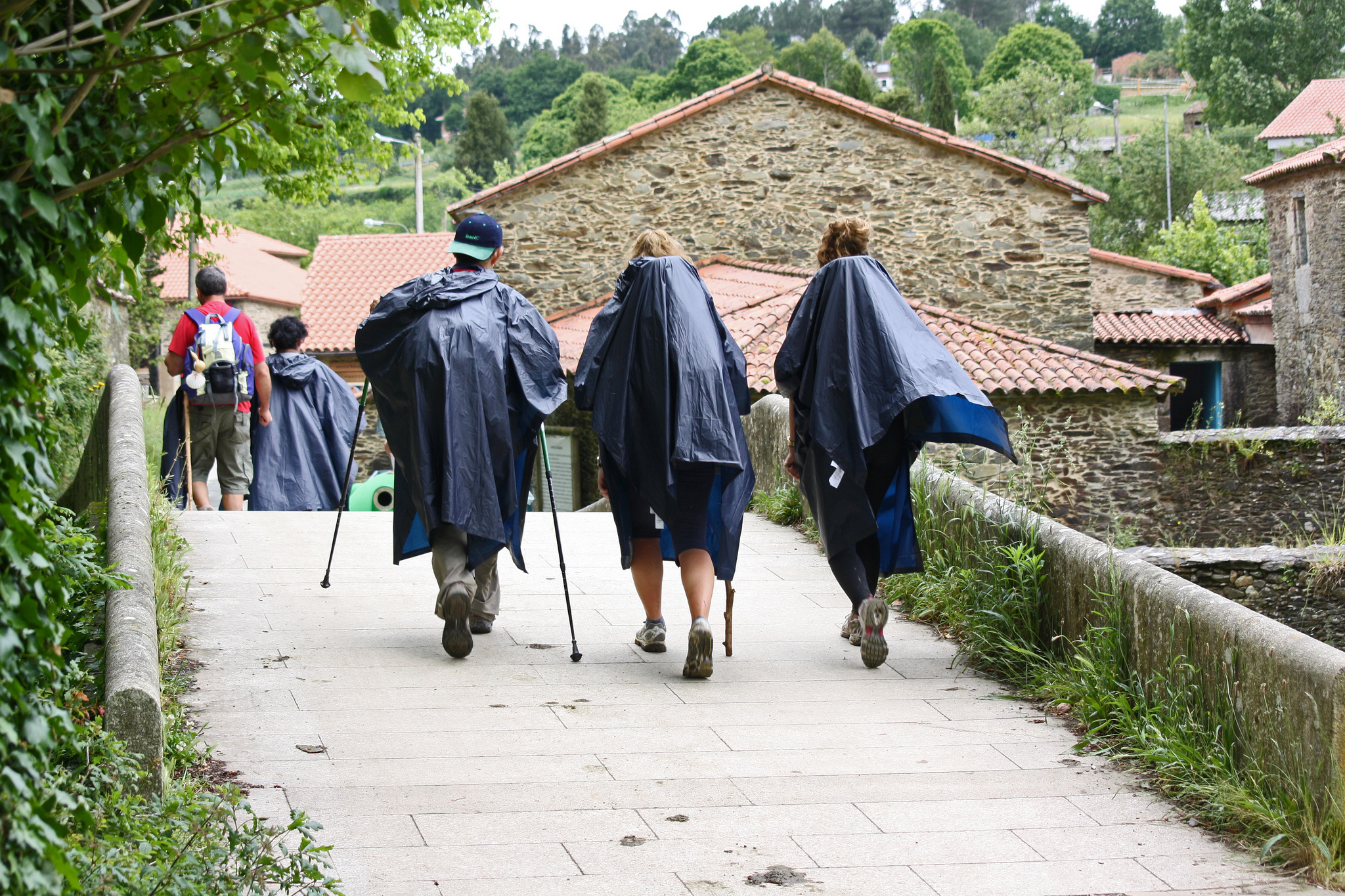
Arzúa is where pilgrims arriving from the north — on the Camino del Norte, the coastal route via the Basque Country and Asturias that was the main alternative when the French Way passed through contested war zones in the Reconquista period — join the French Way for the final push to Santiago. The town itself has little medieval heritage (a 14th-century Magdalena chapel is the main survivor), but it is an important rest stop for one specific reason: cheese.
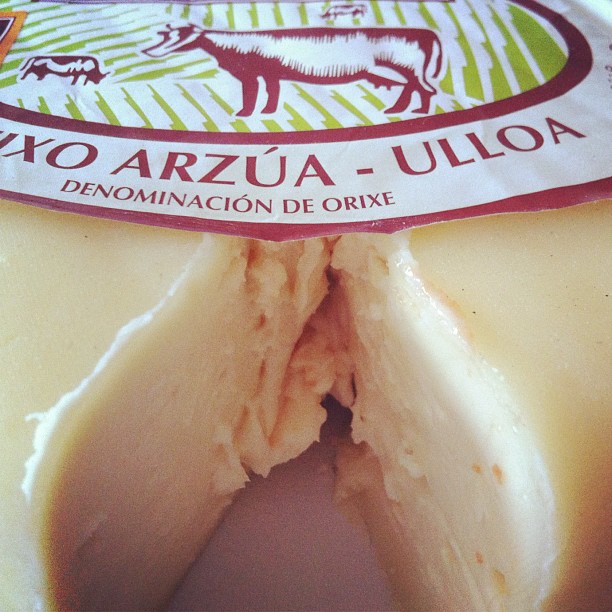
Galicia has four Protected Designations of Origin for cheese. You already encountered O Cebreiro cheese at Stage 11. Here in Arzúa the local variety is Arzúa-Ulloa — a fatty cow’s milk cheese typically consumed very fresh, soft enough that when cut it spreads outward across the plate rather than holding its shape. It is often described in Galician as “que se derrama” — that spills. It is excellent with local honey or with quince, both produced in this area. The other two Galician D.O.P. cheeses are Tetilla (named for its breast-like shape, soft and mild) and San Simón da Costa (smoked over birchwood, harder and more pungent). On a normal day you would not be told to eat cheese at kilometre 14. Today you should.
Arzúa to Salceda: the last rural immersion (km 14–25)
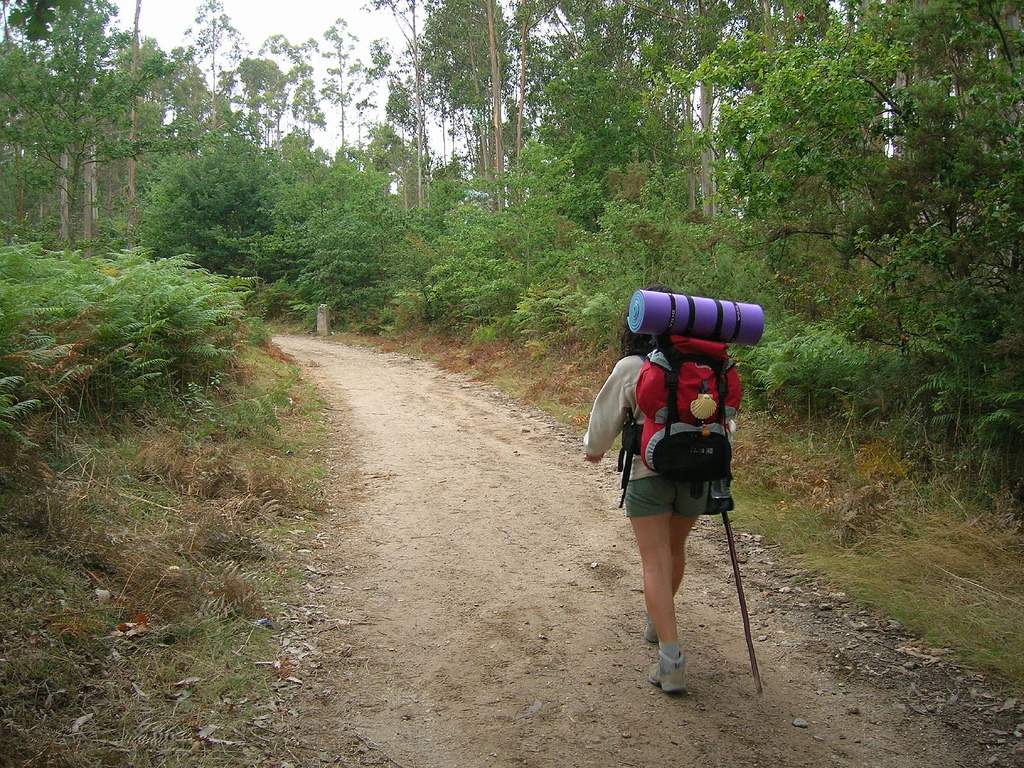
Leave Arzúa on the cobbled Cima do Lugar street, which becomes a gravel path into the As Barrosas forest — named for the mud it generates in rain. A chapel dedicated to San Lázaro marks the historic function of this part of the route: lazarettos were places where people with infectious diseases could be cared for outside the town walls, and the dedication to the saint of plague and leprosy records this history. Cross a river and climb through humid forest to Pregontoño (km 16.2), with its 18th-century chapel of San Paio whose external portico is almost as large as the chapel itself.
From A Peroxa (km 17.3) — a significant gradient change, more consistent descent from here — through Taberna Vella, where a large bridge crosses the infrastructure works of the A-54 motorway (the long-delayed highway connecting Lugo to Santiago), and into A Calzada (km 19.8). The name is telling: calzada means paved road, and the Latin root callis means path, suggesting this settlement was associated with the Camino since antiquity.
At Calle (km 21.8) — whose name also means street/path — an original hórreo is positioned like an arch over the main track of the village: you pass directly under it. Beside it, milladoiros — cairns of stones left as offerings, the same ancient tradition as the Cruz de Ferro — mark the path. Through Boavista (km 23.2) and A Salceda (km 25), where the N-547 begins to intersect the route more frequently and the rural character starts giving way to the periurban.
Salceda to Lavacolla: approaching the city (km 25–42)
From Salceda the N-547 crosses and re-crosses the route ten times before O Amenal (km 36.7). Five of these crossings have no safe pedestrian infrastructure — extreme caution at each one. A plaque to a Belgian pilgrim who died within sight of Santiago, with accumulated messages and offerings from subsequent pilgrims, appears about 1 km from Salceda. The path passes through O Xen (km 26.3), As Ras (km 27), A Brea (km 27.6) with accommodation, and O Empalme (km 29.3) — a particularly awkward N-547 crossing at a change of gradient where cars move quickly.
At Santa Irene (km 30.3): a simple 18th-century chapel surrounded by large oaks, with a fountain reputed to keep young those who wash with its water regularly. Continue through A Rúa (km 31.7) and O Pedrouzo (km 33) — the standard last overnight stop for pilgrims on foot, full services, 18 km from Santiago. Then through San Antón (km 34) and into the forests around O Amenal (km 36.7).
After O Amenal the path climbs continuously to approximately 363 m and then borders the eastern fence of Santiago airport. The airport was built through the middle of the pilgrim routes that converge on Compostela, and the Camino was redirected along its perimeter. Pilgrims hang crosses and messages on the metal fence; the path beside it is often muddy. Pass a large boundary stone announcing the approach to Santiago, then around the airport’s western edge to San Paio (km 40.6) and down by asphalt to Lavacolla (km 42).
Lavacolla: washing before the apostle (km 42)
The name is the town’s complete history. According to the Codex Calixtinus, pilgrims washed in the Sionlla river here before entering Santiago — the etymology is lava-collus, “washing the neck.” This was not merely a hygienic formality: it was a ritual preparation, the physical shedding of the dirt of the road as a symbol of the sins being left behind before presenting oneself at the apostle’s tomb.
The purification did not stop at Lavacolla. Medieval sources describe a further ceremony at the cathedral itself: pilgrims stripped in front of the Fuente del Paraíso (Fountain of Paradise) at the northern entrance — the door of Azabachería — washed again, and then burned their travel clothes in what was called the Cruz dos Farrapos — the Cross of Rags (farrapo is Galician for old clothes). They entered the cathedral clean, in new clothing, to receive full indulgence. After the visit many slept inside the cathedral overnight. The botafumeiro — the enormous silver censer suspended from the cathedral’s transept arch that swings in a spectacular pendulum arc — was designed, at least in part, to manage the smell of a cathedral full of unwashed pilgrims sleeping in their clothes. It burns up to 40 kg of incense per ceremony. The hygiene problem was real; the liturgical solution is magnificent.
In Lavacolla today, a palco de música — the characteristic 19th-century Galician bandstand structure, half urban furniture and half building, designed to allow music and dance in any weather with full visibility of the orchestra — stands beside the path. Cross the N-634, pass the river, and begin the final climb.
O Monte do Gozo: the hill of joy (km 48)
From Lavacolla the road climbs through Vilamaior (km 43.3), past the headquarters of Galician television (TVG) and the regional TVE centre — the media infrastructure of an autonomous community that has fought for and largely secured its linguistic and cultural distinctiveness — and into San Marcos (km 47.2), where a chapel and a monument signal the arrival at Monte do Gozo.
The hill was called San Marcos in the Middle Ages because in the 12th century the bishop of Santiago ordered a chapel dedicated to St Mark built here. A legend attaches to the choice of site: St Mark himself, arriving at the hill almost within sight of the city, asked a German pilgrim how far remained. The German, wanting to be first to see the cathedral and claim the prestige of the “king of pilgrims” (the medieval term for whoever reached the hilltop first), told him thousands of kilometres remained. Discouraged, St Mark decided he could not continue and built his chapel there. In the 18th century the chapel was abandoned; the current structure is a reconstruction.
The hill acquired its current name — o gozo, the joy — from the emotion that overcame pilgrims when they reached the summit and saw, for the first time, the towers of the cathedral in the valley below. This is still the first point from which the cathedral is visible, and the view is still moving — not because of its grandeur but because of what reaching it represents. A thousand years of pilgrims have stood here and looked down at the same towers.
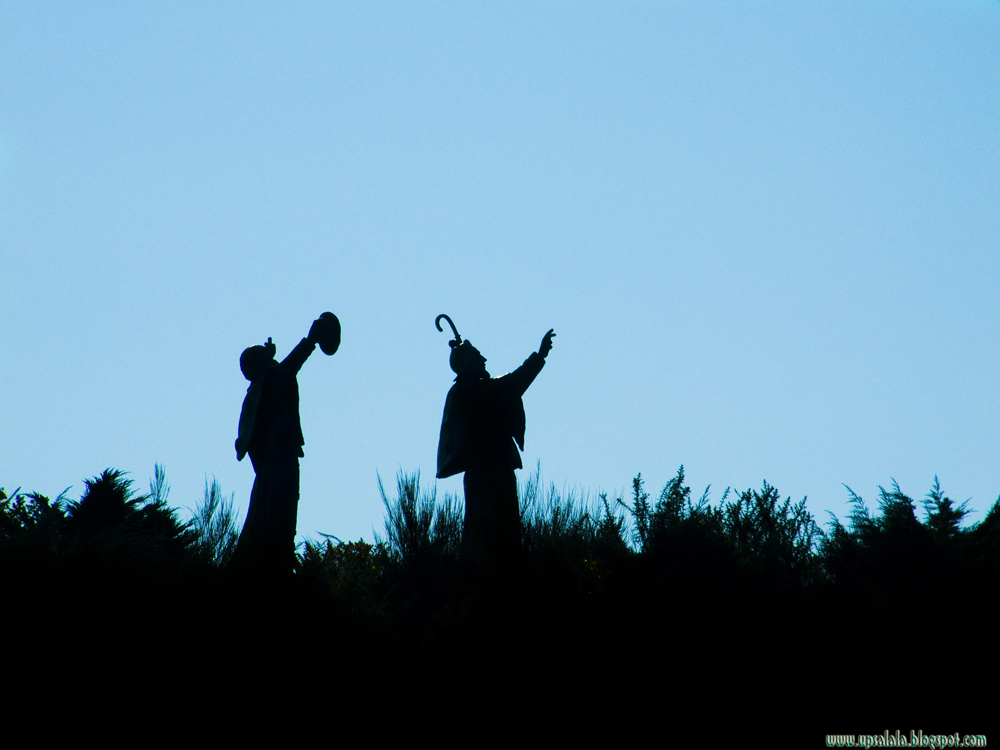
In 1989 Pope John Paul II came to Santiago to preside over the World Youth Days. To accommodate the hundreds of thousands of pilgrims who converged for the event, a large complex of facilities was built on the Monte do Gozo hill: an amphitheatre, hotels, cafés. The amphitheatre has hosted concerts including the Rolling Stones and Bruce Springsteen — an unlikely echo of the medieval troubadours and musicians who performed here for the same reason: a captive audience arriving at the end of a long journey, looking for celebration. A monument to John Paul II stands near the chapel. At the viewpoint, two sculptures by José María Acuña López — the same sculptor whose bronze pilgrim stands against the wind at the Alto de San Roque on Stage 12 — show pilgrims looking toward Compostela with their right hand raised.
Descending into Santiago: the Camino’s last three kilometres (km 48–51)
From Monte do Gozo descend by asphalt to the N-634 (avoid the stairs: follow the track right, which also reaches the road in a few metres). At the first roundabout of the San Lázaro neighbourhood — named for the medieval lazaretto that stood here outside the city walls — red metal letters spell “Santiago de Compostela” on one side and the pilgrim-stickered town-entry sign on the other. Through two more roundabouts, then an oblique left onto a street that ends at the junction with the N-550.
Cross to Calle Concheiros — Shellmakers Street. The name records the artisan neighbourhood that once stood outside the city wall where craftsmen manufactured the scallop shells in brass and bronze that pilgrims wore or purchased as proof of completion. Genuine pilgrims wore a shell obtained at the shrine; the street that supplied them was the last commercial encounter before the wall. Today the street is pedestrian, lined with small shops.
Concheiros leads into Calle San Pedro, ending at the Puerta del Camino — the historic gate in the medieval wall through which all pilgrims on the French Way entered. On the ground nearby, inscriptions in multiple languages read: “Europe made pilgrimage to Compostela” — an acknowledgement that the Camino was one of the principal mechanisms through which medieval Europe built a shared cultural identity across its political and linguistic borders. The wall itself, of which fragments survive, was the physical boundary between the profane world of the road and the sacred city.
Beyond the gate you are on the cobblestones of the old city of Santiago de Compostela, a UNESCO World Heritage Site since 1985. Romanesque, Gothic and Baroque monuments stand between houses with galleries, porticos and small balconies in the characteristic Galician style. Climb Rúa Casas Reais to the Plaza de Cervantes — the original site of the city council, moved in the 20th century to its current neoclassical building on the Obradoiro — then follow the porticoed arcade to the left, down the street, and turn left at the Puerta de Azabachería.
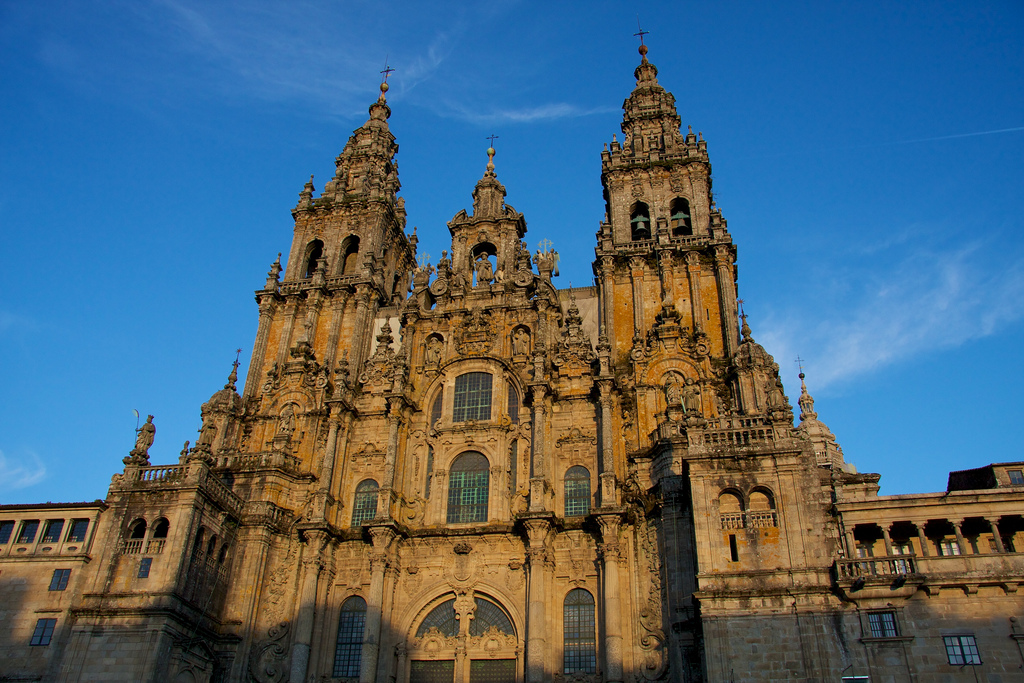
This was the original entrance through which all pilgrims passed: the site of the Fuente del Paraíso where they washed a final time and the door through which they entered to see the apostle. Its decoration no longer survives in its original form. Most pilgrims continue around the building to emerge in the Plaza del Obradoiro — the open space before the western facade, bounded by the cathedral, the Parador (the former royal hospital for pilgrims, now a luxury hotel), the Colegio de San Jerónimo and the neoclassical Pazo de Raxoi (now the city hall). On the right, the enormous facade of San Martín Pinario — the former Benedictine monastery, now partly a hotel and seminary, the second-largest religious complex in Spain after the Escorial.
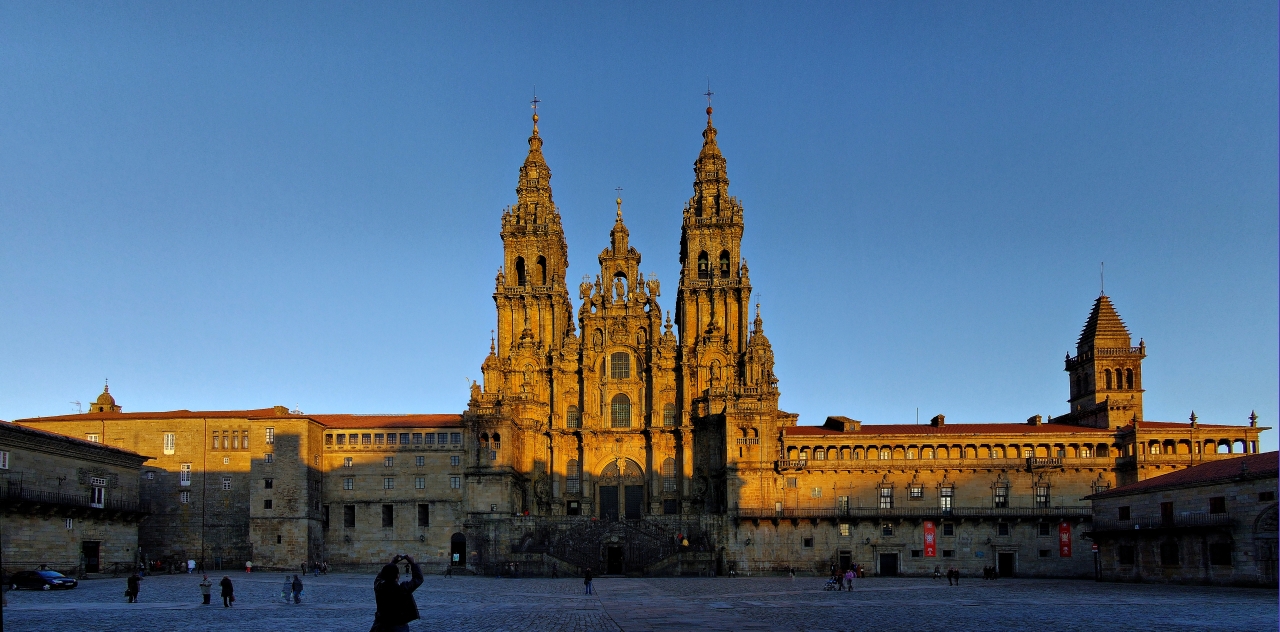
In the Obradoiro square you can get off the bike. Look up at the twin Baroque towers of the cathedral. You are standing in the Campus Stellae — the Field of Stars — from which Compostela takes its name, the place where the tomb of the Apostle James was discovered in the 9th century, around which a city grew, and toward which the entire infrastructure of the French Way — the bridges, the hospices, the Cluniac monasteries, the Romanesque churches, the medieval hospitals — was organised for a thousand years.
What to do when you arrive
1. The Pilgrim’s Office
The Oficina del Peregrino is at Rúa das Carretas 33, next to the Obradoiro square. Here your credential (credencial) is stamped a final time and you receive the Compostela — the Latin-inscribed certificate with your name confirming completion of the Jacobean pilgrimage. This is free. You can also request a Certificate of Distance (€3), which records when and where you set out and the kilometres covered. Tubes for protecting the rolled documents are sold here (€2) and cheaper in the city’s souvenir shops. Open daily except 25 December and 1 January; October to March 10:00–19:00; Easter and the rest of the year 8:00–21:00.
2. Tournride’s office
Five minutes from the cathedral at Rúa Laverde Ruiz 5. Bring your bike here and we will collect it; if you used our luggage transfer service, your bag will be here. We are open Monday to Friday 10:00–14:00 and 16:30–19:30; if you arrive on a weekend, contact us in advance (info@tournride.com or +34 981 936 616) and we will come to the office.
3. The cathedral
The Pilgrim Mass is celebrated at noon daily. The botafumeiro — the 80 kg silver censer that swings on a 65-metre arc from one transept to the other — is used at this mass and at the main daily liturgy, though not at every celebration; it is more likely on Sundays and feast days. Check at the cathedral door. Entry to the cathedral is free; the museum, crypt and cathedral roof tour require tickets purchased separately.
4. The city
Santiago de Compostela deserves at least a full day beyond the arrival afternoon. The old city is compact and almost entirely pedestrian; everything significant is within 15 minutes’ walk of the Obradoiro. The Mercado de Abastos — the covered market, a few blocks south of the cathedral — is one of the best food markets in Spain and the place to buy the local products: Galician empanada, cheese, octopus, percebes (barnacles), Albariño wine, local honey. The Parque da Alameda, just south of the old city, has the most famous view of the cathedral’s twin towers framed through trees. The evening tapeo in the streets around the Rúa do Franco and Rúa da Raíña is an education in Galician food culture.
Leaving Santiago
Santiago de Compostela is well connected. The airport of Lavacolla — which you bordered on this stage — has direct flights to Spanish cities (Alicante, Barcelona, Bilbao, Ibiza, Madrid) and international destinations (Dublin, Geneva, London). Galicia also has airports at A Coruña and Vigo (both under 45 minutes by train, with more connections). For international flights, Porto airport (Portugal) is accessible directly by bus with Alsa and often has competitive prices. The train station is a 15-minute walk south of the old city, with Renfe services to Madrid, Barcelona and across Galicia. The bus station is north of the city with Monbús connections across Galicia and Alsa to the rest of Spain and Europe.
Practical notes for Stage 14
Surface and navigation
The stage has no secondary roads that parallel the pedestrian route, so the only alternatives to the Jacobean path are the N-547 itself (from Melide to Salceda) and the N-634 (from Lavacolla). The pedestrian route is recommended throughout in dry conditions: it passes through the villages and offers the last rural immersion of the pilgrimage. In rain, the forest tracks — especially As Barrosas (km 15–17) and the airport perimeter (km 37–41) — can become deep mud. In those conditions, the N-547 shoulder is the pragmatic choice. The urban approach from Lavacolla onward is entirely asphalt and presents no surface issues.
The ten N-547 crossings between Salceda (km 25) and O Amenal (km 36.7) require concentrated attention — five have no pedestrian infrastructure. Cross deliberately, stop completely, wait for a clear gap.
Water and supplies
Services every few kilometres until Salceda. After Salceda they are less frequent but still present: O Pedrouzo (km 33) is the main full-service stop before Santiago. From O Pedrouzo to Lavacolla (km 42) there are small settlements with bars. From Lavacolla onward you are in the urban fringe of Santiago; services are continuous.
Arriving with a bike
The cobbled streets of the old city are very uncomfortable on any bike. From the Puerta del Camino onward, push rather than ride. Locking your bike in the Obradoiro while collecting the Compostela and visiting the cathedral is possible; bring a lock. Tournride’s office at Rúa Laverde Ruiz 5 is the collection point for rented bikes.
Frequently asked questions about Stage 14
How far is Stage 14 from Melide to Santiago de Compostela by bike?
51 km between 250 m and 470 m elevation. The first 25 km are legbreaking Galician forest with continuous slope changes; from Salceda the N-547 starts intersecting the route more frequently; from Lavacolla it is continuous asphalt to the cathedral. Allow 5–6 hours riding time plus the Arzúa cheese stop and Monte do Gozo.
What is the botafumeiro?
The botafumeiro is an enormous silver censer suspended from the vaulted crossing of the cathedral of Santiago. It weighs approximately 80 kg and swings on a 65-metre pendulum arc from one transept to the other, burning up to 40 kg of incense. It was originally designed, at least partly, to manage the smell of thousands of unwashed medieval pilgrims sleeping in the cathedral. Today it is used at the noon Pilgrim Mass and at certain feast-day celebrations. It is one of the most spectacular liturgical objects in the world.
Why is it called Monte do Gozo?
Monte do Gozo means Hill of Joy in Galician. It is the first point from which the towers of the cathedral of Santiago de Compostela are visible, and it takes its name from the emotion — documented in medieval sources — that overwhelmed pilgrims when they saw their destination for the first time after weeks or months of travel. The hill was formerly called San Marcos, after a chapel dedicated to St Mark ordered built there by the bishop of Santiago in the 12th century.
What is the Compostela and how do I get it?
The Compostela is the Latin-inscribed certificate issued by the cathedral authorities confirming completion of the Jacobean pilgrimage. To receive it you must have covered at least 100 km on foot, 200 km by bicycle or on horseback, and have a credencial (pilgrim passport) stamped at intervals along the route. Present your stamped credential at the Pilgrim’s Office (Rúa das Carretas 33, next to the Obradoiro) and the Compostela will be issued free of charge. A Certificate of Distance showing your specific route and distance costs €3.
How do I return the rental bike in Santiago?
Bring the bike to Tournride’s office at Rúa Laverde Ruiz 5 — 5 minutes from the cathedral. We are open Monday to Friday 10:00–14:00 and 16:30–19:30. If you arrive on a weekend, contact us in advance: info@tournride.com or +34 981 936 616. If you used our luggage transfer service, your bag will be waiting at the office.


