
STAGE 1: SAINT-JEAN PIED DE PORT TO RONCESVALLES
Xavier Rodríguez PrietoStage 1 is not where the French Way begins. It is where it is announced. Before the first pedal stroke you are standing in Saint-Jean-Pied-de-Port — a walled medieval town at the foot of the Pyrenees that has been processing pilgrims bound for Santiago since the 11th century — and you are about to cross a mountain range that has served as a natural border, a mythological boundary and a military frontier since before recorded history. The stage is short: 26 km by the Napoléon route, 28 km by Valcarlos. What it offers in return for the effort is the most spectacular landscape of the entire French Way, and one of the oldest inhabited pilgrimage sites in Europe as the day’s destination.
| Route | Distance | Max elevation | Difficulty | Surface |
|---|---|---|---|---|
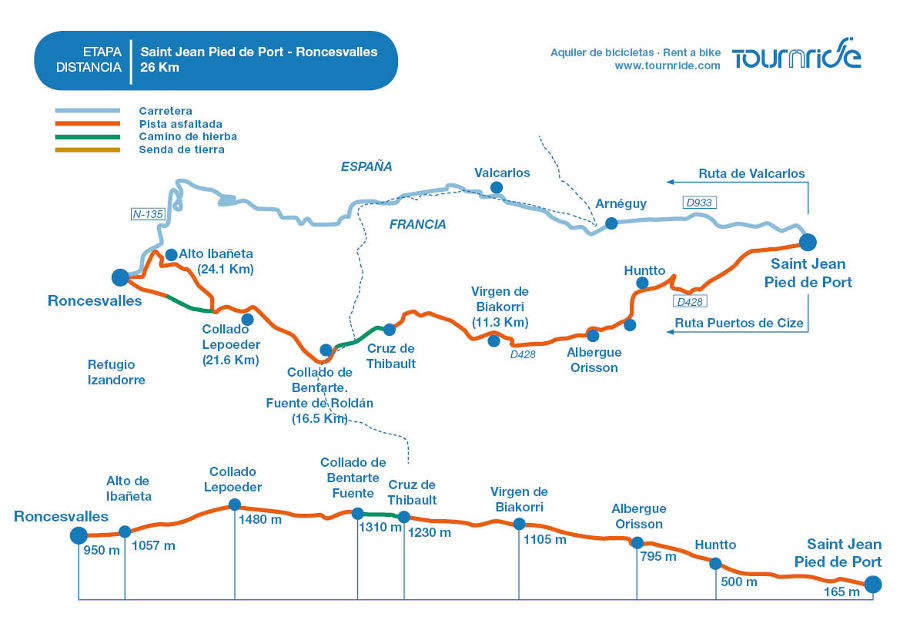
| Napoléon (traditional) | 26 km | 1,480 m (Lepoeder) | 🔴 Very High | Gravel/pasture track |
| Valcarlos (road) | 28 km | 1,057 m (Ibañeta) | 🟡 Medium–High | Paved (D933/N135) |
Distance to Santiago: ~765 km · Estimated time: 4–5 hours · Start: Saint-Jean-Pied-de-Port (233 m)
Choosing your route: Napoléon or Valcarlos?
The decision between the two routes is the first real choice of the Camino, and it is worth making deliberately rather than by default.
The Napoléon route (also called the Route of the Ports of Cize) is the traditional Jacobean path — the one Aymeric Picaud described in the 12th-century Codex Calixtinus, the one Charlemagne’s army crossed, the one Napoleon used when he invaded Spain. It runs over high mountain terrain on gravel tracks and grass paths, climbs to 1,480 m at Collado Lepoeder, and descends steeply to Roncesvalles. It is officially closed from 1 November to 31 March due to weather hazards — several mountain accidents involving pilgrims have occurred in winter. Even within the open season, if the weather is bad — rain, fog, strong wind, cloud cover — do not take this route. The combination of exposed ridgeline, slippery surface and reduced visibility makes it genuinely dangerous. If conditions are fine and your legs are good, it rewards everything the effort costs.
The Valcarlos route follows the D933 (France) and N135 (Spain) roads through the valley and over the Alto de Ibañeta (1,057 m). It is paved throughout, open year-round, and has a more consistent gradient (average around 6% on the steepest section). It has road traffic — take a reflective vest and lights if needed — and is less spectacular than the mountain route. It is not a concession: Aymeric Picaud already documented it in the 12th century as a legitimate alternative for pilgrims who preferred not to cross the mountain.
A hybrid option: take the Napoléon route to Collado Lepoeder (km 21.6) and then divert toward Alto de Ibañeta, rejoining the N135 for the final descent to Roncesvalles. This gives you the mountain landscape and the technical challenge without the steepest descent.
On the Napoléon route: profile and key points
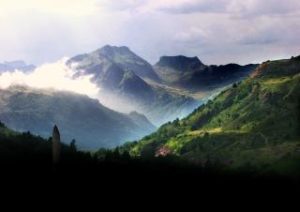
Leave Saint-Jean on the D428 road, then at the Thibault Cross — a fenced wooden cross with offerings, marked by a wooden sign pointing right off the road — take a gravel track onto open mountain. The main challenge comes early: within the first few kilometres a slope of nearly 13% sustained for over 4 km. This is the point where most cyclists dismount and push. Do it without hesitation — fighting this gradient from the start will exhaust you for the rest of the day. The loaded bike (panniers make a significant difference here) makes walking entirely rational.
Once you reach the viewpoint of Arbola Azpian the gradient eases considerably. At km 11.3 on the left is the Virgen de Biakorri — the patroness of shepherds, whose small roadside shrine accumulates offerings from the thousands of pilgrims who pass. If the visibility is clear, the views here are already extraordinary. Rest if you need to.
At km 16.5 the Fuente de Roldán — Roland’s Fountain. Roland was Charlemagne’s most famous commander, and according to the Carolingian chronicles and the Chanson de Roland, he died in battle near Roncesvalles in 778 AD. You will encounter his memory again at the Silo of Charlemagne in Roncesvalles. The fountain marks a place of rest before the final push.
At km 21.6: Collado Lepoeder, 1,480 m — the highest point of Stage 1. Pause. The descent from here requires care: the track is steep with loose surface, and the views in clear weather make it tempting to look around rather than at the ground. From the Collado you can also divert toward Alto de Ibañeta instead of descending directly to Roncesvalles.
At km 24.1: Alto de Ibañeta (1,057 m), where both routes converge. A modern chapel with angular roofs was built here in the 1960s on the site of a monastery that preceded it by centuries. The monastery’s function was specific: its bell was rung during storms and at night to guide pilgrims across the pass, preventing them from getting lost on the mountain. The chapel replaced the monastery; the function it commemorates was one of the earliest organised pilgrim safety systems on the Camino. From Ibañeta, less than 2 km of descent separates you from Roncesvalles.
On the Valcarlos route: through the valley of Charlemagne
Leave Saint-Jean on the D933, following the valley of the Nive river through the French border town of Arnéguy, where the road becomes the N135 and France becomes Spain. The gradient is gentle for the first 8 km (about 200 m of elevation gain), then steepens progressively toward Alto de Ibañeta. The overall character is that of a steady mountain road climb — demanding but predictable.
Valcarlos is the main settlement on this route, and its name encodes a medieval story. The most probable etymology is valle de Carlos — the valley of Charlemagne — connecting the place to the 778 AD campaign in which his rearguard was destroyed in the pass above. Aymeric Picaud mentioned the valley specifically in his 12th-century guide: “Through the valley called Valcarlos also pass many pilgrims who go to Santiago and do not want to climb the mountain”. The alternative has been legitimate since the beginning of the pilgrimage.
In Valcarlos: the church of Santiago Apóstol (18th–19th century), with a triple-arched lower section and a square tower breaking the horizontal facade. The neo-Gothic altarpiece in the apse is from the 19th century. Near the church facade, a sculpture by Jorge Oteiza — six geometric figures of different materials embedded in a concrete base, suggesting a line of pilgrims moving toward a common destination. Oteiza was one of the most important Basque sculptors of the 20th century and this work is characteristic: abstract, formal, unmistakable.
If you happen to be here on Easter Sunday or another festival date, watch for the bolantes — the traditional dancers of Valcarlos, named for the coloured ribbons they wear on white costumes that fly as they dance. The tradition is declared a Cultural Interest of Navarre. It is one of those things the Camino occasionally delivers unexpectedly. Check the town council website (luzaide-valcarlos.net) for scheduled performances.
The Pyrenees: history, mythology and a mountain range built from grief
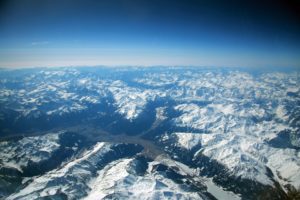
The Pyrenees are 415 km of continuous mountain range running east-west from the Bay of Biscay to the Mediterranean, forming the most complete natural border in Western Europe. The highest peak is the Aneto at 3,404 m. The geology is ancient — the range formed in the Tertiary period through the collision of the Iberian and European tectonic plates — but the human meaning is considerably older than geology.
The mythology of the name
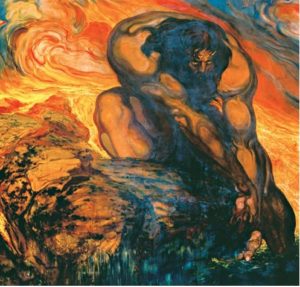
Two competing etymologies exist for “Pyrenees,” both from antiquity. The first derives from pyros — fire in Greek. Ancient historians including Strabo described a colossal fire in the mountains, caused by shepherds clearing land, so intense that it melted underground silver and gold seams and created a spectacle visible from a great distance.
The second, and more poetic, traces the name to a mythological woman named Pyrenée. According to the legend, she fell in love with Hercules, who left her here and continued his journey. She wandered the mountains searching for him until she was killed by wild animals. When Hercules heard her cries and returned, she was already dying. Devastated, he carried her body through the mountains and piled rocks over her in an immense mausoleum — the mountain range that today carries her name. A variant version gives her a different death: she gave birth to a serpent just before dying, and the fire of her funeral pyre blazed so high that it gave the mountains their name.
These are not stories about mountains. They are stories about loss, about natural borders as memorials, about landscape as grief made permanent. The Pyrenees are a good place to think about that.
The most fought-over pass in Europe
The pass you are crossing today has been a strategic military objective since at least the Roman period. The path that pilgrims follow on the Napoléon route is built on the alignment of the Via Trajana — the Roman road linking Astorga to Bordeaux, two of the most important administrative centres of the western Empire. Roman legions, merchants and dispatch riders used this pass for centuries before the pilgrimage existed.
In AD 711 Arab armies crossed from North Africa and conquered the Iberian Peninsula in three years — one of the fastest and most complete military conquests in medieval history. In 721 they crossed the Pyrenees and began pushing into Gaul. In 732 AD they met the Frankish army of Charles Martel at the Battle of Poitiers (or Tours) — one of the decisive battles of European history. The Arab advance was stopped; they retreated south, and the Pyrenees became the frontier between the two civilisations. Charlemagne subsequently established the Hispanic Mark — the fortified border zone of his empire — on the southern slopes of the mountains, a military buffer zone between the Carolingian world and Al-Andalus.
It was in this context that the Battle of Roncesvalles of 778 AD took place — the event that killed Roland and generated the Chanson de Roland, the medieval epic you will encounter again at the town below. Charlemagne’s rearguard was ambushed during the return crossing of the pass. The historical sources identify the attackers as Basques; the epic poem transformed them into Saracens, because that made a better story for a Christian audience.
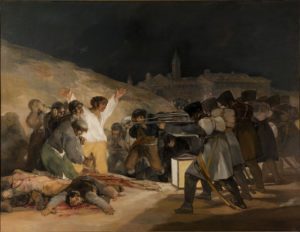
The same pass was used by Aymeric Picaud in the 12th century when he made the journey and wrote what became the Codex Calixtinus — the earliest surviving guide to the Camino de Santiago. And it was crossed by Napoleon Bonaparte in the early 19th century when his army invaded Spain, triggering the War of Independence — which Francisco de Goya documented in the paintings of the Disasters of War and the famous canvases of the Third of May 1808.
You are riding over two thousand years of European history in a single day.
Saint-Jean-Pied-de-Port: the town at the foot of the pass
The name is geographical: Saint-Jean au Pied du Port — Saint John at the foot of the pass. It is not at the foot of the Pyrenees; it is at the foot of the specific mountain pass (the port de Cize) that pilgrims have used since the 11th century. The distinction matters — the town was founded specifically in relation to this pass, as a staging post for the crossing.
The statistics are striking: it is estimated that approximately 1 in 4 pilgrims who arrive in Santiago de Compostela started or passed through Saint-Jean-Pied-de-Port. The Pilgrim Office here issues the first stamp in the credencial; it is the psychological and logistical starting point of the French Way for most people who walk or ride it.
The town has two main streets. The Rue d’Espagne runs from the bridge over the Nive river to the Porte d’Espagne — the Spanish Gate — through which pilgrims exit toward the pass. The Rue de la Citadelle climbs north from the bridge to the citadel above. On the north bank of the Nive, where the two streets meet at the bridge, stands the church of Notre-Dame du Bout du Pont — Our Lady at the end of the bridge, named for its precise location. The building is medieval and Gothic, constructed from the reddish local sandstone that gives the old town its warm colour. The exterior has the compact, fortified quality of a building that needed to withstand more than the weather; the interior, in contrast, has the lightness characteristic of Gothic — pointed arches, tall windows, the management of stone to let in as much light as possible. The architecture of light, as it was called by the theorists of the Gothic, was not primarily aesthetic: it was theological. Light was divine; opening the walls to light was an act of theology in stone.
Further up the Rue de la Citadelle is the Porte Saint-Jacques — the Gate of St James — inscribed as a UNESCO World Heritage Site in 1998 as part of the Routes of Santiago de Compostela in France. The town is walled, with several gates, but this one carries the specific significance of the pilgrimage: since the 11th century, pilgrims from across Europe have converged on this gate and passed through it as the last act on French soil before beginning the crossing. Beyond it: Spain, the mountains, the Camino.
At the top of the Rue de la Citadelle stands the Ciudadela de Mendiguren — a 17th-century military fortification whose elevated position gives exceptional views of the surrounding Basque country and the Pyrenean foothills. If you arrive the evening before your departure, this is the place to watch the light change over the mountains.
When you arrive: Roncesvalles
Roncesvalles is not a village in any normal sense. It is a monastic complex — a group of religious buildings at 952 m on the southern slope of the Pyrenees — with about 30 permanent inhabitants. Its significance to the Camino is total: it has been receiving pilgrims since the 11th century and was at the height of the medieval pilgrimage one of the most important stops on the entire French Way. Everything in Roncesvalles exists in relation to the Camino and the battle that preceded it.
The Collegiate Church of Santa María
The most important building is the Collegiate Church of Santa María, built in the 13th century and one of the very few examples of French Gothic architecture on the Iberian Peninsula. The style — imported from France rather than developed locally — reflects Roncesvalles’ function as the first major stopping point after the French border: an international institution serving pilgrims from across Europe, built in the architectural language of the pilgrimage’s French origin.
The history of the building is complicated by a series of fires over five centuries that culminated in a major 19th-century reconstruction. The exterior today shows considerable Baroque influence from that rebuild; the interior preserves the Gothic lines — pointed arches, the clerestory, the structural elegance of the original 13th-century conception. Every evening at 20:00 a Pilgrim Mass is celebrated in the church. At its conclusion, the names of all pilgrims who have arrived that day are read aloud, and those setting out the following morning are blessed. The names are read in the languages of those present. If you have arrived after a long first day and are sitting in a Gothic church at altitude while a priest reads your name — it is not a neutral experience.
The Chapel of San Agustín and Sancho VII “the Strong”
Adjacent to the collegiate church, bordering the cloister, stands the Chapel of San Agustín, built in the 14th century and substantially rebuilt in the early 20th. The exterior has the solid, almost military quality of much Navarrese Romanesque — thick walls, minimal openings, the look of a building designed to last. Inside, a ribbed vault supported by four large corbels creates a space of unexpected elegance. At the centre of the chapel floor is the sepulchre of King Sancho VII of Navarre, known as el Fuerte — the Strong. The marble effigy you see is a 19th-century reconstruction on the base of the original 13th-century tomb. Sancho VII died in 1234 and chose to be buried here, in the place associated with the greatest military legend of the region.
Sancho VII’s connection to Roncesvalles is not merely sentimental. He fought in the Battle of Las Navas de Tolosa in 1212 — one of the decisive engagements of the Reconquista, in which the Christian kingdoms of Iberia defeated the Almohad Caliphate. According to tradition, Sancho broke the chains that protected the Almohad caliph’s tent and reached the royal standard. The chains appear on the coat of arms of Navarre and can still be seen on the heraldic elements of the collegiate church.
The Church of Santiago: the monogram of Christ
Near the prior’s house is the small Church of Santiago — a Gothic building from the 13th century, rectangular, simply vaulted with ribbed arches, with a characteristically sober exterior of irregular ashlar. In the tympanum above the portal is a carved Chi-Rho monogram — the first two letters of the name of Christ in Greek (Χ and Ρ), flanked by the letters alpha and omega. This is one of the oldest Christian symbols, pre-dating the cross as the primary emblem of the faith, and represents Christ as the beginning and end of all things — I am the Alpha and the Omega (Revelation 1:8). Its presence on a church dedicated to the Apostle at the beginning of the Way is theologically appropriate: you are starting a journey whose end is a tomb, and the monogram on the door frames that journey within the larger one.
The Silo of Charlemagne: the oldest building in Roncesvalles
The oldest structure in the complex is the Chapel of the Holy Spirit, commonly known as the Silo of Charlemagne — dating from the 12th century, heavily modified over the following centuries. The name encodes the legend: Charlemagne is said to have built this structure to bury the knights who died in the Battle of Roncesvalles in 778 AD, including Roland. The chapel was constructed over a pit into which the bones of the dead could be placed — a mass grave that became, over the following centuries, also a repository for the remains of pilgrims who died on the crossing and were brought here for burial.
The building is small and austere: square plan, simple cover, a 17th-century stone arcade added on three sides to create a covered space for the canons of the collegiate church who were buried under its arches. The relationship between the two functions — military memorial and pilgrims’ ossuary — captures something essential about Roncesvalles: a place where the deaths of soldiers and the deaths of travellers occupied the same ground, and where the religious community that developed around both kept the memory of each.
Practical notes for Stage 1
Getting to Saint-Jean-Pied-de-Port
Three main options. By bus from Pamplona (Alsa or Conda from Movelia): available mainly through the summer season, with two to four daily departures depending on the month; approximate price €20–22. Confirm availability before departure. By bus to Roncesvalles (same operators): on arrival in Roncesvalles it is common to find other pilgrims sharing a taxi back to Saint-Jean. By reaching any nearby French or Spanish town and using BlaBlaCar or Camino forums to find a lift. Tournride can also advise on logistics when you collect your bike.
Cash and services
There are no ATMs in Roncesvalles. The nearest one is in Burguete, 3 km further along the route. Saint-Jean has several banks but may charge foreign card fees. Take enough cash for the evening in Saint-Jean and the following night in Roncesvalles before continuing. On the Napoléon route there are no services of any kind between Saint-Jean and Roncesvalles — carry sufficient water and food for the full crossing.
Overnight options
Roncesvalles itself has limited accommodation (the monastery hostel is the main option, plus a small hotel); in high season it fills quickly. If you arrive and there is no space, Burguete (3 km further, gentle descent) has more options including camping. If your legs feel good after the crossing — and for some cyclists after the Napoléon route they genuinely do — Zubiri is 22 km further, substantially downhill, and a reasonable extension for the day.
Weather check: essential before departure
Check the alert board at the Saint-Jean Pilgrim Office (Rue de la Citadelle 39) before leaving. The office displays the current status of the Napoléon route and will advise on conditions. This is not a formality — the high mountain section can have snow in May and October, fog at any time, and storms that develop faster than weather apps predict. If the board shows red or orange, take the Valcarlos route without debate.
Bike and equipment
For the Napoléon route: an MTB or gravel bike handles the surface. A road bike is unsuitable on the gravel and grass sections. Panniers add significant weight on the steep early climb — either travel light or accept that you will push for extended sections. An e-bike makes the climb dramatically more manageable while adding weight on the technical descents; if you have disc brakes and are comfortable on loose surfaces, the trade-off is favourable. For the Valcarlos route: any bike type works on the paved road throughout. Tournride delivers your rental bike to your accommodation in Saint-Jean the evening before departure.
Frequently asked questions about Stage 1
How far is Stage 1 from Saint-Jean-Pied-de-Port to Roncesvalles by bike?
26 km on the Napoléon route (via Collado Lepoeder at 1,480 m) or 28 km on the Valcarlos road route (via Alto de Ibañeta at 1,057 m). Total elevation gain approximately 1,250 m on the Napoléon route, around 900 m on Valcarlos. Allow 4–5 hours for either route.
Which route is better for cyclists: Napoléon or Valcarlos?
For most cyclists, Valcarlos is the more practical choice: paved throughout, open year-round, with a consistent gradient manageable on any bike. The Napoléon route is more spectacular but runs on gravel and grass tracks, requires pushing the bike on the steepest sections, and is officially closed November to March. Choose Napoléon in good weather if you have an MTB or gravel bike and are prepared to push; choose Valcarlos if conditions are doubtful, if you have a road bike, or if it is your first long cycling day.
When is the Napoléon route closed?
Officially closed from 1 November to 31 March every year. During the open season it should also be avoided in rain, fog, snow or strong wind — the combination of high altitude, exposed terrain and slippery surface makes it genuinely hazardous in bad conditions. Check the Pilgrim Office alert board in Saint-Jean before departure.
What is the Battle of Roncesvalles?
In 778 AD the rearguard of Charlemagne’s army was ambushed during its return crossing of the Pyrenees. Historical sources identify the attackers as Basques; the medieval epic Chanson de Roland reimagined them as Saracens. Roland, Charlemagne’s most celebrated commander, was among those who died. The legend was retold and embellished across medieval Europe and became one of the founding texts of French literature. Several buildings in Roncesvalles — the Silo of Charlemagne, the Fuente de Roldán on the route — are directly associated with this event.
Can I rent a bike starting from Saint-Jean-Pied-de-Port?
Yes. Tournride delivers your bike to your accommodation in Saint-Jean-Pied-de-Port the evening before your departure. At the end of the Camino in Santiago de Compostela we collect it from our office, 5 minutes from the cathedral. Luggage transfer from Saint-Jean to Santiago is also available so you only carry what you need on the bike each day. See all bike models and check availability here.


