
A Holy Year (Año Santo or Xacobeo) is a year in which 25 July, the feast of Saint James, falls on a Sunday. 25 July 2027 is a Sunday, so 2027 is a Holy Year in Santiago de Compostela.
Whether you come for faith, the sporting challenge or the journey itself, the Holy Year fills Santiago with atmosphere. This page is about the event and about planning the trip by bike: what the Holy Year is, when the Holy Door opens, what to expect in terms of pilgrims and how to organise dates and route. For prices, see our 2027 rates.
What is the Holy Year, and what is the jubilee?
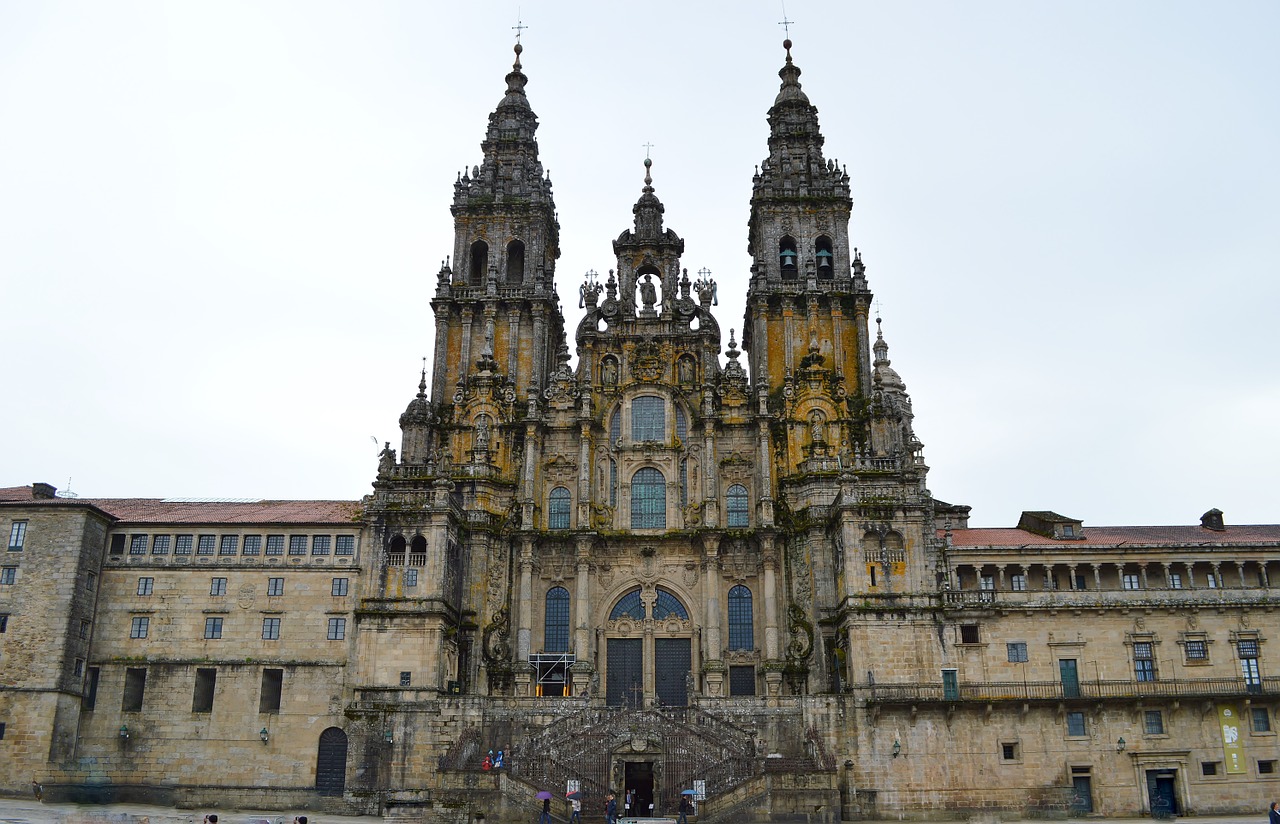
The jubilee is earned by visiting the Apostle’s tomb in the Cathedral and praying there, together with confession (within 15 days before or after) and communion. The plenary indulgence can be gained once a day (source: catedraldesantiago.es).
It is not tied to the Compostela certificate or to how you travel: the conditions are the same whether you arrive on foot, by bike or by bus.
What if you are not coming for religious reasons?
You do not need to be a believer to enjoy the Holy Year: plenty of people arrive in Santiago for the sport, the culture or the pleasure of crossing half the peninsula by bike. Here is what awaits you at the end:
- A World Heritage city: Santiago’s old town has been one since 1985, and the Camino Francés since 1993 (UNESCO). You can walk it in an afternoon, and the Cathedral can also be visited as a monument: the roofs and the Portico of Glory have their own tours.
- Galician food: the Mercado de Abastos, octopus, empanada, tetilla cheese and Santiago almond cake, after several days on the road.
- Concerts and culture: a Holy Year is also lived at night. O Son do Camiño fills the Monte do Gozo every June, the last hill of the Camino before entering Santiago, with big national and international names; in 2026 it ran from 18 to 20 June. It is part of the Xunta’s Xacobeo Concerts, which bring events across Galicia and prepare the cultural programme of Xacobeo 2027 (concerts, exhibitions, festivals). Once the 2027 dates are published, it is worth timing your arrival around one of them.
- The end at the Atlantic: many keep going to the Fisterra lighthouse on the Finisterrana route, about 90 km more.
- The arrival: riding into the Obradoiro square with your bike, among travellers from all over the world, is the moment people remember most, believer or not.
Dates to keep in mind
- 31 December 2026: the Holy Door opens, around noon according to the Galician press (the Archdiocese announced a time about five hours earlier than in recent Holy Years; older guides say 17:00).
- 25 July 2027: Sunday, feast of Saint James.
- 15-18 July 2027: European Youth Pilgrimage, if plans hold (Archdiocese).
- Closing of the Holy Door: tourist guides say 31 December 2027, but we have not found an official source, so we do not give it as confirmed.
The Compostela by bike: the last 200 km
The Compostela is a separate certificate issued by the Pilgrim’s Office. By bike, the official rule (oficinadelperegrino.com) is to cover at least the last 200 km (100 km on foot), ending at the Cathedral. Our guide which starts earn the Compostela by bike compares the options.
Examples: from Porto on the Portuguese Camino it is about 240 km, enough; from Tui (about 115 km) it is too short by bike. On the Camino Francés, Ponferrada (about 200 km) is the minimum start for the Compostela by bike; for a margin, start in Astorga (about 250 km) or León (about 300 km).
How many pilgrims should you expect?
Figures reported by the press from the Pilgrim’s Office: about 530,000 Compostelas in 2025, and over 500,000 by 5 October 2026. In earlier Holy Years the increase over the previous year was reported at 7-10 %.
There is no official forecast for 2027, and we have not found anything official about hostel reservations, credentials or capacity limits, so we will not speculate.
Planning your Holy Year by bike
- When can you start? No rental can start between 1 December 2026 and 31 January 2027 (both included); we reopen on 1 February 2027. A trip that starts earlier may end inside those dates, and existing bookings are served.
- Book early if you already know your dates: it gives you the widest choice of dates and models. Payment is made in advance, following the deadlines in the service conditions.
- Distance: plan 40-60 km a day; this is sightseeing, not the Tour de France.
- Delivery: we deliver in Spain and Portugal and in Saint-Jean-Pied-de-Port, never at train or bus stations or airports, and you return the bike free of charge in our Santiago shop (Rúa Laverde Ruiz 5, a few minutes from the Cathedral), or at an intermediate point of your choice.
- Luggage: an optional suitcase transfer, one single trip from the start to the end of your route. We do not carry backpacks.
- Assistance: Tournride Full Assistance covers mechanical assistance during business hours.
Choosing a route: the Camino Francés (about 769 km from Saint-Jean-Pied-de-Port, 12-14 stages), the Portuguese Camino from Porto (about 240 km, 4-6 stages, the flattest), the Primitivo from Oviedo (about 315 km, demanding) or the Camino del Norte from Irún (about 825 km, 14-16 stages, high difficulty). After the Cathedral, the Finisterrana route adds about 90 km to the Atlantic coast. To lay out your stages, use the route planner.
Frequently asked questions
What is a Holy Year and when is the next one?
A Holy Year is a year in which 25 July, the feast of Saint James, falls on a Sunday. 25 July 2027 is a Sunday, so 2027 is a Holy Year in Santiago de Compostela.
When does the Holy Door open?
On 31 December 2026, around noon according to the Galician press. We do not give the closing date as official because we have not found an official source.
Do I need the Compostela to gain the jubilee?
No. The jubilee is earned by visiting the Apostle’s tomb in the Cathedral and praying, with confession and communion. It is not tied to the Compostela or to how you travel.
Does it make sense to do it if I am not religious?
Yes. Plenty of people do the Camino for the sport, the culture or the journey. Santiago is a World Heritage city, has a very well-known cuisine and the Xunta accompanies Xacobeo 2027 with a cultural programme; and the Finisterrana route leads on to the Atlantic coast.
How far do I have to cycle to get the Compostela?
At least the last 200 km by bike (100 km on foot), ending at the Cathedral. On the Camino Francés, Ponferrada (about 200 km) is the minimum start; for a margin, start in Astorga (about 250 km) or León (about 300 km). From Porto it is about 240 km; from Tui, about 115 km, it is not enough by bike.
Will the Camino be busier in 2027?
About 530,000 Compostelas were issued in 2025 and over 500,000 by 5 October 2026. In earlier Holy Years the increase was reported at 7-10 %. There is no official forecast for 2027.
When can I start cycling in 2027 with Tournride?
From 1 February 2027. No rental can start from 1 December 2026 to 31 January 2027, both included; bookings already made are served.
Which route should I choose?
It depends on days and difficulty: the Portuguese Camino from Porto (about 240 km) is the flattest; the Camino Francés is the most complete; the Primitivo and the Norte are more demanding. Plan 40-60 km a day.