
STAGE 3: FROM PAMPLONA TO ESTELLA
Xavier Rodríguez PrietoStage 3 is where the Navarrese countryside opens up properly. You leave Pamplona through the university district, climb steadily for 12 km to the Alto del Perdón — the most emblematic viewpoint on the French Way — and from there the stage unfolds through a sequence of medieval villages, a detour to one of the most mysterious Romanesque buildings in Spain, the convergence point of two ancient pilgrimage routes, a bridge built by a queen, a Roman road, a viaduct designed by the grandfather of a pop star, and a city that Aymeric Picaud described in the 12th century as a place of good bread, excellent wine, much meat and fish, and all kinds of happiness. He was not wrong.
| Distance | Elevation | Estimated time | Difficulty | Distance to Santiago |
|---|---|---|---|---|
| 44 km | 397–780 m | 4–4.5 hours riding | 🟡 Medium | ~705 km |
Key stops: Cizur Menor (km 4) · Zariquiegui (km 8) · Alto del Perdón (km 12) · Uterga · Muruzábal (km 18) · Santa María de Eunate (detour +1 km) · Obanos (km 20) · Puente la Reina (km 22) · Mañeru (km 27) · Cirauqui (km 29) · Lorca (km 36) · Villatuerta (km 40) · Estella (km 44)
Note: Today the pilgrims who started at Somport on the Camino Aragonés converge with the French Way near Puente la Reina. From here onward, all routes travel together to Santiago.
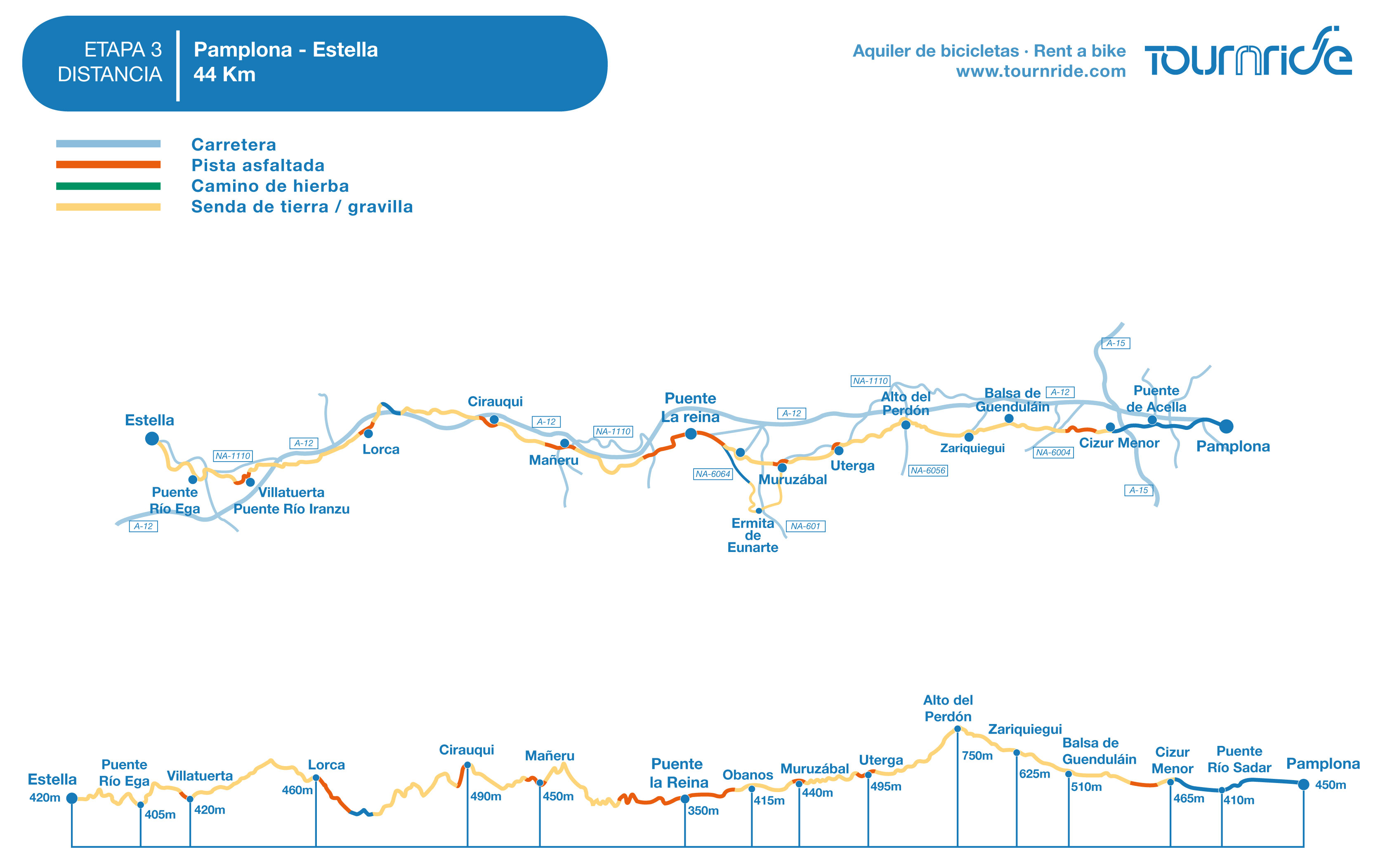
Route profile and key milestones
Pamplona to Zariquiegui: the Navarrese plain (km 0–8)
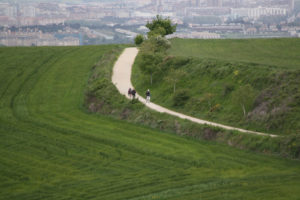
Leave Pamplona through the university campus along the Calle Mayor, past the Parque de la Taconera and down Pío XII Avenue to Avenida Sancho el Fuerte, then right along Calle Fuente de Hierro to the campus. Follow the bike path down Calle Universidad to the Arga roundabout, take the first exit right, cross at the zebra crossing and cross the river on the Puente de Acella Landa — a single-arch stone bridge, three metres wide, eight metres high, part of the Pamplona river park. From the bridge you enter the municipality of Cizur Menor.
Cizur Menor (km 4) is a residential satellite of Pamplona with a Romanesque church of San Miguel Arcángel. Continue through its urbanisation — yellow arrows painted on posts indicate the route — with cereal fields opening to the left and Cizur Mayor to the right. From here, approximately 5 km of progressively steepening path through agricultural fields, past the abandoned settlement of Guenduláin, to Zariquiegui (km 8).
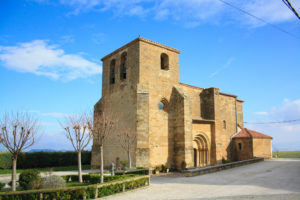
At the entrance to Zariquiegui stands the church of San Andrés — Romanesque, with a fine portal of multiple archivolts and vegetable decoration on the capitals. In the tympanum a carved Chi-Rho monogram — the same symbol we saw at the church of Santiago in Roncesvalles, the first two letters of Christ’s name in Greek, flanked by alpha and omega. The building has been receiving pilgrims since the 13th century. Its solidity gives you the strength for what comes next.
Alto del Perdón: where the road of the wind crosses the road of the stars (km 12)
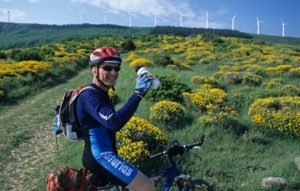
From Zariquiegui the profile changes decisively: 125 m of elevation gain in less than 2.5 km, with gradients that repeatedly reach 15%. Add wind — frequent here — and the effort multiplies. The Alto del Perdón (780 m) is the highest point of Stage 3 and one of the most photographed on the entire Camino. It is worth every metre of climb.
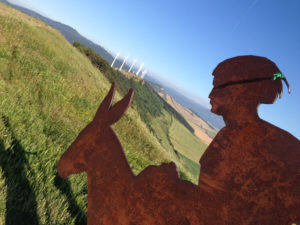
At the summit, a line of iron silhouettes follows the ridgeline: pilgrims from different centuries — some on foot, some on horseback, one on a bicycle — moving westward against a backdrop of wind turbines and the vast Navarrese plain. The sculpture was created by Vicente Galbete in 1996. Its inscription reads: “donde el camino del viento se cruza con el de las estrellas” — where the road of the wind crosses the road of the stars. The “road of the stars” is the Milky Way, and this is not decorative language: in the Middle Ages, pilgrims navigated by the Milky Way’s arc, which runs roughly east-west across the sky — pointing toward Santiago. Campus Stellae, the Field of Stars, is one of the etymologies proposed for Compostela itself.
Beside the sculpture a stone niche stands empty. A hermitage and pilgrim hospital once stood here, dedicated to the Virgen del Perdón. The sculpture of the Virgin was carried to the church of Astrain for safety in the 19th century, when Napoleon’s army desecrated the hermitage during the War of Independence. The name of the pass — the Alto del Perdón, the Pass of Forgiveness — refers to the complete indulgence of sins that a completed pilgrimage to Santiago could obtain, one of the main incentives for the medieval pilgrim. A legend associated with this specific spot tells of the devil offering water to a thirsty pilgrim in exchange for renouncing God, the Virgin and Santiago — the pilgrim refusing, the apostle appearing to drive Satan away.
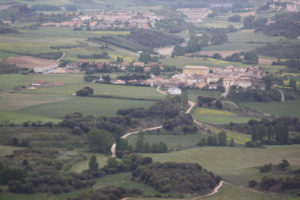
Behind you: the basin of Pamplona and the line of the Pyrenees. Ahead: the Valdizarbe valley with its fields and scattered villages — a complete picture of what the next 32 km will look like.
The descent from the Alto del Perdón requires care. Maximum gradient 12.5%, average 7%, terrain unstable with loose stones. In wet conditions it can be dangerous. If you are not confident on loose descents, take the N-111 around the mountain before the summit — it is a small detour and the road surface is straightforward.
Uterga, Muruzábal and the detour to Santa María de Eunate (km 15–21)
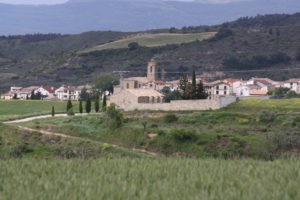
The descent brings you to Uterga and on to Muruzábal (km 18), a village at the edge of the cereal zone where the first vineyards begin to appear. In Muruzábal, a large Baroque palace (the Palacio de Muruzábal) is home to a winery that can be visited and whose wine is still produced and bottled here. The church of San Esteban accompanies it. From Muruzábal you have a choice: go directly to Obanos (2 km) or make the detour to Santa María de Eunate (only 1 km extra via a southeasterly path).
Make the detour.
Santa María de Eunate: three unanswered questions (km ~19, detour)
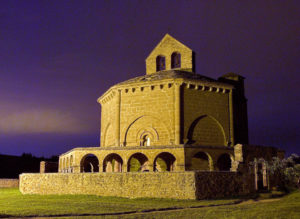
The church of Santa María de Eunate stands alone in the middle of agricultural fields with no village nearby, no obvious reason for its position, and no adequate historical documentation of its construction. It is one of the most unusual buildings on the French Way, and its strangeness is genuine rather than invented.
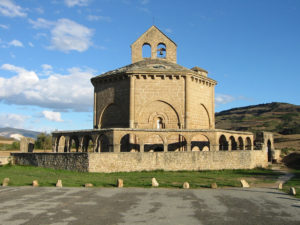
Three things make Eunate genuinely remarkable. First, its location: it sits at what experts in land energies identify as a convergence point, and in purely geographical terms it stands at the approximate centre of Navarre. It is also the point where the Camino Aragonés arrives to join the French Way — pilgrims coming from Somport through Jaca and Sangüesa converge here. Second, its documentary absence: despite being datable to the 12th century and having the quality of construction that implies significant resources, it appears almost nowhere in historical texts. Third, its form: an octagonal Romanesque church (octagonal plans are associated with the Holy Sepulchre in Jerusalem and with military orders’ chapels), surrounded by a freestanding portico of 33 arches that repeat the same octagonal form but have never had a roof — there are no attachment marks in the stone. The octagon is intentionally imperfect, even though the construction quality proves they could have made it regular if they chose to.
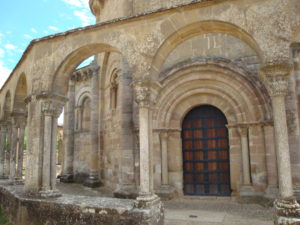
The octagonal form recalls the Holy Sepulchre in Jerusalem, which led to early speculation about Templar involvement. Historically this does not hold: the Templars were active in this area but there is no documentary evidence connecting them to Eunate. The more credible hypothesis links the church to the Order of St John of Jerusalem (the Hospitallers) — archaeological finds of burials with scallop shells around the building suggest it may have functioned as a pilgrim hospital or funerary chapel. The tower may have served as a lantern tower, visible from a distance at night to guide pilgrims across the fields.
None of this is certain. The church remains genuinely mysterious. Sit with it for a moment before continuing west to Obanos.
Obanos: the Mystery and the convergence (km 20)
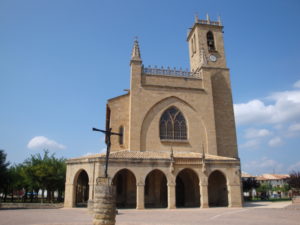
Obanos is where the two routes of the French Way formally converge: those arriving from Roncesvalles (via Stage 1–3) and those coming from the Camino Aragonés through Eunate meet here to continue together to Santiago. The town has a strong Jacobean identity built around a specific legend staged every two years in a theatrical performance involving over 600 residents — the Misterio de Obanos. According to the legend, a duke and his wife were making the pilgrimage when she decided to stay in the town to serve in the pilgrim hospital. Her husband, enraged at her decision, killed her. Devastated by remorse, he spent the rest of his life as a hermit in the nearby hermitage of Arnotegui, which still stands in the village outskirts.
The church of San Juan Bautista dates from 1912 in neo-Gothic style. Its asymmetry — one tower rather than two — results from the reuse of elements from the earlier Gothic church (14th century) that it replaced; the southern portal is still that earlier building’s work. Leave through the stone arch at the town exit and follow a dirt track with a gentle slope to Puente la Reina.
Puente la Reina: the urban prototype of the pilgrimage town (km 22)
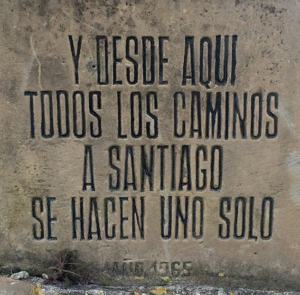
At the entrance to Puente la Reina a monument erected in 1965 carries the inscription: “Y desde aquí todos los caminos a Santiago se hacen uno” — from here all roads to Santiago become one. The technical convergence happened in Obanos, but the symbolic statement belongs here.
Puente la Reina is the purest example of the pueblo-calle — the town-street — on the entire French Way. Its origin is not accidental but designed: in the 11th century, Queen Doña Mayor ordered a large stone bridge built over the Arga to help pilgrims cross. King Alfonso I subsequently issued a carta puebla — a founding charter with tax incentives — attracting francos (foreign settlers) to establish a settlement beside the bridge and alongside the road. The urban result is geometrically precise: a central main street that is simultaneously the Camino, flanked by parallel streets, enclosed by what were formerly walls (now streets called the “nuevo cercado” and “viejo cercado”) — an almost perfect rectangle. The street is the Camino; the Camino is the street. Aymeric Picaud mentioned Puente la Reina in the Codex Calixtinus as the convergence point of the Aragonese Way with the three routes from Saint-Jean-Pied-de-Port — an acknowledgement of its strategic position that has not changed in nine hundred years.
The debate about the town’s name is unresolved: most scholars trace it to Queen Doña Mayor, who ordered the bridge; others argue from the Basque that the Arga river was once called rune, making pons rune — bridge over the Arga — the more likely etymology. The bridge itself has five pillars with cutwaters and six arches; the eastern arch is buried underground. Three medieval towers once stood on it; one held the niche of the Virgen del Txori (txori = little bird in Basque) — the Virgin of the Little Bird, named for the legend that a small bird washed her face daily with water carried in its beak from the river.
The three monuments of the Calle Mayor
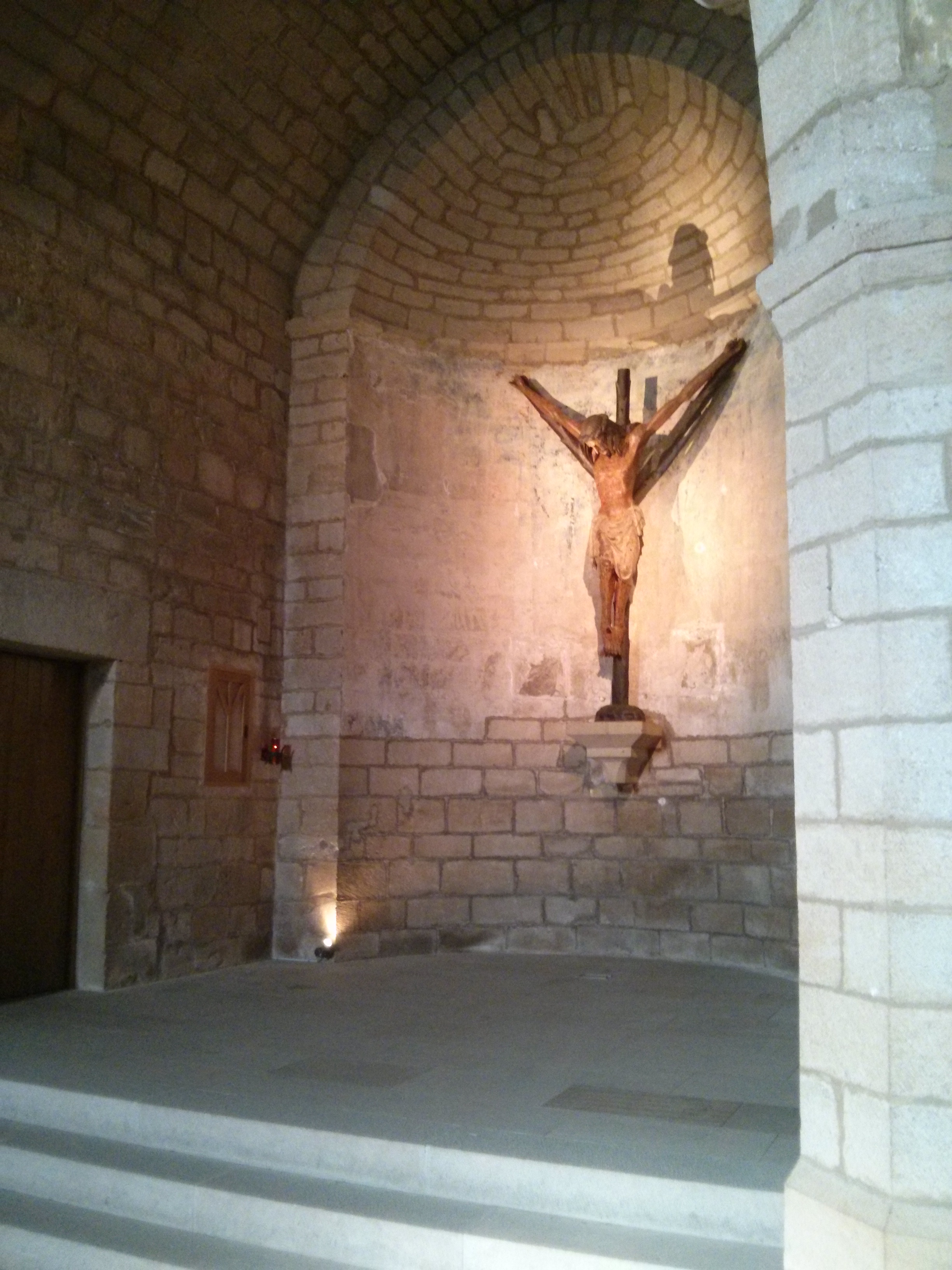
Just after entering the town on the left, the church of the Crucifijo was built at the end of the 12th century as part of the old pilgrim hospital complex. The hospital is now a school; the church carries the name of the Cofradía del Crucifijo that managed it from the 15th century. Inside is one of the great Gothic carvings of the Camino: a crucified Christ on a Y-shaped cross, the trunk formed by natural forking wood so that the cross itself looks like a living tree rather than a constructed object. Gothic in style — realistic, dynamic, anguished — it shows the shift from the Romanesque Christ as serene and triumphant to the Gothic Christ as human and suffering. The sculpture is credited either to German pilgrims who carried it across the route and donated it to the hospital, or to a connection with the Templars. Neither attribution is confirmed.
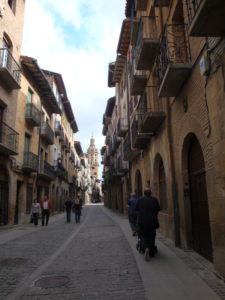
Continuing along the Calle Mayor, the church of Santiago contains one of the most celebrated images on the entire Camino: Santiago “Beltza” — Santiago the Black (beltza in Basque), named because before a restoration the sculpture’s complexion was that colour. Over 300 images of the apostle exist on the French Way; this is among the most admired. The church’s interior shows a mixture of Romanesque, Late Gothic and Renaissance styles accumulated through successive rebuildings; the vaulted nave has complex starred ribbing supported by Renaissance pillars.
At the end of the Calle Mayor, the church of San Pedro (16th century) holds the original Virgen del Txori — the one whose niche was in the bridge tower — now relocated here for safety.
Mañeru and Cirauqui: the view from the hill (km 27–32)
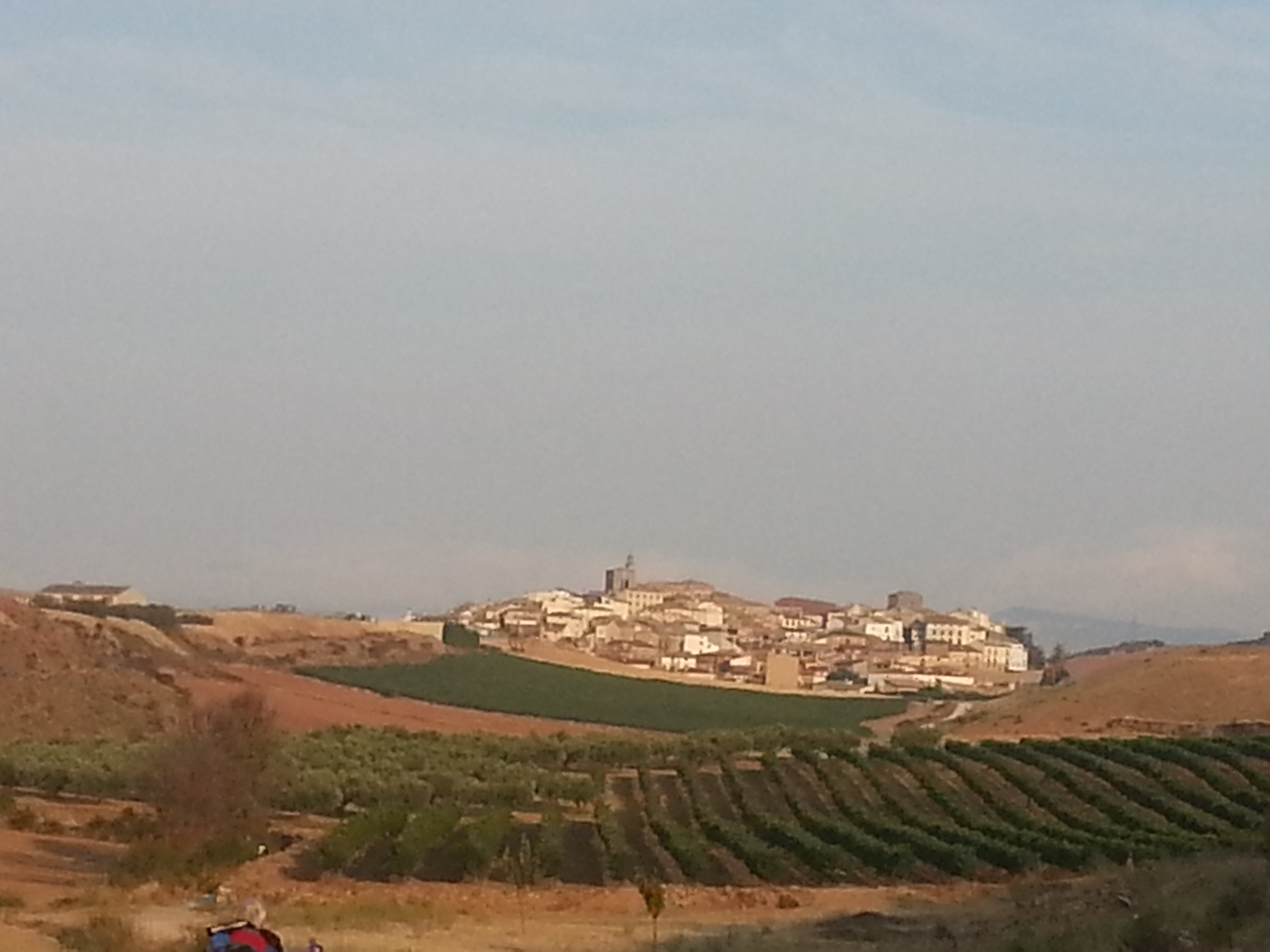
Leave Puente la Reina across the medieval bridge, turn left through the barrio de las monjas (the Augustinian convent has been here since the 13th century), follow the Arga and then climb 1.5 km through a pine grove to reach Mañeru (km 27).
Mañeru is a medieval village of under 500 inhabitants built on a hill in the characteristic Navarrese style. It had a winemaking tradition — a cooperative still produces a wine called Belardi — but cereal has gradually displaced the vineyards. In the Middle Ages it was controlled by the Order of St John and later became dependent on Puente la Reina and the monastery of the Crucifijo. It was also a scene of the first Carlist War. From the cemetery end of Mañeru, 2.5 km of quiet agricultural path opens the view ahead: Cirauqui rising on its hill in the distance, cereal fields between, and silence.
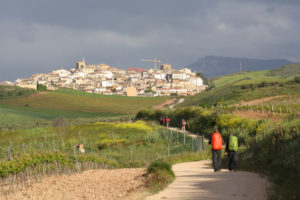
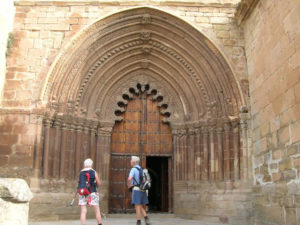
Cirauqui (km 29) is a medieval walled village perched on a hill with steep streets. A signed cyclist bypass skirts the town for those who want to avoid the ramps; but before taking it, stop at the church of San Román. Built in the 12th century and belonging to the monastery of San Millán de la Cogolla — one of the great Benedictine foundations of Castile — it preserves its south portal intact despite many later additions. That portal is a textbook in three architectural vocabularies: the sculptural programme is Romanesque, the vault profiles are Cistercian (clean, undecorated, emphasising structure over ornament), and the geometric decorative elements recall Moorish influence. In a single doorway you can read the three cultural currents that shaped the Iberian Peninsula in the 12th century: Latin Christian, reformed monastic and Andalusian Islamic.
From Cirauqui to Lorca: Roman road, medieval bridge and Ana Torroja’s grandfather (km 29–36)
The path leaving Cirauqui runs on an ancient Roman road — the original Via Trajana surface, partially preserved — to a bridge that was built in the 18th century over an earlier Roman structure. Rolling on stone laid two thousand years ago, you cross the A-12 motorway on a modern overpass and continue parallel to the highway, then pass beneath it and reach a roundabout. Take the NA-7171; about 500 metres later, a large structure crosses the road above you.
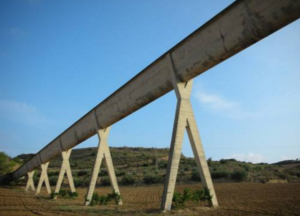
The Viaduct of Alloz was designed by Eduardo Torroja in 1939 to carry the waters of the Mañeru reservoir. Torroja is considered one of the masters of reinforced concrete in the 20th century — his structures appear in engineering textbooks alongside those of Maillart and Nervi. His granddaughter is Ana Torroja, the singer of the Spanish pop group Mecano, one of the bestselling Spanish-language acts of the 1980s and 90s. The family connection is not incidental: the same Torroja talent for elegant, precise form runs through grandfather’s bridges and granddaughter’s melodies. The viaduct has stood for over eighty years. The songs have lasted similarly well.
A few metres after the viaduct, a dirt track leads to another bridge — this one medieval, over the Río Salado. Aymeric Picaud warns in the Codex Calixtinus that bandits once stationed themselves on this bank and encouraged pilgrims to let their horses drink from the river. The water is saline; it killed the horses. The bandits then slaughtered the animals and stole the pilgrims’ belongings. The bridge is still there. The river still runs salt.
Lorca, Villatuerta and the hermitage of San Miguel (km 36–40)
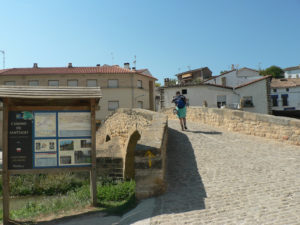
Lorca (km 36) today has fewer than 100 inhabitants. Nine hundred years ago it had a pilgrim hospital. Cross it east to west along its Calle Mayor and continue either by the NA-1110 road or by dirt path through fields to Villatuerta (km 40).
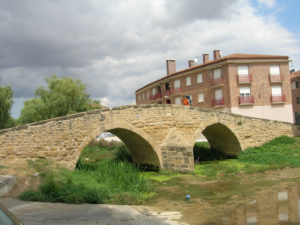
Villatuerta is divided by the Irantzu river, crossed on a medieval dromedary bridge — higher in the centre than at the ends, like a camel’s back, a characteristic form of medieval Navarrese bridge construction. The church of the Asunción replaced a late-Roman church that burned in the 14th century; the Gothic building that stands today preserves the remains of medieval murals inside.
Before leaving northwest toward Estella, take the short path to the hermitage of San Miguel. This is the first pre-Romanesque temple on the entire French Way — a structure predating the Romanesque movement that defined most of what you have seen since Roncesvalles. It rises from the fields like a fortress: a large stone mass, solid and austere. Inside, the copper altarpiece decorated with semi-precious stones is a medieval jewel of extraordinary quality. The hermitage is also associated with two folk traditions: women who wished to conceive would sit on a specific stone and hear Mass, and there is a hole in the central chapel wall through which people inserted their heads to cure chronic headaches. The traditions are documented, not invented. Whether they worked is a question the medicine of the time was not asking.
When you arrive: Estella, the Toledo of the North (km 44)
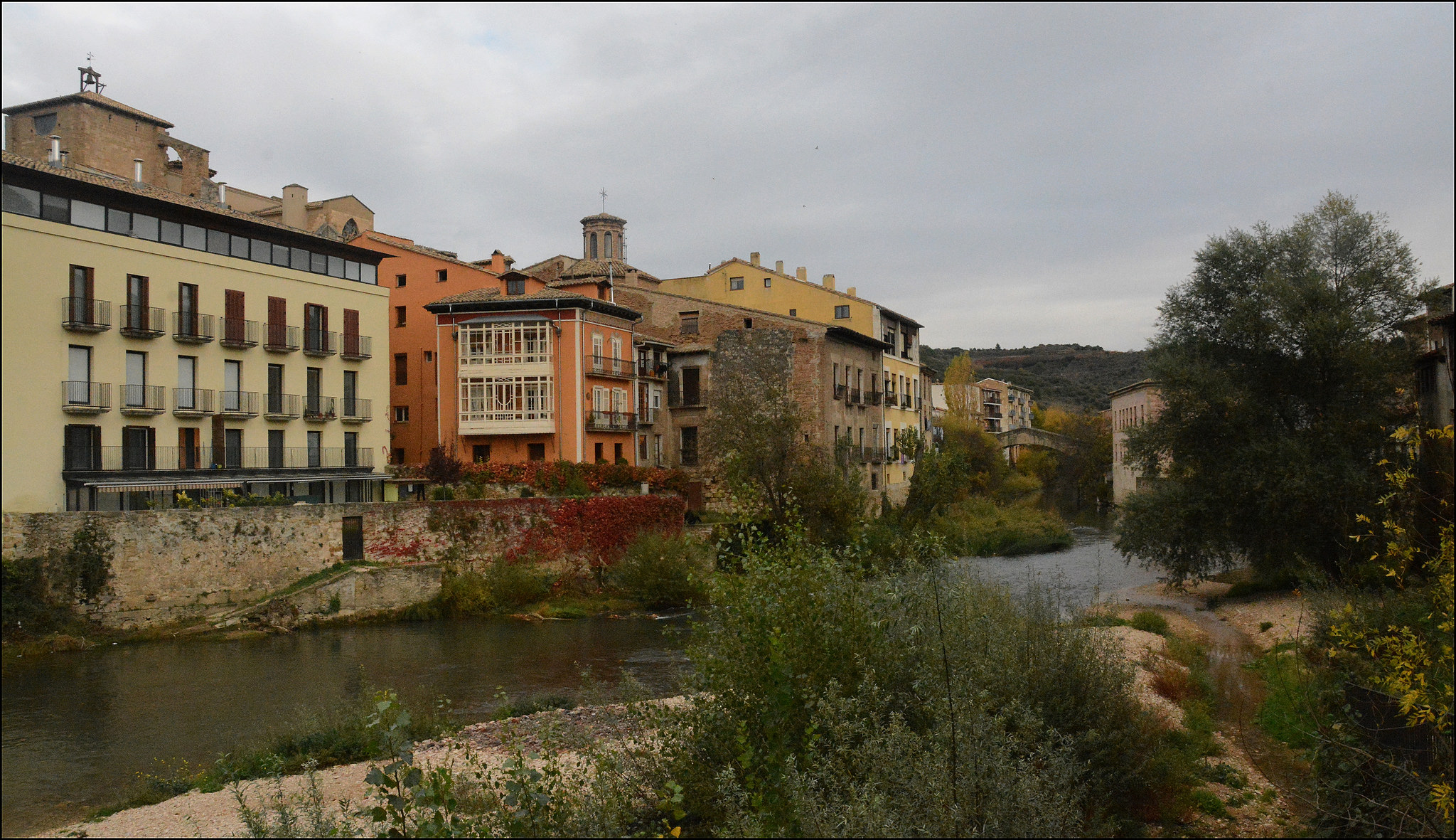
Enter Estella by the Calle Curtidores. The city owes its existence and its form to a royal decision: in 1090 King Sancho Ramírez diverted the Camino route to the banks of the Ega river here, then issued a fuero inviting the francos to settle and trade. With the pilgrimage boom of the following centuries, great constructions followed. A large Jewish community established itself here and remained until the expulsion of 1492. The accumulation of Romanesque, Gothic and Renaissance monuments — dense, varied, well preserved — earned Estella its nickname: “el Toledo del Norte”.
The walking tour (50 minutes)
From the Curtidores hostel, the main circuit touches four monuments in quick succession.
The church of the Santo Sepulcro is the first you encounter, and its 14th-century Gothic portal with 12 archivolts forming a great flared door is one of the most elaborate on the Camino. Among its carved figures, a Santiago dressed as a pilgrim — staff, cape, scallop shell — stands out. In the Middle Ages this was the principal church of several of Estella’s medieval boroughs.
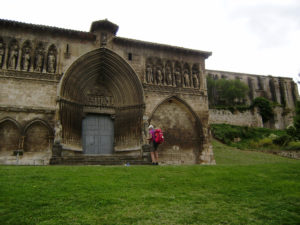
Adjacent: the Convento de Santo Domingo, paid for by the King of Navarre and occupied by Dominican friars, abandoned during the Napoleonic War of Independence, confiscated in 1939, left to decay until mid-century, then rehabilitated as a nursing home — so its interior is not visitable. And the church of Santa María Jus del Castillo — “below the castle” (jus in Basque) — which stands on the site of a synagogue converted to Christian use in the 12th century. It functioned as a church until the 17th century, deteriorated for two centuries, and is now the Centre of Interpretation of the Romanesque and the Camino de Santiago.
Return to Curtidores and continue west to the Museo del Carlismo, housed in the 17th-century palace of the Governor of Navarre. Carlism was a 19th-century political movement opposing liberalism, summarised in the motto “Dios, Patria, Rey” (God, Fatherland, King) and seeking to preserve the traditional fueros and the pre-constitutional order. It generated three civil wars in the 19th century and persisted into the Franco dictatorship. The Navarre that we have been cycling through — with its special fiscal arrangements, its strong local identity, its Carlist Wars battlefields at Mañeru and elsewhere — is partly shaped by this movement. The museum has a clear educational approach and is worth the time.
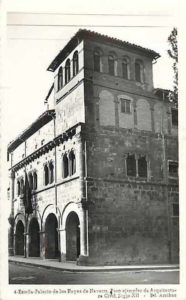
West along Curtidores to the Plaza de San Martín, where a 16th-century Renaissance fountain stands between two exceptional buildings. On one side: the Palace of the Kings of Navarre — the only surviving example of Romanesque civil architecture in Navarre. Everything else that survives from the Romanesque movement (roughly 11th–13th centuries) is religious; this is a secular building, though its original function is debated. Some scholars believe it housed the francos with administrative power over Estella’s boroughs; others argue it was a large wine cellar and granary with a room for the kingdom’s governor. Regardless of function, the building is exceptional: three horizontal bodies with a porticoed gallery on the ground level, large windows above, an upper extension from the 17th century. Today it houses the Museo Gustavo de Maeztu.
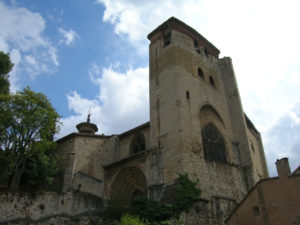
Opposite, reached by stairs or a lift, the church of San Pedro de la Rúa occupies the highest point of the medieval city — originally next to the castle, its tower a watchtower, its position defensive. Its cloister is heavily decorated, its portal has polylobulated arches of Moorish influence — the same influence we saw at the portal of San Román in Cirauqui, here more elaborate. In the Middle Ages the church served as the pilgrim cemetery of Estella. The views from the church steps over the city and the Ega valley are the best in town, particularly at sunset.
Food and rest in Estella
Aymeric Picaud’s description from the 12th century remains essentially accurate: this is a place with good food. Signature dishes include bacalao al ajoarriero (salt cod with tomato and vegetables), trout, roast suckling pig (gorrín — look for it in the restaurant menus), and the full range of Navarrese vegetables. For dessert, the local pastry shops produce the alpargatas (Estella puff pastry) and chocolate bonbons. The Parque de los Llanos on the Ega riverbank has pools and is said to have medicinal waters — a good place to sit after the day’s 44 km before tomorrow’s crossing into La Rioja.
Practical notes for Stage 3
The stage is fully cyclable on an MTB or gravel bike in dry conditions. The only technically demanding sections are the descent from the Alto del Perdón (12.5% max, unstable surface, 3.5 km — bypass via N-111 if conditions are bad) and the climb to Cirauqui (cyclist bypass available at the village entrance). From Puente la Reina onward, the profile is mostly gentle and the surface well-maintained agricultural tracks.
Two significant supply gaps: from Villamayor de Monjardín (Stage 4) to Los Arcos there are no services, but on this stage services are available in every significant village. In summer, fill up on water at each opportunity — the section from Uterga to Puente la Reina crosses open fields with limited shade.
Accommodation midway: Puente la Reina (km 22) has the widest range. A camping-hostel sits just past the bridge if all pilgrim hostels are full. Mañeru, Cirauqui and Lorca also have hostels. Estella has five hostels including a municipal one on the Curtidores entry street.
Frequently asked questions about Stage 3
How far is Stage 3 from Pamplona to Estella by bike?
44 km between 397 m and 780 m elevation. The main effort is the first 12 km climbing to the Alto del Perdón; from there the profile is considerably gentler with only isolated ramps. Allow 4–4.5 hours riding time plus stops at Eunate and Puente la Reina.
What is the Alto del Perdón and why is it significant?
The Alto del Perdón (780 m) is the highest point of Stage 3 and one of the most iconic on the entire French Way. Its name refers to the complete indulgence of sins (perdón = forgiveness) obtainable through the pilgrimage — a key medieval incentive for making the journey. The iron sculpture at the summit by Vicente Galbete (1996) shows pilgrims from different centuries moving toward Santiago guided by the Milky Way. The views take in Pamplona behind and the Valdizarbe valley ahead.
Why visit Santa María de Eunate?
It is one of the most unusual Romanesque buildings in Spain: a 12th-century octagonal church standing alone in the middle of agricultural fields with no village around it, almost no historical documentation, and a freestanding arcade of 33 arches that was never roofed. Probable connection to the Order of St John (Hospitallers) and possible use as a pilgrim hospital and lantern tower. Add only 1 km to the stage from Muruzábal.
Where do the Camino Aragonés and the French Way converge?
The technical convergence is at Obanos (km 20), though the monument at Puente la Reina entrance (km 22) marks it symbolically. Pilgrims who started in Somport (Aragonese Way via Jaca and Sangüesa) arrive at Eunate and Obanos and join the French Way from here to Santiago.
Can I rent a bike starting from Pamplona or Puente la Reina?
Yes. Tournride delivers to both. Pamplona has bus, train and air connections; Puente la Reina is served by La Estellesa buses from Pamplona (30 min), Irún, Logroño and San Sebastián, and by Conda and Avanza from Pamplona. A 7-seat shared taxi from Pamplona costs approximately €30. See all bike models and check availability here.


