Buen Camino by Checco Zalone: the real Camino de Santiago, and how to do it by bike
Tournride TeamJust finished Buen Camino on Netflix and feel the itch to go? You’re not alone. Checco Zalone’s film, directed by Gennaro Nunziante, opened in cinemas on 25 December 2025 and grossed over 76 million euros: it is the highest-grossing film in the history of Italian cinema, ahead of Avatar, with more than eight million viewers in a month.
Since 29 April 2026 it has been on Netflix, where it entered the top 10 in sixteen countries and was the fifth most-watched title in Spain. And everywhere the same thing happens: people watch it and then google “how do you actually do this Camino”.
Behind the comedy there is a real route: the French Way, the Jacobean trail that starts in Saint-Jean-Pied-de-Port and ends in Santiago de Compostela. In this article we tell you what’s true and what’s just cinema in the film, where it was really shot and — above all — how to ride that same Camino by bike, in one or two weeks instead of more than a month on foot.
Do the stages in Buen Camino really exist?
Yes, almost all of them. According to the official Italy for Movies database, the film was shot in three countries. The first part — the protagonist’s “old life”, rich and shallow — is set in Italy, between the Costa Smeralda in Gallura (Sardinia) and Rome. Then the journey enters the Camino itself.
- France: Saint-Jean-Pied-de-Port, at the foot of the Roncesvalles pass, the classic start of the French Way.
- Navarre: Roncesvalles, Pamplona, Puente la Reina, Estella-Lizarra, Los Arcos.
- Castile and León: Burgos and Boadilla del Camino, in the heart of the Meseta.
- Galicia: Santiago de Compostela and Finisterre, the Atlantic finale, shot in October 2025.
These are exactly the places that anyone walking the Camino for real passes through. The difference is that the film condenses into just over two hours a route of around 769 kilometres of net pedalling between Saint-Jean-Pied-de-Port and Santiago: in reality there are 14 real stages, which we have laid out with distances, elevation and difficulty in our guide to the 14 stages of the French Way by bike. If you’d rather grasp the overall logic of the route first, there’s also our presentation and planning of the French Way.
What to see in the film’s stages
More than backdrops, the film’s locations are real destinations. These are the highlights you’ll find riding the French Way:
- Saint-Jean-Pied-de-Port: a fortified medieval town, the Porte Saint-Jacques and the symbolic start of the Camino, before the climb to Roncesvalles and the Pyrenees.
- Pamplona: the city of San Fermín and the famous bull runs, with its old town and cathedral; in the film it’s the first big urban stage.
- Burgos: its Gothic cathedral, a UNESCO World Heritage Site, is one of the most powerful images of the whole Castilian Meseta.
- Santiago and Finisterre: the Plaza del Obradoiro in front of the cathedral, the final embrace, and then “km 0” on the ocean where the film closes.
Between one of these cities and the next are the villages, the Romanesque bridges and the fields that make the Camino: all the stage-by-stage detail is in the guide to the 14 stages.
What’s realistic in the film
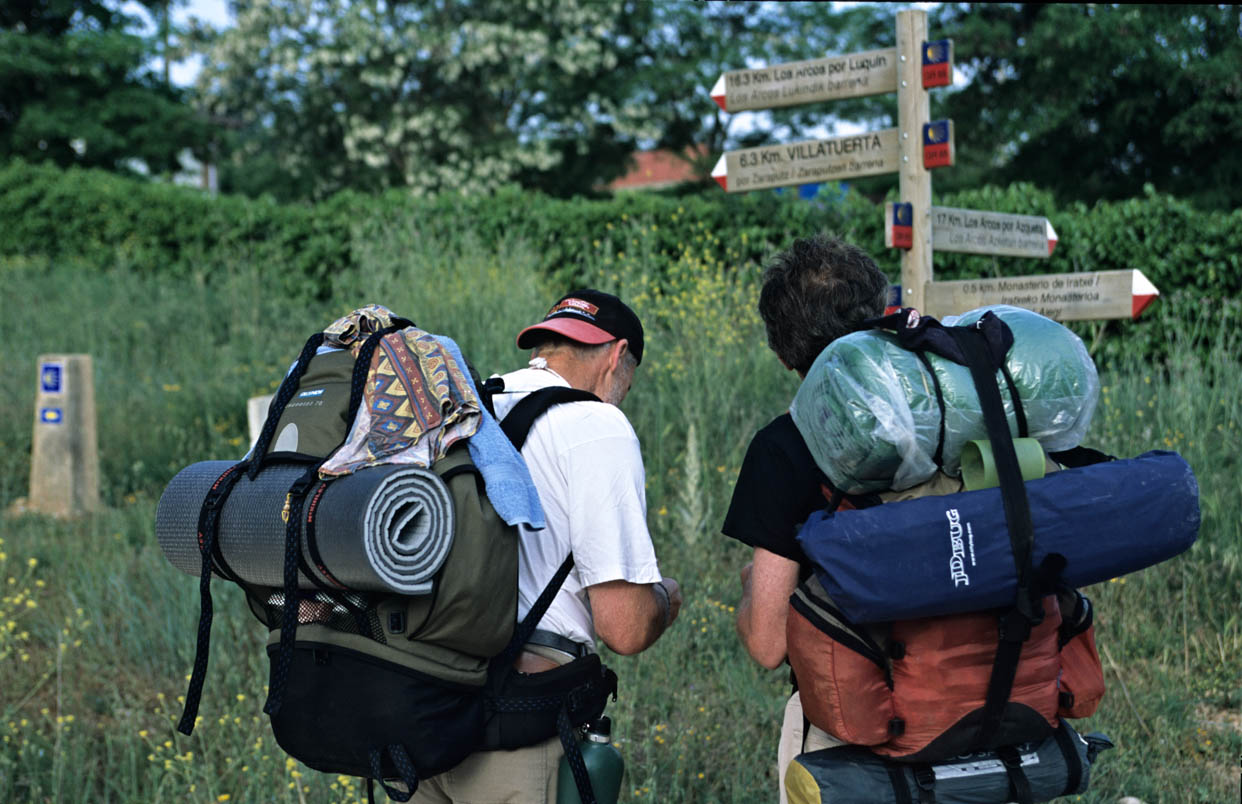
More than it seems. The “Buen Camino” greeting that gives the film its title is exactly what other pilgrims will say to you dozens of times a day: it’s the phrase people use to encourage each other along the route, in any language. Realistic too are the first-day blisters, the shared hostels, the credential you stamp at every stage, and the way the distances between one point and the next set the rhythm of the day.
The people are real too: on the Camino you team up with strangers within a few hours, you walk (or ride) with them for days and say goodbye in Santiago like old friends. And then there’s the most authentic thing of all: the protagonist’s transformation. A comfortable, distracted man who sets out to find his runaway daughter and, stage after stage, changes. Anyone who has done the Camino recognises that mechanism. It’s not a screenwriter’s invention: the Camino, quite simply, has that effect.
What’s only cinema
Some licence, of course, there is — and rightly so: it’s a comedy, not a documentary. The first part on the Costa Smeralda and in Rome is not part of the Camino: it’s the contrast with the character’s previous life. The film also compresses time: the French Way on foot takes around 30-35 real days, not a handful of scenes. And the hostels aren’t always that non-stop theatre of hilarious encounters — sometimes they’re just bunks, wet backpacks and silence by nine in the evening.
None of this takes anything away from the film, quite the opposite. The interesting part is that the real Camino is more accessible than the on-screen effort suggests. You don’t need a month off or athlete-level training. You just need to pick the right means of travel — and that’s where the bike comes in.
How many days you need and where to start
It’s the question everyone asks after the film. The answer depends on how many days you have, not on how fit you are — because by bike, especially an e-bike, the margin is wide. The three options that make the most sense:
- The whole French Way (as in the film): from Saint-Jean-Pied-de-Port to Santiago, around 769 km in 10-14 days by bike. The full experience, from the Pyrenees to the Atlantic.
- From León to Santiago: around 300 km in 5-7 days. Galicia, the greenest stages and the arrival at the cathedral, in just over a week.
- The last 100 km from Sarria: 3-4 days. The minimum distance to earn the Compostela, ideal if you only have a long weekend.
The weak point of any plan is the logistics: getting to the start with the right bike and not having to bring it back. That’s what we take off your hands. We deliver and collect the bike wherever you need it: in Saint-Jean-Pied-de-Port if you want to start at the very beginning like Zalone, but also in Pamplona, Burgos, León, Sarria or straight in Santiago de Compostela. You ride; we handle the transport, the bike and the support.
How to do the real Camino de Santiago by bike
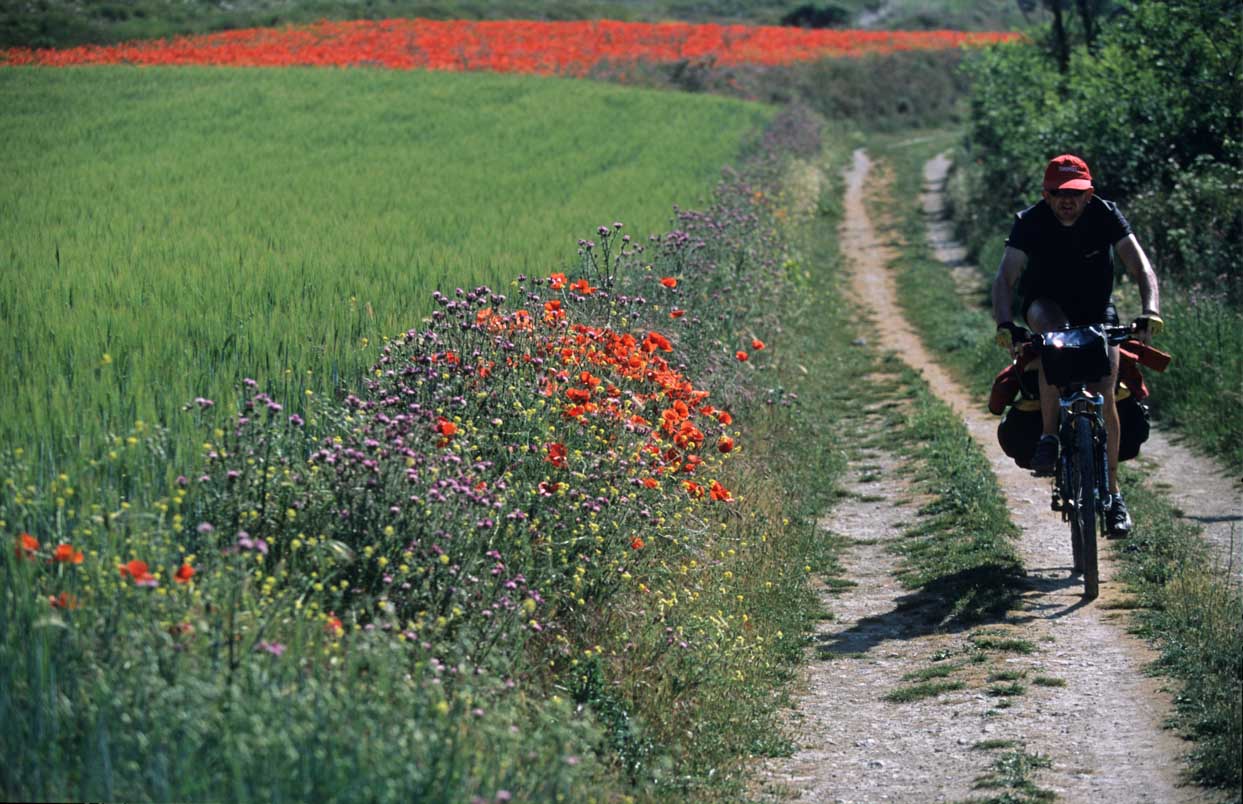
Three decisions and you’re ready. First: e-bike or regular bike? If you ride regularly and want the challenge, a regular bike is more than enough. If you don’t train consistently — the majority of those who set off after the film — the e-bike turns the climbs of Navarre and the ramps of León from obstacle into scenery: you always pedal, but you decide how much effort to make. We explain the technical choice in full in how to cycle the Camino de Santiago in 14 days.
Second: when to go. The season runs from April to mid-October. Spring and early autumn are the sweet spot: manageable temperatures and fewer crowds. The Meseta (Burgos-León) in July and August is hard because of the heat; Galicia, on the other hand, is cooler and greener than you’d imagine, even in summer. Third: preparation. You don’t need cyclist-level training: a few rides before you leave and accepting that you’ll pedal 4-6 hours a day at a calm pace are enough. The heavy luggage isn’t carried by you — it travels from one stage to the next with the transport service, so you get in the saddle light.
A typical worry after the film: “what if I get lost?”. Relax. The French Way is the best-waymarked route in the world: the famous yellow arrows and the scallop-shell markers guide you at every junction, from the Pyrenees to Santiago. By bike you follow the same track as walking pilgrims, with the odd detour onto minor paved roads on the more technical sections. To that we add a stage-by-stage roadbook and support, so the only thing on your mind is pedalling.
If Buen Camino has made you want to set off, now is the moment: you already have the places and the atmosphere in your head. All that’s missing is the bike — and that’s what we provide, where and when you need it.
Frequently asked questions about Buen Camino and the real Camino
Is Buen Camino a true story?
No, the plot is fiction: a wealthy man chasing his runaway daughter along the Camino. But the route, the places and the pilgrimage experience are real and carefully set on the French Way.
Where was Buen Camino filmed?
In Italy (Costa Smeralda and Rome), in France in Saint-Jean-Pied-de-Port and in Spain along the French Way: Roncesvalles, Pamplona, Puente la Reina, Estella, Los Arcos, Burgos, Boadilla del Camino, Santiago de Compostela and Finisterre.
How long does the Camino de Santiago take by bike?
The full French Way (around 769 km) takes 10-14 days by bike, compared with 30-35 days on foot. Shorter sections are also possible: 5-7 days from León, 3-4 days for the last 100 km from Sarria.
Can you rent e-bikes in Saint-Jean-Pied-de-Port?
Yes. We deliver the bike (regular or e-bike) directly to Saint-Jean-Pied-de-Port, the film’s starting point, and collect it in Santiago or wherever you prefer.
Which Camino is in Checco Zalone’s film?
It’s the French Way, the most popular Jacobean route: from Saint-Jean-Pied-de-Port to Santiago de Compostela, with the final extension to Finisterre on the ocean.
Is it worth doing the Camino after watching the film?
It’s the ideal moment: you already have the places and the atmosphere in mind. By bike you can really live them in just one or two weeks, without having to walk for over a month.